Daily market commentary
The Launch Pad |
|
|
|
 |
| | |
|
Today
Markets are digesting the latest economic data prints out of the U.S. for clues on when the Fed will begin to lower borrowing costs. Treasury yields are falling and equities are paring losses after reports that the U.S. economy grew at an annualized rate of 1.3% in the first quarter, down from an initial estimate of 1.6%, due to softer-than-expected consumer spending, which increased by 2.0% instead of the previously reported 2.5%. Forecasters had predicted 1.3% GDP growth and a 2.2% rise in consumer spending. Also, the Fed’s preferred inflation measure, the personal consumption expenditures price index, rose at a 3.3% annualized rate, slightly lower than initially projected. Excluding food and energy, the core PCE index increased by 3.6%, down from the previous estimate of 3.7%. On the jobs side, weekly jobless claims in the U.S. increased by 3,000 to 219,000, slightly above the median estimate of 217,000 while continuing claims also increased, rising by 4,000 to 1.791 million for the week ending May 18. Despite the increase, jobless claims remain relatively low compared to historical standards, indicating a still-tight labour market.
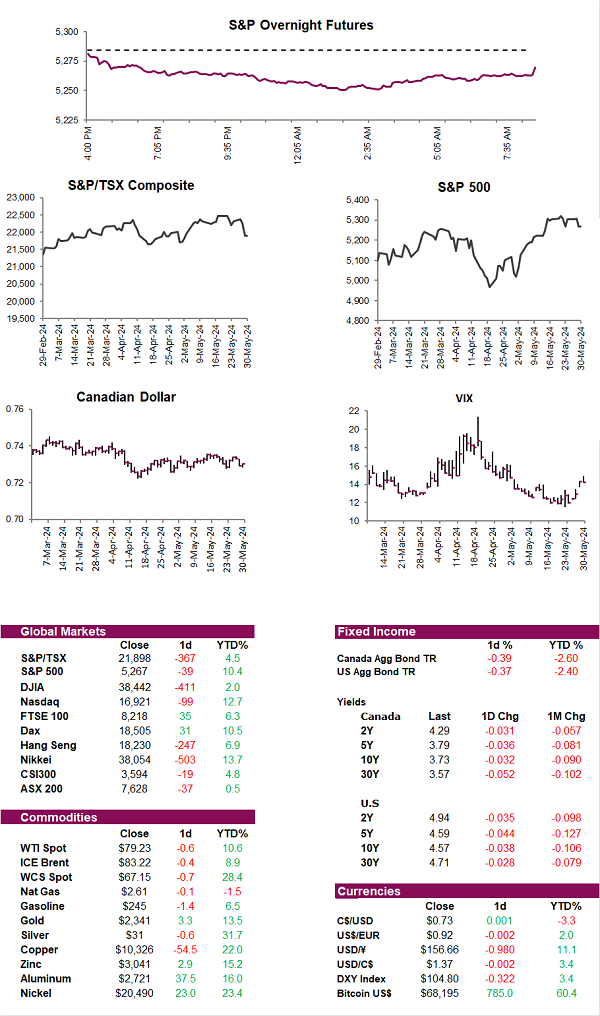
We are talking about volatility again, this time for bond markets. Global bond yields, including the U.S. are on the rise again, back up near the highest level this year. In a short trading week, U.S. 10-year yields rose to 4.61, before a few buyers came back in to bring the yield back to 4.59 (at the time of writing). This selling could be a case of traders getting ahead of Friday’s PCE number (the Fed’s preferred inflation gauge), with buyers jumping back in should the inflation data surprise to the downside. However, buyers looking for a bargain on yields may wait for better levels, with 4.75 to 4.85 being a target according to dealing desks.
The Canadian dollar weakened against the U.S. dollar yesterday, trading 0.5% lower at 1.3710, amid concerns central banks might maintain interest rates higher for longer than expected, boosting demand for the safe-haven U.S. dollar. The decline aligns with broader G10 currency trends, as equities fell and interest rates rose, reflecting renewed fears over prolonged high rates and limited central bank rate cuts. U.S. government bond yields reached near four-week highs, pressuring global stocks, while the U.S. dollar strengthened against major currencies. Investors are awaiting Canadian GDP data on Friday, which may influence the timing of potential Bank of Canada rate cuts, with a 60% chance of easing expected at next Wednesday's policy decision.
As of February 2024, Canada's residential mortgage debt reached $2.16 trillion, up 3.4% y/y, marking the slowest growth in 23 years. The Canada Mortgage and Housing Corporation expects this slowdown to be short-lived, with mortgage debt growth anticipated to rise due to projected lower mortgage rates, population growth, and increased real disposable incomes. The report also noted that most borrowers continue to choose shorter-term, fixed-rate mortgages over traditional five-year fixed terms as they remain uncertain of the short- and medium-term mortgage rate outlook.
Large U.S. banks may be more exposed to commercial real estate than regulators realize due to substantial credit lines and term loans provided to REITs, according to a new study. When indirect lending to REITs is considered, banks' exposure to CRE increases by about 40%, a factor largely overlooked in current risk assessments. REITs, which rely heavily on bank credit lines during economic stress, face challenges from high borrowing costs and declining property values. The study suggests that regulators should incorporate this indirect exposure in stress tests, as these credit lines can lead to significant liquidity risks for banks. The researchers also recommend that banks charge higher fees for these credit lines to offset the associated risks. Despite low leverage ratios for REITs, the study warned that the banking sector needs to be mindful of this, if a stress event should occur.
Global debt has surged to $315 trillion, marking the most significant rise since World War II, largely driven by the pandemic, according to a report from the Institute of International Finance. Emerging markets contributed significantly to this increase, with their debt reaching an unprecedented $105 trillion, $55 trillion more than a decade ago. The debt-to-GDP ratio for these markets hit a new high of 257%, driven by China, India, and Mexico. Meanwhile, two-thirds of the global debt originates from mature economies like Japan and the U.S., although their debt-to-GDP ratios have generally been falling. The IIF warns that persistent inflation, rising trade tensions, and geopolitical issues could worsen debt dynamics and increase global funding costs. Looking closer at the numbers, household debt stands at $59.1 trillion, business debt at $164.5 trillion (with $70.4 trillion from the financial sector), and public debt at $91.4 trillion.
To address its declining birthrates, Seoul is introducing a program where the government will pay residents to reverse vasectomies or tubectomies. The city will provide up to 1 million won ($734 USD) per citizen with 100 million won allocated for the program. This initiative is part of a broader 1.5 trillion won extra budget aimed at boosting birthrates in South Korea, which has the world's lowest fertility rate at 0.72. Seoul's fertility rate is particularly low, with only 55 babies born per 100 women over their lifetimes. The city's population is projected to decrease from 9.4 million in 2022 to 7.9 million by 2052. The city is also offering financial aid for egg freezing and infertility treatments. High living costs and unaffordable housing are major factors deterring South Koreans from having children. The national government, recognizing the severity of the issue, plans to create a new ministry focused on the fertility crisis. For context, South Korea promoted vasectomies in the 1970s and 1980s to control population growth.
Diversion: Badt dog
|
|
|
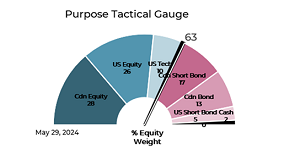
(% equity weight)
Our tactical fund is designed to complement your existing holdings to minimize portfolio volatility. To learn more, please click here.
|
|
|
| |
|
|
Company news
Royal Bank beat earnings estimates on strong performance from their capital-markets business and lower-than-expected provisions for potential loan losses. Royal’s provisions for credit losses totaled C$920 million ($670 million), less than the C$929 million analysts had forecast. Royal Bank saw costs increase 12% from a year earlier as it digests the purchase of HSBC Holdings Plc’s Canadian assets, the biggest takeover in its history. Royal Bank closed its C$13.5 billion takeover of HSBC Canada on March 28, with about one month left to go in the quarter, and immediately began converting branches to the Royal Bank banner and switching customers and employees over to its own systems. The lender’s Common Equity Tier 1 ratio was 12.8% at the end of the quarter, higher than the 12.5% level it forecast it would hit after closing the HSBC deal. Royal Bank announced a dividend increase of 2.9%.
CIBC beat analysts’ estimates as it set aside less money than expected for possible loan losses. A positive considering CIBC has grappled with higher provisions in the past owing to the bank’s US office-loan portfolio. But executives said earlier this year that the issue was largely behind the lender after it took steps to reduce its exposure to such debt. CIBC’s provisions for credit losses totaled C$514 million ($375 million) for the three months through April, less than the C$567 million analysts had forecast.
Brookfield is in exclusive talks to acquire a majority stake in Neoen SA with a view to launch a takeover offer that would value the French renewable energy developer at about €6.1 billion ($6.6 billion). Brookfield, together with Brookfield Renewable Partners and Singapore’s Temasek Holdings Pte, plans to purchase the 42% owned by French billionaire Jacques Veyrat’s Impala SAS holding company. It will acquire the remainder from some other Neoen’s shareholders. Once it has completed the stake purchase, Brookfield intends to make an all-cash tender offer for the rest of the company at the same price — which could take place in the first quarter of next year pending regulatory approvals — and take it private. The board of Neoen unanimously welcomes the proposed offer.
Kohl’s shares are under significant pressure after reporting first-quarter sales and earnings that fell short of estimates and lowering guidance, as demand for apparel and home goods remained weak. Comparable sales, which measure the performance of stores open at least one year, fell 4.4% and was below the average analyst estimate. Revenue also missed expectations, and the company reported a loss instead of the profit analysts had forecast. The retail chain, which has partnered with cosmetics chain Sephora to draw in more customers, said the quarter’s results “did not meet our expectations and are not reflective of the direction we are heading with our strategic initiatives.”
|
|
|
|
Commodities
Copper extended its downturn from a record as a historic short squeeze in New York futures unwound. Copper dropped for the sixth time in seven sessions with the loosening of a key price spread on CME Group’s Comex exchange taking the pressure off traders who faced spiraling losses on short positions earlier this month. July-delivery contracts traded at a narrow discount to September futures on Wednesday, returning to levels seen before the turmoil began. The spread spiked to a record premium in mid-May, imposing huge mark-to-market losses on financial investors and physical copper traders who were positioned for Comex prices to fall relative to other global price benchmarks. Copper surged to an all-time high earlier in May as investors bet that aging mines would struggle to meet booming demand from green energy industries.
The European Union has agreed to hike tariffs on imports of Russian grain to curb the Kremlin’s revenues and prevent those shipments from destabilizing the region’s farm sector. EU trade chief Valdis Dombrovskis stated the tariffs, which also apply to Belarusian grain, will be in place from July 1. EU ministers also made the decision to tackle illegal Russian exports of stolen Ukraine grain into EU markets, he said. “The regulation increases duties on cereals, oilseeds and derived products from Russia and Belarus to a point that will in practice halt imports of these products.” Russia exported 4.2 million tons of grain and oilseeds to the bloc last year, but that amount is a small portion of the EU’s overall imports. 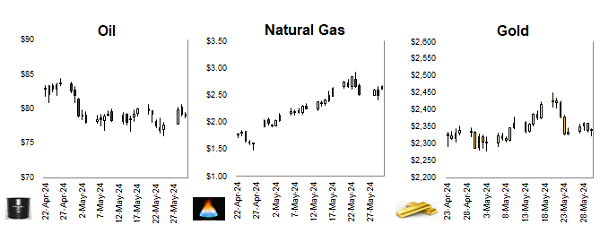 |
|
|
|
Fixed income and economics
The latest Fed Beige Book report indicates that the U.S. economy grew at a “slight or modest" pace in most regions since early April, with consumers resisting higher prices, particularly in discretionary spending. Eight of the twelve districts reported minimal job gains, and wage growth is stabilizing at pre-pandemic levels. Price increases were modest, reflecting consumer pushback against further hikes. The report, compiled by the Federal Reserve Bank of Dallas with data up to May 20, highlights regional business conditions, noting a more pessimistic outlook amid rising uncertainty. Despite this, several Fed officials, including Chair Jerome Powell, have emphasized the need for patience in future policy actions, awaiting clearer signs of cooling inflation.
Experts are noting the recent shifts and potential future movements in the U.S. bond market amidst the backdrop of mixed signals and increased noise in financial markets. With yields trending upwards and bond selling likely to continue, some suggest that the market might favour a steepening yield curve. Recent data, such as low bid/cover ratios in Treasury auctions and discrepancies in consumer confidence among income groups, indicate a tepid demand for bonds at current yields. Despite challenges, including poor consumer confidence and the risk of increased trade failures due to the faster settlement cycle, some expect the market may see a re-emergence of steepening trades, especially as the Fed tapers its quantitative tightening. This shift is driven by the potential constraints on short-term yields set by current Fed policies and the relatively neutral aggregate positioning in bond futures.
|
|
|
|
Quote of the day
 |
Good advice is always certain to be ignored, but that's no reason not to give it.
Agatha Christie
|  |
|
|
Contributors: A. Innis, A. Nguyen, P. Kwon
|
|
|
Charts are sourced to Bloomberg unless otherwise noted.
The opinions expressed in this report are the opinions of the author and readers should not assume they reflect the opinions or recommendations of Richardson Wealth Limited or its affiliates. Assumptions, opinions and estimates constitute the author's judgment as of the date of this material and are subject to change without notice. We do not warrant the completeness or accuracy of this material, and it should not be relied upon as such. Before acting on any recommendation, you should consider whether it is suitable for your particular circumstances and, if necessary, seek professional advice. Past performance is not indicative of future results. Richardson Wealth Limited, Member Canadian Investor Protection Fund. Richardson Wealth is a trademark of James Richardson & Sons, Limited used under license.
|
|
| Address: 100 Queens Quay East, Suite 2500 Toronto ON M5E 1Y3 Canada
|
|
|
|
|