To view images or for a printer-friendly version, click here

To ensure delivery to your inbox, please add Research@RichardsonWealth.com to your address book.

Richardson Wealth - Connected Wealth
Daily market commentary
The Launch Pad 
June 11, 2024
  
Click here to sign up for the Launch Pad
     
Today

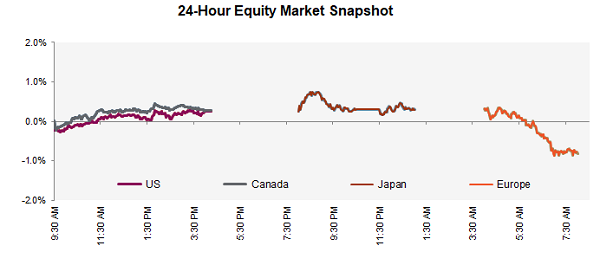
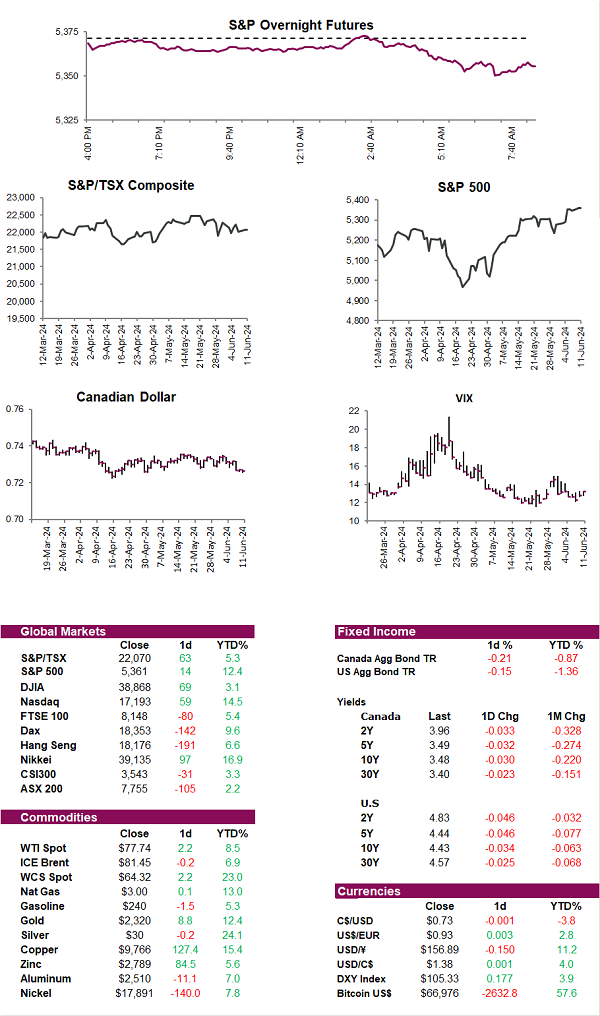
Equities are pointing down this morning with demand for safe haven assets rising with concerns rising over political uncertainty in Europe. Investors are also looking ahead to tomorrow’s U.S. inflation data and the Fed’s interest rate decision. Although expectations for a rate cut are unlikely, markets will be focused on the Fed’s interest rate projections, otherwise known as the dot plot. While there will likely be dissent among officials over the longer-term rate path, there is agreement today that taking a cautious wait-and-see approach is warranted to avoid policy mistakes that may veer the economy and prices away from the central bank’s targets. A year after the Fed lifted interest rates to a two-decade high, they will likely continue to remain focused on the upcoming data for jobs, the consumer, and inflation to determine if the economy is cooling enough to continue the disinflation required to stay on track to meet its targets.  

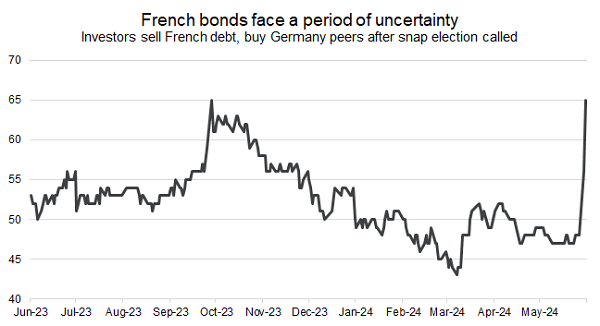
Au revoir bonds. French President Emmanuel Macron's decision to call a snap election has cast some doubt on the stability of the French economy and Macron's pro-business agenda. The move led to a sharp selloff, with French bonds seeing their highest yields relative to German bonds since December. The upcoming vote poses a challenge to Macron's economic policies, particularly regarding budget management and reforms. Macron's policies, which have focused on long-term savings and growth-friendly reforms, will likely face resistance amid growing political turmoil and opposition. The uncertainty surrounding the elections has raised fears of prolonged fiscal deficits and prompted credit rating downgrades, contributing to market volatility and weakening the euro. While Macron's opponents, including Marine Le Pen, criticize his fiscal policies, it remains unclear how they would address France's economic challenges should they come to power.  

The significant redeployment of pandemic-era excess savings in the U.S. and Canada has certainly boosted consumption growth and helped the economy avoid a recession (so far). Economists are noting, however, that a similar effect may be unlikely in China, despite households accumulating CNY 144 trillion in bank deposits during the pandemic, noting a weak relationship between changes in bank deposits and consumption growth in China. The reason? unlike the U.S. and Canada, China's fiscal support during the pandemic did not include direct cash transfers to households. Poor household sentiment, driven by a bleak employment and income outlook, further hinders these savings from driving consumption. With labour market conditions in China unlikely to improve until corporate profits recover significantly, consumers are also avoiding short-term loans. Additionally, Chinese stimulus efforts have largely targeted the supply side of the economy rather than reviving consumer demand. 

Looking on the bright side. Pessimism about the Canadian economy is easing as consumer confidence reaches a two-year high. The Bloomberg Nanos Canadian Consumer Confidence index climbed to 54, its highest since May 2022, reflecting a growing optimism among Canadians about their personal finances, job security, and economic and real estate prospects. Despite current conditions being viewed more negatively than the historical average, future expectations have improved, driven by bullish real estate sentiment. This rise in confidence comes ahead of the BoC's recent interest rate cut, indicating an anticipation of economic stabilization. However, challenges remain as the country has been in a per-capita recession since 2022 and consumer prices have significantly increased. Notably, sentiment varies across regions, being more positive in Quebec and Atlantic Canada and weaker in BC, Ontario, and the Prairies. 

As U.S. major cities look for creative ways to deal with higher office vacancy rates, they are looking to models north of the border for inspiration. According to the WSJ, some U.S. cities have sent delegates to Calgary to learn about the promises (and limitations) of the city’s attempts to convert low occupancy office buildings to residential buildings. A litany of office space came after oil prices plummeted, and coupled with pandemic challenges, it forced Calgary to rethink their real estate footprint. The city offered developers healthy subsidies (at least at the time), with no strings attached. While the city points to progress, the economics have not always panned out. Higher construction costs have left Calgary’s $75 a square foot subsidy insufficient for some developers to step up to take on the risk of repurposing the half empty buildings. For now, developers embarking on a conversion won’t be able to rely on more city incentives but will have to earmark buildings that they can buy at deep discounts and convert quickly. 

The U.S. finance sector is defying expectations amid a prolonged period of stable Federal Reserve policy, with interest rates at 23-year highs. Key reasons for its resilience include the privatization of risk, as a significant portion of financing now comes from private markets, reducing the potential for widespread contagion from problems within the private lending sector. Additionally, government debt has played a crucial role in fueling economic growth, perceived as less risky compared to private sector borrowing. However, risks persist, particularly in the opaque private credit market and concerns about unsustainable government debt levels, highlighting the need for continued vigilance and risk management to sustain stability in the U.S. finance sector. 

This should be an open and shut case. A juror in the U.S. was dismissed from a trial of seven individuals accused of stealing over $40 million from a pandemic-related program meant to feed children. The dismissal occurred after the juror reported that someone left a bag containing $120,000 cash at her home, with the implication she would receive more if she voted to acquit. Prosecutors characterized the incident as akin to something out of a mob movie. The defendants are among 70 expected to go to trial in a conspiracy that cost taxpayers an estimated $250 million. While 18 others have pleaded guilty, the defendants deny any wrongdoing. The aid money, provided by the USDA and administered by the state Department of Education, was intended to serve meals to children. However, prosecutors allege only a fraction of it went toward that purpose, with the rest spent on luxury items.  


Diversion: Good boy. 

The
Tactical model 
(% equity weight)

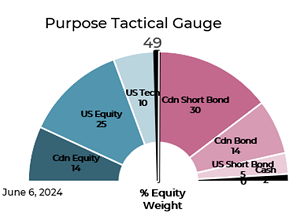
Our tactical fund is designed to complement your existing holdings to minimize portfolio volatility. To learn more, please click here.


Company news

Apple unveiled its long-awaited new AI features, including a partnership with ChatGPT maker OpenAI, betting that a personalized and understated approach to the technology will win over customers. The new platform called Apple Intelligence was the highlight of the company’s Worldwide Developers Conference presentation yesterday, which also included updates to the iPhone maker’s operating systems. The technology will help summarize text, create original images and retrieve the most relevant data when users need it. The push also includes a revamped version of Siri, the company’s once-pioneering digital assistant. The partnership with OpenAI, will let customers access ChatGPT via Siri at no extra cost. Apple Intelligence will begin rolling out later this year, but some features — including the ability for Siri to precisely control features within apps — won’t come until next year. Investors gave a tepid reaction to the event — a not-uncommon reaction when Apple debuts long-anticipated new features.   

General Motors authorized a new $6 billion share buyback plan and raised its dividend as the automaker said improving profitability in its electric vehicle operations allowed it to return cash to investors. The company said it plans to “opportunistically” buy its stock under the new program after completing a $10 billion accelerated share repurchase approved last November, according to a statement Tuesday. GM expects to exhaust the remaining $1.1 billion of the prior authorization by the end of this quarter. GM raised its quarterly dividend 33% to 12 cents a share. 


Commodities

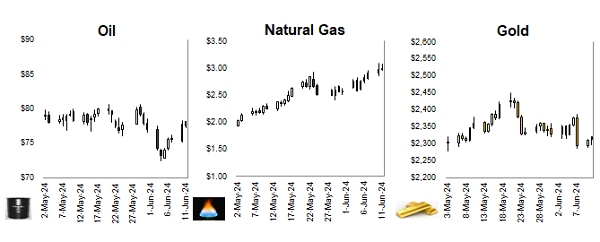
Oil prices are slightly lower following the biggest daily gain since March as crude rallied on Monday with traders deciding to “buy the dip”. The buying cane after the steepest weekly loss since early May, following a decision by OPEC+ to restore some supply this year. The selloff prompted the group to clarify it could pause or reverse production changes if needed. Oil has trended lower since early April on concerns about demand and swelling supply from outside of OPEC. Output from Russia last month stayed above a level the country had pledged to OPEC+, even as it made the deepest cuts in over a year.  

Iron ore prices are down the lowest level in two months as doubts persisted over how successful China’s efforts to ease its protracted property crisis will be. The State Council, the country’s cabinet, asked officials to keep formulating new policies that will absorb existing housing stock and stabilize markets, according to a statement posted on the government’s website late Friday before the start of a three-day holiday. Keep in mind that China unveiled a real estate rescue package last month to address the biggest cloud over its economy, relaxing mortgage rules and encouraging local governments to buy unsold homes. Many investors and analysts are skeptical that the measures will be sufficient. Supplies are building up with iron ore inventories at ports at the highest in more than two years. 


Fixed income and economics

U.S. businesses and consumers had started the year thinking interest rates would finally come down, making big plans to buy equipment or a house. Now all of that is on hold, slowing large pockets of the economy for the foreseeable future. When inflation progress stalled early this year and Federal Reserve officials decided to keep rates at a 23-year high for longer, it forced companies to rethink investments in capital expenditures, inventory and hiring. On Wednesday, policymakers are expected to keep borrowing costs steady again after their two-day policy meeting in Washington, which means that long awaited big purchases will have to remain on hold for longer. For businesses, the pain is showing up in data with S&P Global Market Intelligence projecting capital investments in manufacturing will rise by only 3.9% this year, down from a January estimate of 6.7%. U.S. business bankruptcy filings increased by more than 40% during the past year through the end of March, while personal filings rose 15%. With the release of the Fed dot plots tomorrow, we will see how much longer these businesses may have to endure the higher-for-longer scenario. 

Despite a surge in new U.S. municipal bond sales last week, which reached the highest level in over two years, the municipal bond market remained resilient, buoyed by reinvestment demand from maturing and called debt. With state and local governments issuing over $15.5 billion in bonds, surpassing levels seen since late 2021, investors saw an opportunity to diversify their portfolios. This surge in supply was met with notable demand, contributing to a 1.1% gain in municipal bonds since the start of June, offsetting losses from the previous month. Analysts anticipate this demand to persist, especially with expectations of below-average supply this week. The positive market performance was bolstered by a strong Treasury market rally, indicating a favourable reception for the increased primary market volume. Despite concerns about supply dynamics, the market is expected to remain supported by the upcoming redemption flows, which are forecasted to be nearly double the amount received in May. This mismatch between supply and demand is likely to continue supporting the market at least through July, providing investors with opportunities amid a surge in new issuances. 


Chart of the day
 

Markets

Quote of the day
 

To improve is to change; to be perfect is to change often.
Winston Churchill

Contributors: A. Innis, A. Nguyen, P. Kwon

Charts are sourced to Bloomberg unless otherwise noted.

The opinions expressed in this report are the opinions of the author and readers should not assume they reflect the opinions or recommendations of Richardson Wealth Limited or its affiliates. Assumptions, opinions and estimates constitute the author's judgment as of the date of this material and are subject to change without notice. We do not warrant the completeness or accuracy of this material, and it should not be relied upon as such. Before acting on any recommendation, you should consider whether it is suitable for your particular circumstances and, if necessary, seek professional advice. Past performance is not indicative of future results. Richardson Wealth Limited, Member Canadian Investor Protection Fund. Richardson Wealth is a trademark of James Richardson & Sons, Limited used under license.

Address: 100 Queens Quay East, Suite 2500 Toronto ON M5E 1Y3 Canada