Daily market commentary
The Launch Pad |
|
|
|
 |
| | |
|
Today
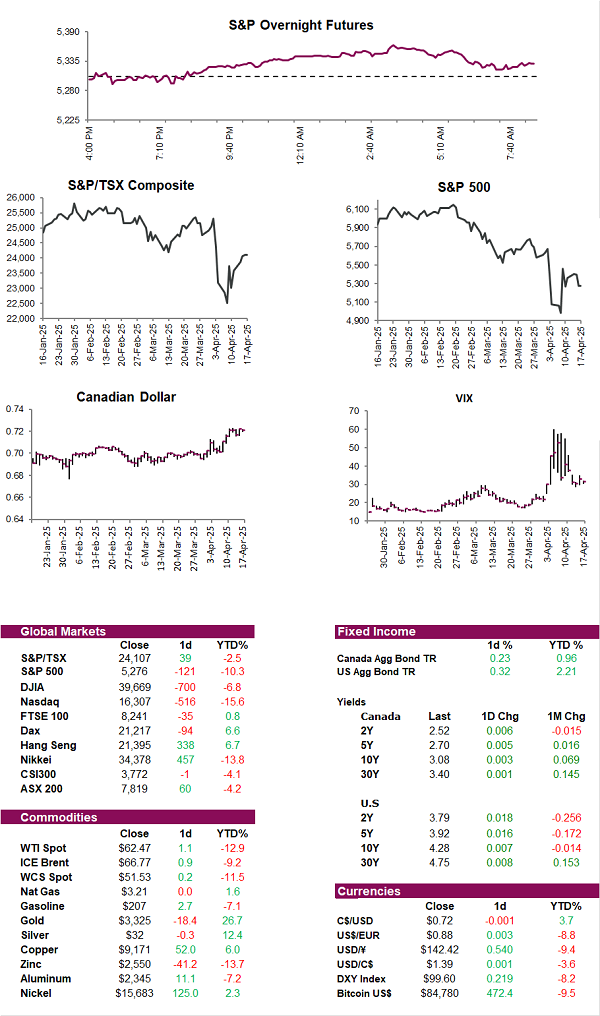
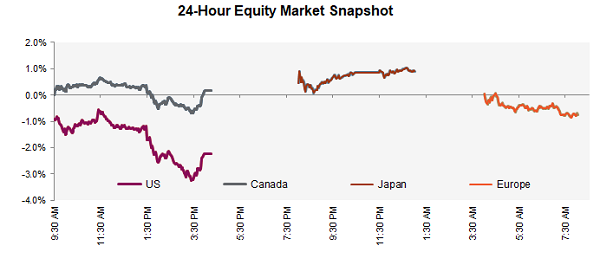
Equities are rising this morning with U.S. stocks attempting to recover from sharp losses yesterday, led by tech stock declines. Investors were also rattled by Fed Chair Jerome Powell’s warning that Trump’s tariffs could drive inflation higher and complicate the Fed’s dual goals of price stability and full employment. With markets closed tomorrow for Good Friday, U.S. indexes are on track for a losing week, however, Canadian equities have seen solid gains this week, helped by the Materials sector.
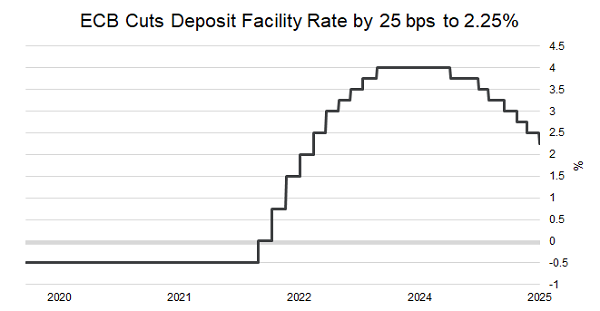
Donald is going to be very jealous. The ECB cut interest rates by 25 basis points this morning, lowering its key deposit facility rate to 2.25%, down from a peak of 4% in mid-2023. It was the central bank’s seventh rate cut since June 2024 and came amid escalating global trade tensions, particularly new U.S. tariffs, which threatens to derail the euro zone’s economic recovery. While some U.S. and retaliatory tariffs have been paused or eased, fears of their potential impact on euro zone growth prompted the ECB's action. Investors are closely watching for signals from ECB President Christine Lagarde on the future path of monetary policy, particularly regarding the neutral interest rate (the level that neither stimulates nor restricts the economy). With inflation easing and confidence indicators falling, markets expect two or three more cuts this year, possibly starting again in June.
The BoC held its policy rate steady at 2.75%, pausing its rate-cutting cycle amid rising uncertainty over U.S. trade policy. Governor Tiff Macklem emphasized the need for more clarity on tariffs before making further moves, noting the central bank’s focus on maintaining price stability and economic confidence. Faced with highly unpredictable trade developments, the bank outlined two economic scenarios: one with modest growth and low inflation if tariffs ease, and another involving a prolonged recession and high inflation if a global trade war unfolds. While the bank refrained from offering detailed forecasts or forward guidance, it signaled caution, stressing that monetary policy cannot fully offset the effects of a trade war.
Trump would like to say “You’re fired!” Donald Trump sharply criticized Fed Chair Jerome Powell, calling for his removal and accusing him of being consistently too slow in lowering interest rates. In a Truth Social post (don’t worry we’ll save you from reading the whole thing), Trump nicknamed Powell “Too Late” and claimed that his "termination cannot come fast enough," though it remains unclear whether he was referring to the end of Powell’s term or suggesting an earlier date. The remarks have reignited debate over the Fed's independence, especially as the White House's ability to remove officials from independent agencies faces legal scrutiny. Powell, whose term as chair ends in 2026, defended the Fed’s independence and noted that removal can only occur "for cause." This came after Powell emphasized the importance of maintaining price stability to support a strong labour market, warning that recent tariff hikes could lead to a more persistent rise in inflation. He signaled that the Fed is in no rush to change interest rates, preferring to wait for more clarity amid economic uncertainty. Powell acknowledged the potential conflict between the Fed’s dual goals of controlling inflation and supporting employment, especially if inflation remains elevated while the economy weakens. Despite these risks, the labour market remains strong, with low unemployment and solid job gains, and the Fed plans to continue gradually reducing its balance sheet.
Tariffy-ing sales. U.S. retail sales jumped 1.4% in March, the biggest gain in over two years, driven largely by a rise in car purchases and other goods as consumers rushed to buy ahead of impending tariffs. Broad-based increases across categories like electronics, building materials, and sporting goods suggest widespread front-loading of purchases, especially with Trump’s 25% vehicle tariffs and steep levies on Chinese imports set to take effect by May. While this boosted Q1 momentum, rising inflation expectations, declining consumer sentiment, and growing recession fears are clouding the outlook.
The World Trade Organization has sharply downgraded its 2025 forecast for global merchandise trade, now expecting a 0.2% decline instead of the 3.0% growth previously projected, citing escalating U.S. tariffs and broader spillover effects. This would mark the steepest drop since the 2020 pandemic slump. Officials at the WTO warned that continued tariff escalation, especially in the intensifying U.S.-China trade war, could further damage global GDP and financial stability. The WTO fears a long-term decoupling of the U.S. and Chinese economies, which could shrink global GDP by 7% if it leads to broader geopolitical fragmentation. Trade in services is also expected to slow significantly due to weakening demand and uncertainty, despite some regions benefiting from diverted Chinese exports and opportunities to fill gaps left by reduced U.S.-China trade.
Just weeks after reports surfaced about food service companies like DoorDash offering financing options for takeout, new reports show that the majority of Coachella’s $599 general admission tickets were financed. Facing rising costs, over 60% of Coachella 2025 attendees turned to installment plans to afford tickets. For a $49.99 down payment plus a $41 fee, fans could split the cost across several months, making attendance more financially feasible amid soaring travel, accommodation, and other expenses. Festival organizers have shifted their marketing to highlight low upfront payments rather than artist lineups or lifestyle, a strategy now common across major festivals. With ticket prices soaring and buy-now, pay-later services normalizing debt for non-essential experiences, the trend signals potential recessionary pressures and a cultural economy increasingly dependent on credit.
Diversion: This bunny has a particular set of skills
 |
|
|
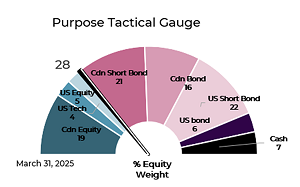
(% equity weight)
Our tactical fund is designed to complement your existing holdings to minimize portfolio volatility. To learn more, please click here.
|
|
|
| |
|
|
Company news
UnitedHealth Group shares are looking to open much lower after cutting its earnings outlook for the year and reporting first-quarter earnings below estimates, citing heightened care needs in Medicare that were “far above” what it had planned for. The company also cited “unanticipated changes” in its Optum Health care delivery business that are affecting reimbursements. Both segments have been hit by Medicare payment changes that the US government has made since 2024 to crack down on tactics insurers use to boost their revenue. The company said it expects the factors to be “highly addressable” this year and in 2026. The announcement comes after it missed targets for medical costs several quarters in a row. UnitedHealth has been rocked by turmoil since the December killing of a top executive.
Eli Lilly & Co. shares are getting a boost following data showing its experimental pill helped diabetic patients lose similar amounts of weight to injectable GLP-1 medications, bringing it one step closer to becoming a needle-free alternative to weight-loss shots. The trial is one of several that Lilly is running to test the drug, called orforglipron, in diabetes, obesity and other related conditions like sleep apnea. Investors and analysts had expected it to work at least as well as Ozempic, the blockbuster diabetes shot from Novo Nordisk A/S. Recent setbacks from Pfizer Inc. and disappointing results from Novo have made Lilly’s studies some of the most anticipated of the year. The company’s main obesity trial won’t wrap until at least July, according to a clinical trial database.
American Express Co. maintained its full-year guidance for revenue growth and profit as its wealthier clientele continue to spend in spite of tariff-induced volatility and uncertainty. The exorbitant costs of household items like eggs have dragged on the budgets of average U.S. consumers for months, though not as much for Amex’s customers, who are generally better off financially as they’re willing to pay for a rewards-focused premium credit card. However, no consumer is entirely insulated from an economic downturn, which could slow spending if a potential recession is substantial enough to make them pause before making a purchase.
D.R. Horton reported declines to its top and bottom lines as a combination of cautious demand and weak economic conditions weighed on results, prompting the company to reduce its outlook for the year. The home builder forecast fiscal 2025 revenue between $33.3 billion and $34.8 billion, as well as homes closed by homebuilding operations in the range of 85,000 to 87,000 homes. The company previously forecast revenue between $36 billion and $37.5 billion, as well as homes closed in the range of 90,000 to 92,000. Factors including persistently high home prices and mortgage rates combined with declining consumer confidence and tariffs that threaten to raise costs further have dented a fuller housing market recovery, though it has started to thaw.
|
|
|
|
Commodities
Oil prices are higher for a second day after the Trump administration again vowed to reduce Iran’s energy exports to zero, while talks between the U.S. and Japan stirred optimism that agreements on trade can be reached. Crude benchmarks are on track for their first weekly gain this month. Treasury Secretary Scott Bessent said the U.S. would apply maximum pressure to disrupt the OPEC member’s oil supply chain, as his department sanctioned a second Chinese refinery accused of handling crude from the Islamic Republic. The so-called teapot oil processor sanctioned by the US, Shandong Shengxing Chemical Co., had allegedly handled more than $1 billion of Iranian crude, the Treasury Department said. Tehran, meanwhile, warned that nuclear talks with Washington may fall apart if the Trump administration “moves the goalposts.” The renewed focus on Iran came after signs that China may be willing to engage in talks with the US in a bid to ease the escalating trade war.
Gold is hitting record highs once again as warnings from Federal Reserve Chief Powell about the impact of the trade war fueled volatility, leading to sharp declines in stocks and the U.S. dollar. Gold added 3.5% yesterday in its biggest one-day gain since March 2023, as the U.S. dollar fell to a fresh six-month low. Gold has been on a tear and has climbed almost 28% this year, already outpacing the 27% gain it notched in 2024, as the escalating trade war creates anxiety over a possible global recession. 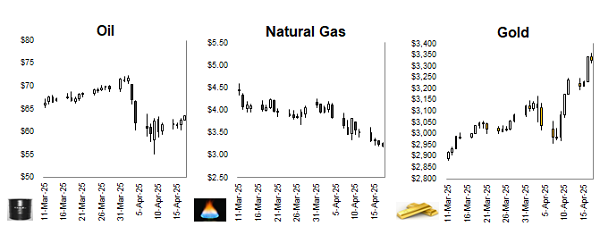 |
|
|
|
Fixed income and economics
U.S. Treasuries are lower snapping three days of gains, as traders pared bets on Federal Reserve interest-rate cuts after Chair Jerome Powell reiterated his commitment to keeping inflation in check. Yields rose across the curve, reversing much of Wednesday’s gains and sending the benchmark 10-year rate to 4.30%. Also, signs of progress in trade talks between the U.S. and Japan boosted risk assets, adding to the weakness in Treasuries. Yesterday, Powell stressed that the Federal Reserve must ensure tariffs does not cause a rise in prices, a reminder that policymakers remain focused on fighting inflationary. This week’s earlier moves in U.S. Treasuries did offer some comfort that the securities are starting to re-assume their haven qualities, at least for now.
Speaking of buying U.S. Treasuries, data is showing foreign holdings of U.S. Treasuries surged in February by the most since June 2021, with Canada and Japan among the biggest net buyers during a month that preceded the bond market’s recent turmoil. Total overseas holdings of Treasury securities jumped by $290 billion to a record $8.82 trillion in February, Treasury Department figures showed Wednesday. Foreign buyers purchased a net $106.2 billion of long-term, and $73.2 billion of short-term, Treasuries in the month. Canada, which had net sales of Treasuries in January, more than made up for those in February, with net purchases of $46.5 billion in long-term Treasuries.
|
|
|
|
Quote of the day
 |
Commitment is the nucleus of all success
Diana Nyad
|  |
|
|
Contributors: A. Innis, A. Nguyen, P. Kwon
|
|
|
Charts are sourced to Bloomberg unless otherwise noted.
The opinions expressed in this report are the opinions of the author and readers should not assume they reflect the opinions or recommendations of Richardson Wealth Limited or its affiliates. Assumptions, opinions and estimates constitute the author's judgment as of the date of this material and are subject to change without notice. We do not warrant the completeness or accuracy of this material, and it should not be relied upon as such. Before acting on any recommendation, you should consider whether it is suitable for your particular circumstances and, if necessary, seek professional advice. Past performance is not indicative of future results. Richardson Wealth Limited, Member Canadian Investor Protection Fund. Richardson Wealth is a trademark of James Richardson & Sons, Limited used under license.
|
|
| Address: 100 Queens Quay East, Suite 2500 Toronto ON M5E 1Y3 Canada
|
|
|
|
|