Daily market commentary
The Launch Pad |
|
|
|
 |
| |
|
|
Today
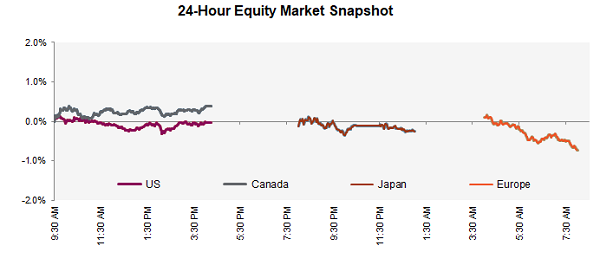
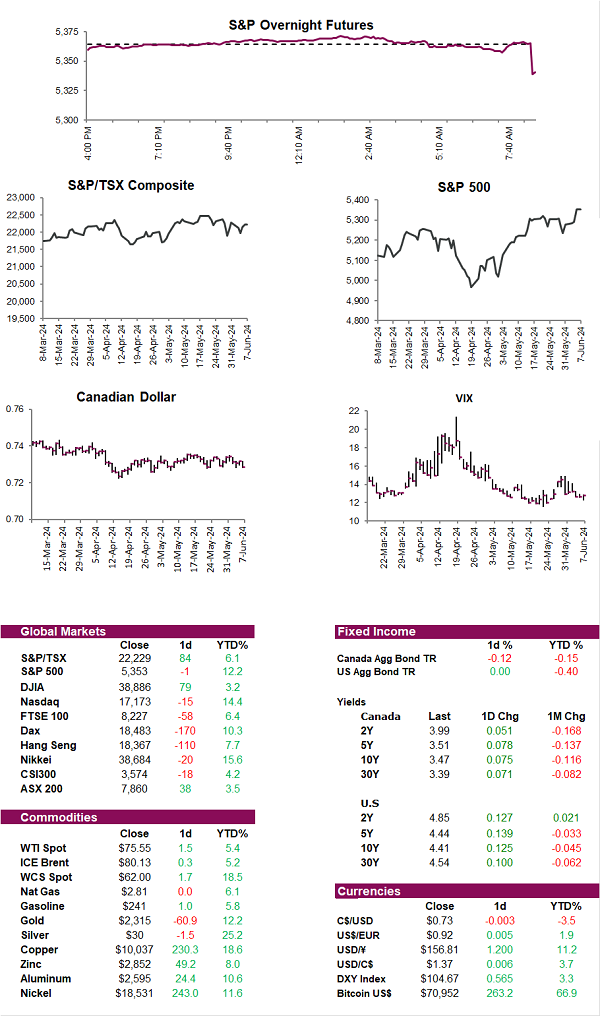
Equities are falling this morning while Treasury yields surged, after data showed unexpected strength in the U.S. labour market as nonfarm payrolls advanced 272,000 last month, lowering wagers on Fed interest-rate cuts this year. The U.S. government’s May employment report showed that job growth exceeded expectations while wages were rising, bad news for the Fed. This was one of the last major reports Fed officials will see before next week’s meeting, when they’re widely expected to keep borrowing costs at a two-decade high. Traders reduced the odds of a November cut to 80%, a step drop from yesterday when a cut was fully priced in.
In May, Canada added 26,700 jobs, but the unemployment rate rose to 6.2% as the working-age population grew faster than job creation. This supports the BoC's stance on excess supply in the economy, contributing to easing price pressures. Despite the job gains, part-time positions increased while full-time jobs declined, and wage growth accelerated to 5.2%. The employment rate fell slightly, reflecting immigration-driven population growth outpacing employment. The report, along with upcoming economic forecasts, will inform the BoC's next rate decision on July 24, with some economists anticipating further rate cuts amidst gradual easing expectations.
Surprising election results in Mexico and India earlier this week have disrupted markets, highlighting the pitfalls of relying on opinion polls. In Mexico, a twist in elections led to a significant devaluation of the peso, disrupting profitable currency trades. Similarly, in India, a miscalculation of the extent of Narendra Modi’s election victory resulted in a $386 billion stock market wipeout. These events emphasize the high stakes of 2024 elections globally, with the European Union and U.S. elections looming. Experts are warning that incidents such as these underscore the importance of considering the limitations of opinion polls, as markets struggle to price political risks accurately.
Private credit dealmakers are facing a growing concern that the boom period for the $1.7 trillion private credit market might be ending. Despite last year’s optimism, the market is now contending with a slowdown in buyouts, competition from banks, and liquidity challenges. Some private credit funds are struggling to meet investor expectations and return capital, with notable examples including Ninepoint Partners LP suspending cash distributions and Fidelity International halting European direct lending activities. While returns have remained strong, outpacing private equity in recent years, investors are increasingly wary of the sector's future as deal flow slows, leverage rises, and spreads tighten.
In April, Canada reported a merchandise trade deficit of $1.0 billion, improving from March's revised $2.0 billion deficit, driven by a 2.6% rise in exports to $64.4 billion, particularly in natural gas (up 60.1%) and crude oil (up 3.0%) due to increased volumes. Exports of metals, including unwrought gold, also rose by 4.7%. Imports increased by 1.1% to $65.5 billion, with notable gains in motor vehicles and parts and aircraft and transportation equipment. While total export volumes grew by 1.7%, import volumes fell by 0.2%, reflecting a rebound in export activity. Canada's international trade in services saw a deficit rise to $1.1 billion, resulting in a combined goods and services trade deficit of $2.2 billion for April, down from $2.9 billion in March.
The health of healthcare. The sector has underperformed the S&P 500 by 23% since early 2023 due to squeezed profit margins after the pandemic revenue boost ended and long-term contracts prevented price increases in line with rising costs. History also shows that defensive sectors tend to be less favoured in risk-on environments. Still, some experts are noting that as these long-term contracts reset, companies will gain improved pricing power and margins. Additionally, if there is an economic downturn, the healthcare sector could benefit. Structural factors, such as an aging population and rising healthcare expenditure per capita, have also been noted as reasons why some are warming up to the healthcare sector. And it seems like AI is making its way into everything these days, with companies highlighting the potential for generative AI to shorten the R&D cycle.
A new report reveals that the average asking rent for a home in Canada reached a record high of $2,202 in May, marking a 9.3% increase from the previous year and a 0.6% rise from April. This milestone is the first time average rents have surpassed the $2,200 threshold. One-bedroom units saw an average asking rent of $1,927, a 10.7% increase, while two-bedroom units averaged $2,334, up 12.1%. Purpose-built rental apartments experienced a 13.7% increase to $2,146, significantly outpacing the 3.4% rise for condominium apartments, which averaged $2,312. Saskatchewan, Alberta, and Nova Scotia led the annual rent inflation, with increases of 21.4%, 17.5%, and 17.1%, respectively. British Columbia maintained the highest average asking rents at $2,526, followed by Ontario at $2,423. Despite overall national increases, Vancouver and Toronto saw declines, with rents dropping 4.1% and 0.9% to $3,008 and $2,784, respectively.
It's not always easy being a world-famous musician, especially these days. Performers like Jennifer Lopez, The Black Keys, Bad Bunny, Troye Sivan, and Charli XCX are experiencing challenges in ticket sales. The current oversaturation of the market with post-pandemic tours and the high cost of tickets are contributing factors. While some acts like Taylor Swift and Beyoncé continue to thrive, others are finding the competition and economic pressures difficult to navigate and deciding to simply cancel their tours. The concert industry is certainly complex, with factors such as ticket pricing, market saturation, and the dominance of Live Nation-Ticketmaster influencing artists' success (or in this case, lack of success) on the road.
Diversion: Better than a tan. |
|
|
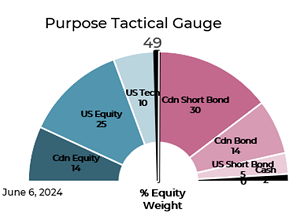
(% equity weight)
Our tactical fund is designed to complement your existing holdings to minimize portfolio volatility. To learn more, please click here.
|
|
|
| |
|
|
Company news
Lululemon Athletica shares got a boost yesterday after international sales growth and new women’s merchandise helped propel a higher full-year profit outlook. Lulu unveiled new products through 2024, including leggings that use hydrogen yarn in July, and said it has invested in store expansion, supply-chain improvements and international facilities. The company hopes to attract more male shoppers with offerings for training and golf. CEO Calvin McDonald told analysts that Lululemon had “missed opportunities” in its women’s business last quarter and is honing its product assortment to drive demand. He attributed the company’s higher earnings outlook to better sales of more profitable items.
The rollercoaster ride for GameStop continued as shares whipsawed ahead of Keith Gill’s highly anticipated return to YouTube, after the video-game retailer announced that it would sell up to 75 million additional shares. Gamestop also released first quarter results earlier than expected and they showed net sales declining in the first quarter. GameStop shares fell as much as 19%, erasing an earlier surge that had reached more than 37%. Gill has helped drive recent volatile swings in the stock price, which has soared 167% since he returned to X with a cryptic meme on May 12, adding $11 billion to GameStop’s market value over that stretch. Investors were awaiting Gill’s first livestream in more than three years which is supposed to happen today. The latest surge move has been predicated by his position in the company of more than $500 million, when accounting for common stock and call options, according to a Reddit post on June 6. Now, the video stream could serve as yet another catalyst for the meme stock, as roughly 15,000 YouTube users have asked to be notified when it starts at noon in New York.
|
|
|
|
Commodities
Oil prices are higher but heading for a weekly loss after some OPEC+ members reiterated that its plan to revive halted supplies is contingent on market conditions. Brent crude futures were trading near $80 a barrel, rebounding from the four-month low struck on Monday after Saudi Arabia and its partners outlined plans to gradually resume production. Oil has trended lower since early April in part due to concerns over the demand outlook. However, geopolitical risks surrounding the war in Ukraine and the Middle East continue to simmer, which could spur further price gains.
Gold prices are lower after data showed China’s central bank didn’t buy any gold last month, ending a massive buying spree that ran for 18 months and helped push the precious metal to a record high in May. Gold soared to an all-time high above $2,450 an ounce in May, supported by strong central bank buying. The PBOC’s demand for bullion has come as the world’s second-biggest economy seeks to diversify its reserves and guard against currency depreciation. There had been signs that China’s demand was cooling as higher prices took their toll. In April, the PBOC bought only 60,000 troy ounces, down from 160,000 ounces in March, and 390,000 ounces in February. The country’s imports in April, meanwhile, slipped 30% from the previous month. 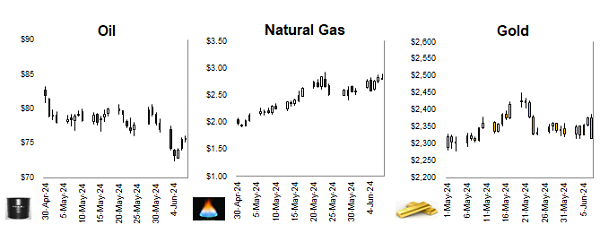 |
|
|
|
Fixed income and economics
European Central Bank officials have nearly ruled out a second interest-rate cut in July and are uncertain about a possible reduction in September. While a rate cut was delivered this week as widely expected, policymakers remain divided on future actions. Austrian central-bank Governor Robert Holzmann opposed the recent cut, highlighting the need for data-driven decisions, especially after May's higher-than-expected inflation. ECB President Christine Lagarde reiterated the bank's commitment to data dependent and meeting-by-meeting decisions, emphasizing uncertainty about the pace and timing of future moves.
The global easing cycle has begun, highlighted by recent interest rate cuts from the BoC and the ECB. This synchronized monetary policy approach follows the global inflation surge post-pandemic, with markets anticipating two rate cuts from the Fed this year. Despite favourable conditions for the equity market, certain risks remain, including inflation (oh yeah, that still hasn’t gone away) and the broader economic outlook. On top of that, monthly U.S. imports as a percentage of retail sales have declined, reflecting decreased globalization, although recent trade data shows a slight uptick. This trend, if it continues, may influence the dollar's future trajectory, suggesting that significant weakening will require more than just Fed policy changes.
|
|
|
|
Quote of the day
 | There cannot be a crisis next week. My schedule is already full.
Henry Kissinger |  |
|
|
Contributors: A. Innis, A. Nguyen, P. Kwon
|
|
|
Charts are sourced to Bloomberg unless otherwise noted.
The opinions expressed in this report are the opinions of the author and readers should not assume they reflect the opinions or recommendations of Richardson Wealth Limited or its affiliates. Assumptions, opinions and estimates constitute the author's judgment as of the date of this material and are subject to change without notice. We do not warrant the completeness or accuracy of this material, and it should not be relied upon as such. Before acting on any recommendation, you should consider whether it is suitable for your particular circumstances and, if necessary, seek professional advice. Past performance is not indicative of future results. Richardson Wealth Limited, Member Canadian Investor Protection Fund. Richardson Wealth is a trademark of James Richardson & Sons, Limited used under license.
|
|
| Address: 100 Queens Quay East, Suite 2500 Toronto ON M5E 1Y3 Canada
|
|
|
|
|