Daily market commentary
The Launch Pad |
|
|
|
 |
| |
|
|
Today
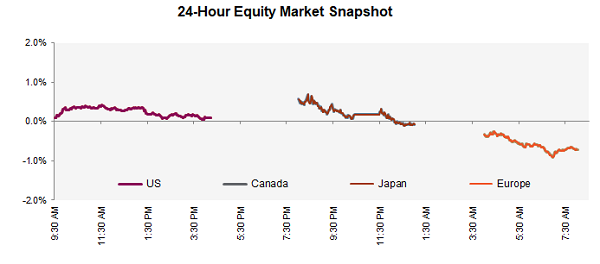
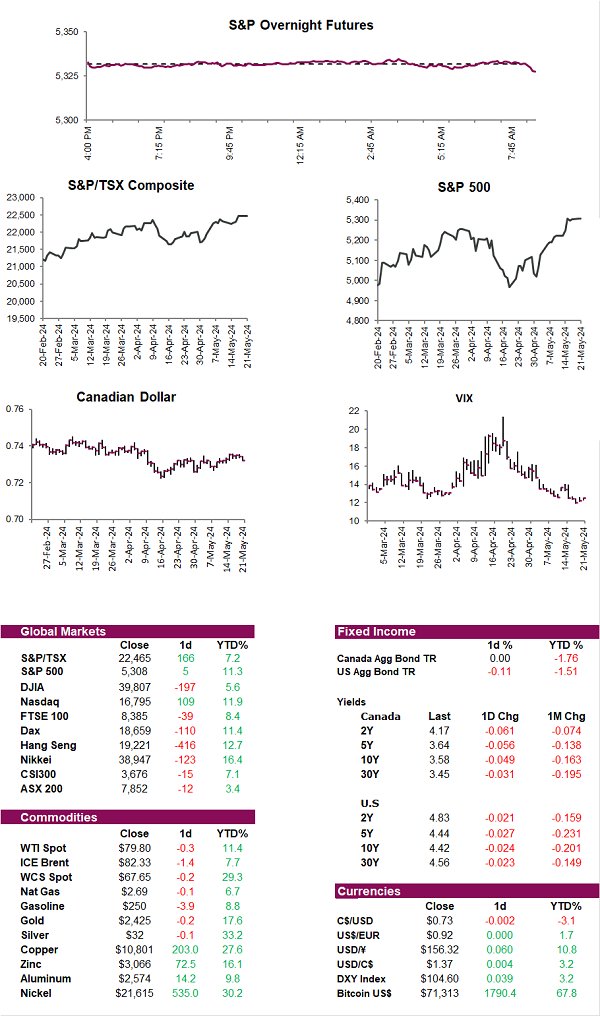
Stocks are looking to open lower, as investors wait on the sidelines ahead of earnings results from Nvidia and speeches by Fed policymakers. While markets in Canada were taking a break yesterday, the U.S. was open for business. The Nasdaq reached an all-time intraday high yesterday after Nvidia's shares rose over 2% amid positive analyst reports and increased price targets ahead of its fiscal first-quarter earnings report set to be released later this week. Nvidia's stock has surged 91.4% YTD and 203.2% over the past year, making it the third-largest market cap in the S&P 500 at $2.3 trillion.
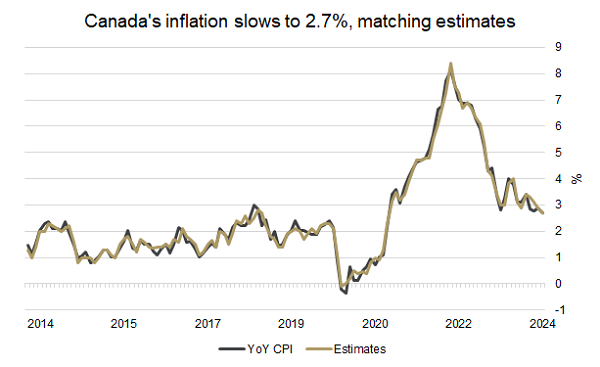
Some good news on the inflation front. Canada's annual core inflation rate eased for the fourth consecutive month in April to an average yearly pace of 2.75%, slightly below the expected 2.8%. We’re not out of the woods yet, however, with data showing a three-month moving average rising to an annualized pace of 1.64% from 1.35% in March, marking the first increase since December. Headline consumer price index inflation slowed to 2.7% y/y, down from 2.9% in March, while monthly inflation matched expectations at 0.5%. Mortgage interest costs and rents were the largest contributors to annual inflation, with mortgage costs up 24.5% and rents up 8.2%. Excluding shelter costs, the consumer price index rose 1.2% year-over-year. Despite the deceleration in core inflation, a slight uptick in the three-month average may complicate the BoC's decision on whether to cut rates when they next meet in June. Policymakers are waiting to see sustained progress in easing core inflation before pivoting to an easier policy, and some may still not be convinced.
Iranian President Ebrahim Raisi and Foreign Minister Hossein Amirabdollahian died in a helicopter crash on the mountainside in northwest Iran, introducing significant uncertainty into Iran's political landscape. The accident occurred amidst ongoing turmoil and tensions in the Middle East over the war in Gaza. Acting President Mohammad Mokhber, closely linked to the IRGC, is expected to maintain the status quo until new elections are held within 50 days, likely with low voter turnout due to public cynicism. Raisi's death intensifies the succession crisis for Supreme Leader Khamenei, potentially opening the door for his son Mojtaba or other hardliners. Despite these upheavals, Iran's foreign policy, dictated by the Supreme Leader and the Supreme National Security Council, is expected to remain consistent, maintaining relations with Saudi Arabia and its adversarial stance toward Israel. The upcoming elections could offer an opportunity for the regime to reintegrate moderates and increase voter engagement, but substantial change is believed unlikely.
Canada is considering raising tariffs on Chinese-made EVs after the U.S.’s recent increase in tariffs on similar imports. The news came from Canada’s Trade Minister Mary Ng and follows the Biden administration's symbolically significant tariff hikes on various Chinese products, including a substantial increase on EVs from 27.5% to 102.5%. Currently, Canada imposes a 6% tariff on Chinese vehicles. Ng highlighted ongoing discussions with U.S. officials and emphasized Canada's priority to enhance domestic EV production, citing agreements with automakers like Honda and Volkswagen to manufacture EVs and components in Ontario. While Chinese factories have a minor share of Canada's auto market, there has been a notable rise in imports of Chinese-made Teslas.
M&A activity is expected to recover only slightly in the second half of 2024 from historically low levels, hindered by unclear U.S. policies, a potentially heated presidential election, persistent inflation, and geopolitical tensions. Historically, M&A activity peaks in the latter half of election years, often in the fourth quarter, however, the contentious political climate in the U.S. may lead to only modest improvements in M&A volumes. The most active sectors may be consumer non-cyclicals and communications, with significant deals historically occurring in these industries during election years. Despite a possible uptick in the second half of this year, the momentum may not carry into 2025, especially since deal volumes have historically declined post-election. IPO activity, in contrast, is expected to remain subdued, with any significant recovery unlikely until well into 2025.
With auto thefts appearing to be a common occurrence these days (We’re sure you or someone you know has been impacted) it should be no surprise that auto theft insurance claims in Canada surged to a record $1.5 billion in 2023, marking a 20% increase from the previous year. This continues the trend of costs exceeding $1 billion annually. Ontario saw a particularly sharp rise, with claim costs increasing by 524% from 2018 to 2023. The Insurance Bureau of Canada highlights that luxury vehicles are targeted by criminal organizations for international markets, funding activities like drug trafficking and terrorism. The bureau is calling for federal action to modernize vehicle safety standards and curb the export of stolen vehicles, noting the impact of rising theft on insurance premiums.
Tokyo is grappling with a significant invasion of North American raccoons, initially brought to Japan as pets following the popularity of the 1970s anime "Rascal the Raccoon." Despite a ban on raccoon imports, many were released or escaped, proliferating rapidly due to the lack of natural predators. Tokyo's efforts to control the population have been ineffective, with raccoon captures increasing from 259 in 2012 to 1,282 in 2022, though many raccoons evade capture (talk about being bandits). These raccoons are causing considerable agricultural damage, costing Japan's agriculture industry millions of yen annually, and have also attacked residents. The persistence and adaptability of raccoons suggests that controlling their population may remain a challenging issue for Tokyo and other affected areas. If Tokyo raccoon would like tips on surviving unfriendly situations, talk to Toronto raccoon who enjoys considerable freedom in its city.
Diversion: Elliot from ET did it better... |
|
|
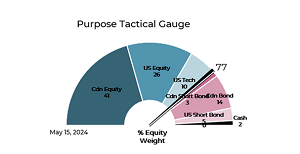
(% equity weight)
Our tactical fund is designed to complement your existing holdings to minimize portfolio volatility. To learn more, please click here.
|
|
|
| |
|
|
Company news
Lowe’s reported comparable sales for the first quarter that beat estimates, a sign that the company is making inroads with professional contractors despite a weak U.S. housing market. Comparable sales, a key metric for the industry, fell 4.1% in the first quarter, but were still better than expected. Inflation and high interest rates have hurt consumers’ appetites for big purchases, eroding sales at Lowe’s and its main rival, Home Depot Inc., in recent quarters. Lowe’s affirmed its full-year outlook.
Macy’s easily beat profit estimates in the most recent quarter, leading the department store operator to raise its outlook for the remainder of the year. The results will ease some pressure for CEO Tony Spring and help convince shareholders and board members that he deserves more time to execute a turnaround strategy. There is interest of a $6.6 billion buyout offer from activist investor Arkhouse Management Co. and Brigade Capital Management. Macy’s has been investing in new products, displays and customer experience, which Spring expects will help the company “return to sustainable, profitable growth” over the long term, he said in a statement.
Red Lobster has filed for Chapter 11 bankruptcy protection in a Florida court after securing $100 million in financing commitments from its existing lenders. The company reported assets and liabilities between $1 billion and $10 billion. Despite the bankruptcy, Red Lobster will continue operating its restaurants, while planning to reduce the number of locations and pursue a sale of most of its assets. Also, the restaurant entered a "stalking horse" purchase agreement with an entity controlled by its term lenders. Executives stated that this restructuring is essential for addressing financial and operational challenges and will help the company to emerge stronger and focus on growth. Let’s just hope they don’t stop the free biscuits…
Jamie Dimon, CEO of JPMorgan Chase, suggested his tenure may end in less than five years, marking a shift from his usual statement of retirement being perpetually five years away. At the bank's annual investor meeting, Dimon, 68, emphasized his continued energy for the role but acknowledged that the timing of his departure will be decided by the board. Potential successors include Marianne Lake, CEO of JPMorgan's consumer bank, and Jennifer Piepszak, co-leader of the commercial and investment bank. Despite stepping down as CEO, Dimon is expected to remain as chairman. The market didn’t seem to like his remarks though, leading to a 3.6% drop in JPMorgan's shares yesterday.
ASML Holding NV and Taiwan Semiconductor Manufacturing Co. have a plan in place in the event that China invades Taiwan. They have created ways to disable the world’s most sophisticated chipmaking machines. The remote shut-off applies to Netherlands-based ASML’s line of extreme ultraviolet machines, known within the industry as EUVs, for which TSMC is its single biggest client. EUVs harness high-frequency light waves to print the smallest microchip transistors in existence — creating chips that have artificial-intelligence uses as well as more sensitive military applications. ASML reassured officials about its ability to remotely disable the machines when the Dutch government met with the company on the threat. The Netherlands has run simulations on a possible invasion in order to better assess the risks. Officials from the Interestingly enough, spokespeople for ASML, TSMC and the Dutch trade ministry declined to comment, as well as, spokespeople for the White House National Security Council, US Department of Defense and US Department of Commerce.
|
|
|
|
Commodities
Oil prices are lower as attention turns toward the upcoming OPEC+ meeting that will set the group’s supply policy. Futures have been in a narrow range, with implied volatility near lows last seen in 2019 according to one measure, despite ongoing drone strikes on Russian oil refineries and another Houthi attack against a tanker in the Red Sea area over the weekend. Brent’s prompt timespread was at its weakest since January yesterday, settling in backwardation of just 25 cents a ton, and has since narrowed even further. Meanwhile, money managers cut their net long positions on Brent to the lowest since January, although they increased those for WTI.
Copper’s rally is showing signs of slowing, after touching an all-time high, with investors cautioning its rally may have been running ahead of weak fundamentals for refined metal. The latest months-long rally has been driven by financial investors betting on deepening supply shortages. Many participants in the physical trade have been warning that prices were running ahead of signals of underlying market conditions. Demand remains relatively tepid — especially in top buyer China, where inventory levels remain high and suppliers of copper wires and bars have been cutting output. The rally went into overdrive last week as a short squeeze on the New York futures market triggered a global rush to secure the metal. The spread between front months has since eased. 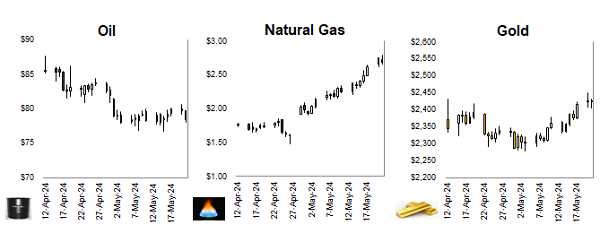 |
|
|
|
Fixed income and economics
Investors are receiving the lowest compensation in six years for taking on the risk of emerging-market corporate bonds instead of staying with the safety of U.S. Treasuries. An index of dollar-denominated EM corporate debt has rallied since October, reducing the yield premium over Treasuries to 216 bps, down significantly from 2022. Despite thin spreads, investors are betting on further gains due to attractive total returns and technical factors such as shorter durations and limited new bond supply. The demand for EM bonds is also driven by a positive outlook for EM sovereign credits and strong fundamentals. However, some investors caution that ignoring risk spreads and chasing nominal yields could be dangerous if global markets deteriorate. The rally has persisted despite higher U.S. yields and delayed Fed rate cut expectations, supported by improved global economic conditions and reforms in high-yielding EM countries. Overall, the strong fundamentals and technical dynamics are currently outweighing concerns about thinning spreads.
Recent export data from Taiwan and South Korea indicate strong global growth momentum. In April, Singapore's electronics exports grew by 3.3% y/y, recovering from a 9.5% contraction in March. Despite this, Singapore's total non-oil exports to the U.S. and Europe are declining, and exports to China are also decreasing with Japan's preliminary April machine tool orders also falling sharply. Economists are noting that the data may suggest that global growth stabilization may be short-lived, with some still calling for a U.S. recession by the end of 2024 or early 2025.
|
|
|
|
Quote of the day
 | Failure is the condiment that gives success its flavor
Truman Capote |  |
|
|
Contributors: A. Innis, A. Nguyen, P. Kwon
|
|
|
Charts are sourced to Bloomberg unless otherwise noted.
The opinions expressed in this report are the opinions of the author and readers should not assume they reflect the opinions or recommendations of Richardson Wealth Limited or its affiliates. Assumptions, opinions and estimates constitute the author's judgment as of the date of this material and are subject to change without notice. We do not warrant the completeness or accuracy of this material, and it should not be relied upon as such. Before acting on any recommendation, you should consider whether it is suitable for your particular circumstances and, if necessary, seek professional advice. Past performance is not indicative of future results. Richardson Wealth Limited, Member Canadian Investor Protection Fund. Richardson Wealth is a trademark of James Richardson & Sons, Limited used under license.
|
|
| Address: 100 Queens Quay East, Suite 2500 Toronto ON M5E 1Y3 Canada
|
|
|
|
|