Today
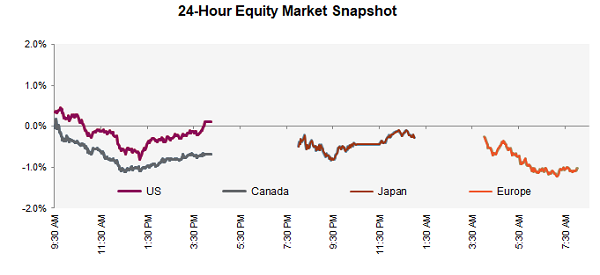
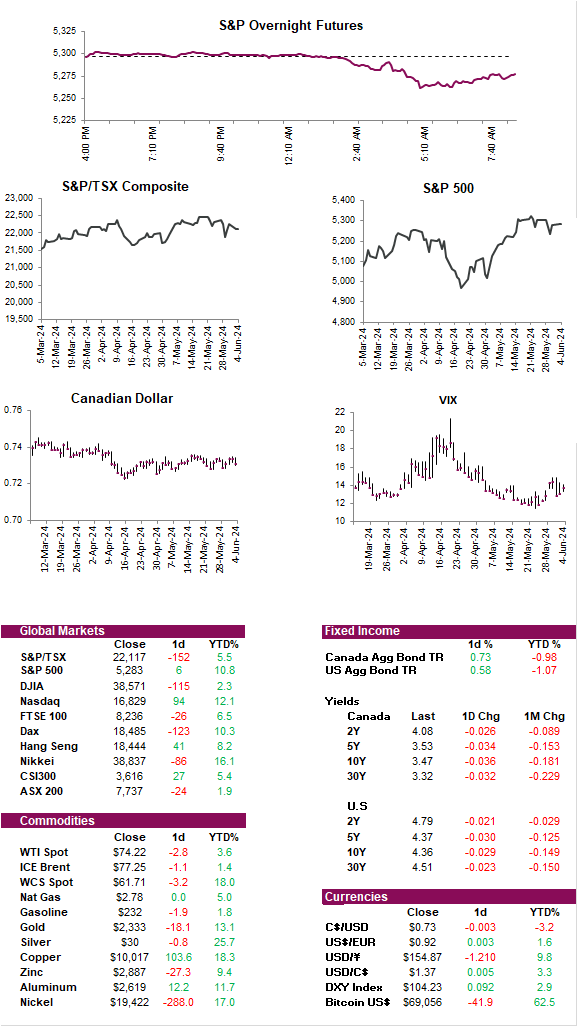
Equity futures are pointing lower while Treasuries are clinging to gains from yesterday’s rally prompted by signs the U.S. economy is cooling. The stock market has been benefiting from bad economic news recently, as it raises hopes for Fed interest rate cuts. However, excessive negative data could signal an impending recession, reversing this trend. Over the past two months, the S&P 500 has risen while the U.S. dollar declined, and the Citi Economic Surprise Index has been falling, showing reality underperforming forecasts. Critical Canadian and U.S. labour data this week, including job growth and unemployment rates, will be pivotal into shaping the future rate path of the BoC and the Fed.
Emerging-market equities surged yesterday as Chinese manufacturing activity rose at its fastest pace since June 2022, driving MSCI’s EM stock benchmark up by 2.3%, led by Asian tech companies. Still, there was a lot of volatility in emerging markets, with EM markets pairing gains this morning after election results caused Mexico’s peso to tumble by 4.2% and stocks to fall 4.4% after the ruling party's unexpected broad majority in Congress, raising concerns about increased state control. Mexico wasn’t the only EM country to suffer after election results, with news about Indian’s election pairing most of those gains made yesterday.
A good reminder to not count your chickens before they hatch. Just a few days ago it looked like the Indian election would show a clear winner. Prime Minister Narendra Modi all but declared victory after exit polls showed his ruling party would cruise to an easy win. That all came to a sudden stop this morning when real votes were counted, and the numbers show his Bharatiya Janata Party (although still winning the most seats) looks all but certain to lose the single-party majority in parliament that it has enjoyed since he first became prime minister in 2014. The surprise at the polls sent shockwaves through the market with investors fearing the setback would dent India’s growth prospects. The NSE Nifty 50 Index fell as much as 8.5% in Mumbai, the biggest intra-day drop in more than four years. Experts are noting that despite the setback for Modi, India is unlikely to see a drastic shift in its long-term economic growth prospects. From a foreign policy perspective, Indian is also likely to stay roughly the same as well, with India more closely aligned with the U.S. against China while seeking to carve out a leadership role in the Global South.
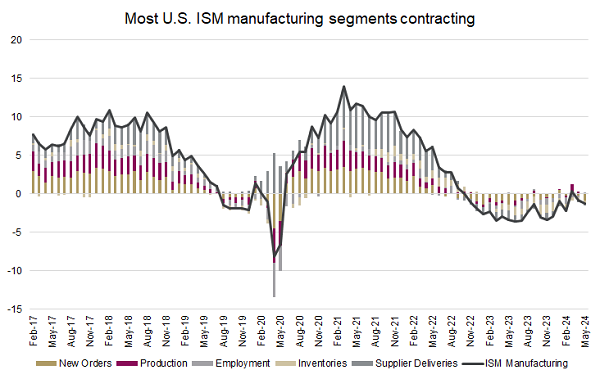
U.S. factory activity contracted in May, with output nearly stagnating and orders falling significantly. The Institute for Supply Management's manufacturing index dropped to 48.7, the lowest in three months and below the expected 49.5, indicating contraction. The new orders index plummeted by 3.7 points to 45.4, the lowest in a year, reflecting weakening demand. Seven industries, including wood products, plastics and rubber, and machinery, reported declining activity, while seven sectors grew. High borrowing costs, reduced business investment, and subdued consumer spending have hampered manufacturing growth, despite a slight reduction in input costs. However, export demand and factory employment showed positive signs, with the employment index rising to 51.1, the highest since August 2022, indicating improved labour acquisition by producers.
It's not much better here though. Canadian manufacturing activity further contracted in May, extending a record period of sectoral decline, as output and new orders decreased more rapidly, leading firms to cut back on purchasing. The S&P Global Canada Manufacturing Purchasing Managers' Index slightly dropped to 49.3 from April's 49.4, marking its lowest since January and the 13th consecutive month below the 50 threshold, indicating contraction. This prolonged period of contraction is unprecedented since data collection began in October 2010. Companies reported subdued demand and uncertainty, resulting in reduced buying activity due to sufficient stock levels. However, there was some relief as inflationary pressures eased, with the input price index dropping to 53.8 and the output price measure hitting its lowest since July 2020 at 50.2. This cooling inflation might reassure policymakers, potentially leading to the BoC reducing interest rates by 25 basis points to 4.75% tomorrow, as anticipated by most economists.
The recent stock market rally has become increasingly concentrated, with the usual suspects (Apple, Alphabet, Microsoft, Amazon, Meta, and Nvidia) driving over 75% of the S&P 500's gain in May. And although it’s not quite the “Magnificent Seven", 6 out of 7 ain’t too bad. So despite the S&P 500 achieving its best May since 2003 and the Nasdaq posting its strongest May in over two decades, it’s clear why investors may be on edge, market breadth has diminished with fewer stocks contributing to gains. This narrow leadership has raised concerns about market health and sustainability. The equal-weighted S&P 500's performance has significantly lagged behind the market-cap-weighted index, hitting its worst relative level since March 2009. While narrow breadth often precedes strong future returns, the current rally’s reliance on big tech and the recent rise in Treasury yields suggest potential vulnerabilities.
Despite a broader consumer spending slump in China, EV sales surged in May, driven by price cuts and new model launches. Leading EV manufacturers like BYD, Nio, and Seres Group reported significant sales growth, with Seres seeing a nearly threefold increase in deliveries and Nio a 234% rise. BYD, the top-selling brand, sold 330,488 passenger vehicles, marking a 25% increase. This growth boosted EV makers' shares, with BYD, Nio, Li Auto, and Xpeng all experiencing gains. However, Chinese EV producers face challenges such as domestic competition, slowing demand, and potential trade barriers in overseas markets like the EU and the U.S. Despite these issues, domestic EV and plug-in hybrid sales are projected to grow 33% in May.
A man in the UK was arrested for a series of burglaries and shop thefts, during which he stole 17 tubes of Pringles. When questioned by the police, he stated, "once you pop, you can’t stop," referencing the snack’s slogan. The man admitted to the offences, which included multiple thefts from a variety of grocery chains, where he also stole over £300 worth of stock. He received a six-month prison sentence, suspended for a year, was ordered to pay £200 in compensation, and must complete a six-month drug rehabilitation program. Didn’t think Pringles were that addictive, but I guess I was wrong.
Diversion: Legolas has nothing on this guy.