To view images or for a printer-friendly version, click here

To ensure delivery to your inbox, please add Research@RichardsonWealth.com to your address book.

Richardson Wealth - Connected Wealth
Daily market commentary
The Launch Pad 
July 9, 2024
  
Click here to sign up for the Launch Pad
     
Today

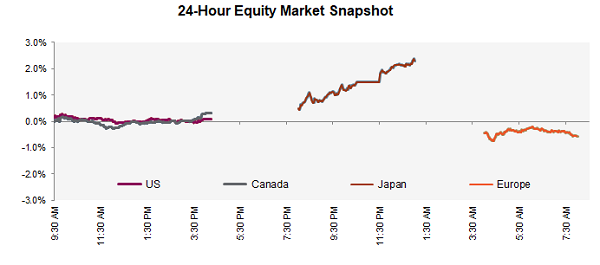
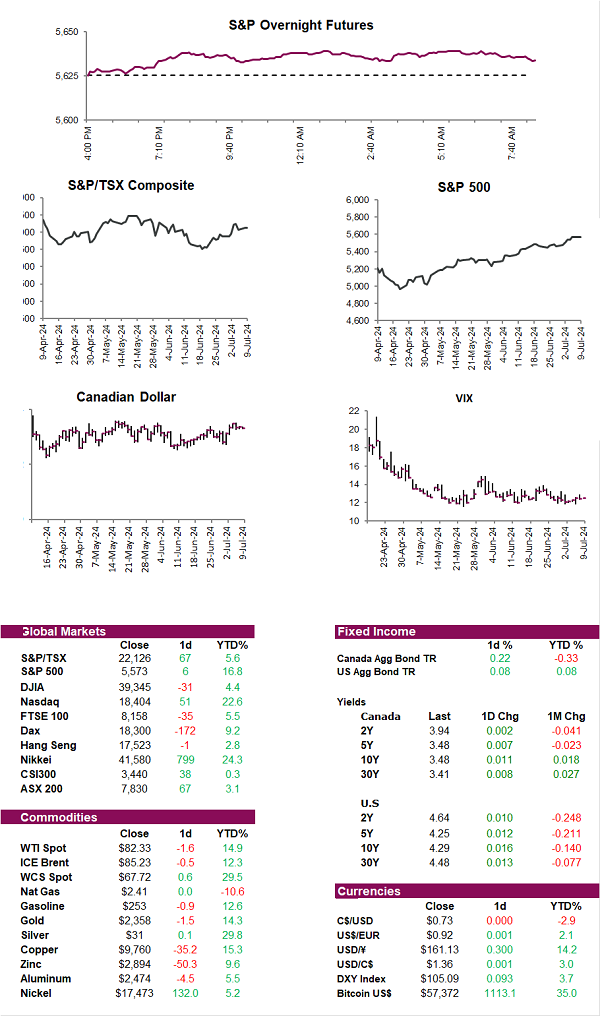
U.S. equities are poised to notch more record highs as investors await Jerome Powell's testimony to Congress for insights on interest rate policy. Futures for the TSX, Nasdaq, and S&P 500 are up, with the latter setting its 35th record this year yesterday. Markets are anticipating a roughly 70% chance of two rate cuts this year, with the first likely in September. Additionally, Powell will face questions about plans to require Wall Street banks to increase capital reserves, a move that could potentially save the largest banks billions of dollars. European stocks on the other hand have declined amid concerns over French government spending following a recent election. 

Q2 earnings season is set to begin on Friday, with Citigroup, JPMorgan, and Wells Fargo reporting their results for the quarter ending June 30, while Bank of America will follow a week later. Strategists are closely examining these reports for insights into the health of households and businesses, with particular interested in borrower performance, lender willingness, liquidity conditions, and the actions and intentions of households and businesses. Since the pandemic, these banks' earnings calls have been crucial for understanding household consumption and credit outlooks for businesses and consumers. This quarter, important topics include an update on Citigroup's private-label credit card portfolio, which faced negative guidance in April, and potential concerns about commercial real estate, especially for Wells Fargo, which has significant exposure. Analysts anticipate that several of the largest U.S. banks will report weaker profits for the second quarter due to reduced interest income and increased provisions for deteriorating loans, particularly commercial and industrial (C&I) loans and commercial real estate. 

On Sunday, the U.S. Transportation Security Administration screened over 3 million passengers in a single day for the first time, reflecting a surge in travel. This record, anticipated during the July Fourth weekend, surpassed the June 23 figure of over 2.99 million. Eight of the TSA's ten busiest days have occurred this year, with travel exceeding pre-pandemic levels. Despite ongoing inflation, travel costs, including airline tickets and hotel prices, have decreased from last year. Still, despite record summer travel demand, U.S. airlines are struggling to translate this into profits due to higher operational costs, delays in new aircraft deliveries, and increased capacity which has kept airfares low. The sector's stocks have underperformed the broader market, with the NYSE Arca Airline Index down nearly 19% this year. Airlines like Delta, United, and Alaska are faring somewhat better due to strategic advantages, but the industry faces challenges from weaker domestic pricing and shifting travel demand. Investors will get more insight into the state of the airline industry later this week when airlines report quarterly results, starting with Delta Air Lines on Thursday. 

Despite cooling inflation, consumer frustration over high prices remains intense, leading to backlash against major brands like Walmart, Wendy’s, and Chipotle for practices such as dynamic pricing and shrinkflation. Consumers are wary of deceptive pricing, including smaller product sizes and additional fees, contributing to a perception of being ripped off. Grocery prices have risen significantly since 2019, further straining budgets. In response, companies like Target and McDonald’s are increasing promotions and value offerings to attract shoppers and regain trust. Dynamic pricing, while controversial, is being cautiously approached, with companies emphasizing operational benefits rather than price manipulation. 

In May, U.S. consumer borrowing surged by $11.4 billion, the largest increase in three months, driven primarily by a $7 billion rise in credit card balances, according to Fed data. This spike in revolving credit comes as Americans increasingly rely on credit cards due to depleted pandemic-era savings and rising living costs. Non-revolving credit, including loans for vehicles and education, also grew by $4.3 billion. Despite this borrowing surge, consumer spending showed signs of slowing, with retail sales barely increasing in May. Household debt hit a record $17.7 trillion in early 2023, with higher interest rates on new debt. Credit card interest rates climbed to 22.76% in May, close to a historical high. Delinquency rates have risen across all debt types, although they remain below pre-pandemic levels. 

U.S. small-business confidence rose to a six-month high in June, with the NFIB's Small Business Optimism Index reaching 91.5, although it remained below the 50-year average for the 30th consecutive month due to ongoing inflation worries and high borrowing costs. A net 22% of businesses plan to increase worker compensation in the next three months, up from May, despite 37% reporting unfilled job openings. The labour market remains tight in construction, transportation, and retail, but overall job creation plans are stable. Higher borrowing costs are limiting capital expenditure, with only 52% of small businesses reporting capital outlays in the past six months, the lowest since August 2022. Adding to this, 27% of businesses plan on raising selling prices in the coming months. 

Talk about taking inflation seriously…. In Myanmar, the owner of three mobile phone shops in Mandalay was arrested by the military regime for giving his employees a raise amid soaring inflation and a plunging currency. The man, along with at least nine other business owners, faces charges of inciting public unrest under a law often used to suppress dissent, potentially leading to three years in prison. This crackdown comes as Myanmar struggles with severe economic crisis post-2021 coup, widespread unrest, and battles with ethnic rebels and pro-democracy fighters. The mismanagement has led to inflation, currency devaluation, and widespread poverty, exacerbated by Western sanctions and disrupted trade. The regime's focus on military spending, at the expense of health and education, and measures like price freezes and currency restrictions have done little to alleviate the economic hardship faced by ordinary citizens. 


Diversion: It’s that bad huh? 

The
Tactical model 
(% equity weight)

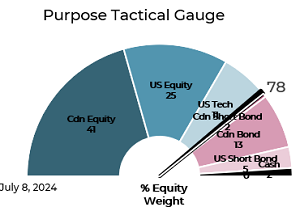
Our tactical fund is designed to complement your existing holdings to minimize portfolio volatility. To learn more, please click here.
 
 
The latest
Market Ethos 


Second half challenges ahead - NEW
Déjà vu 
Is inflation beat? Not so fast​ 
Everything in moderation 

Sign up for the Market Ethos mailing list.
 

Company news

Maple Leaf Foods announced it will spin off its pork business and split into two independent public companies. Maple Leaf Foods will retain a 19.9% ownership position in the yet-to-be named new pork division and the two companies will have an evergreen pork supply agreement. The board approved the separation, which is expected to be completed next year. The pork company will be led by Dennis Organ, who joined Maple Leaf Foods in February 2023 as president, pork complex. Maple Leaf Foods will continue to be led by CEO and President Curtis Frank. Adam Grogan will remain as COO and David Smales as CFO. 

BP Plc shares dropped in early trading after it warned of “significantly lower” refining margins and predicted a writedown on the value of a plant in Germany of $1 billion to $2 billion. Lower profits from making fuels such as diesel and higher levels of maintenance will have an adverse impact on BP’s second-quarter earnings from oil products of $500 million to $700 million. BP’s post-tax impairment charge relates to the review of the Gelsenkirchen refinery in Germany, which was announced earlier this year. The company plans to scale back its refining operations in the country due to high costs and declining demand for fuels. The Gelsenkirchen complex will become the second German plant to reduce crude consumption starting 2025, with Shell Plc working on a similar move at a nearby facility. The UK’s Grangemouth site is also set to close, while other facilities such as TotalEnergies SE’s Grandpuits are moving toward biofuels and plastics recycling. 

Corning shares are getting a boost after the specialty glass maker raised its second-quarter sales and profit guidance after a strong performance for its new optical connectivity products for Generative AI. Corning makes glass for big-screen TVs, mobile phones and optical fiber and believes the first quarter will be the lowest one for all of 2024. Corning is now expecting sales of about $3.6 billion for the quarter, up from prior guidance of $3.4 billion. The outlook for all its markets is position and its market positions are strong, said the company.  


Commodities

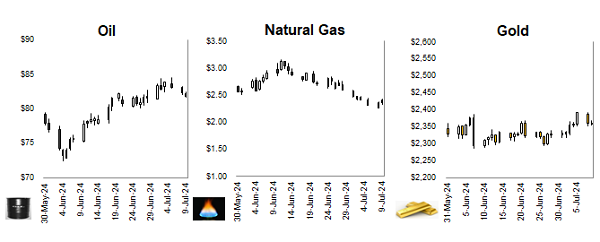
Oil prices are lower as the U.S. crude hub of Houston moved past the worst of storm Beryl, and traders looked ahead to Federal Reserve Chair Jerome Powell’s two-day testimony on monetary policy. As storm Beryl continued its path through the US mainland, recovery efforts were in progress in Texas, with some infrastructure, such as the Port of Houston and the Explorer Pipeline, remaining offline. About 85% of Houston lost power. Forecasts for higher fuel consumption throughout the northern hemisphere’s summer have been supportive of prices, although slumping supertanker earnings are a reminder of ongoing concerns about Chinese consumption. Clues on the state of the market will come later today with the release of the Energy Information Administration’s Short-Term Energy Outlook. 

Soybeans extended a drop to the lowest since 2020 in Chicago as rains from storm Beryl are seen benefiting US crops. Forecasts for strong rains come as US farmers are on course to reap a bumper harvest, which has helped push prices down about 13% since mid-May. Data released Monday showed 68% of US soy crops were in good-to-excellent condition as of July 7, up from 51% a year earlier. 


Fixed income and economics

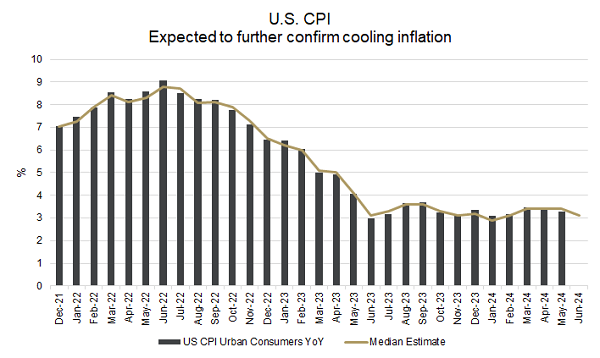
U.S. consumers' near-term inflation expectations declined in June for the second consecutive month, with expectations for price increases over the next year dropping to 3% from 3.2% in May, according to a Federal Reserve Bank of New York survey. This marks a return to the levels seen from December to April before a spike in May. The survey aligns with recent data showing a deceleration in inflation, with the core consumer price index expected to show modest gains. Consumers also lowered their expectations for home price increases to 3%, matching the 12-month average, and foresee slower rises in costs for gas, food, medical care, and rent. However, the three-year inflation outlook slightly increased to 2.9%, while the five-year expectation decreased to 2.8%. 

The Bank of Japan is holding meetings to give participants in the market a chance to convey their views as it assesses how quickly it can reduce its huge footprint in the bond market ahead of the unveiling of its plans for the next one to two years on July 31. And participants are not being quiet. Japan’s largest banks are calling on the Bank of Japan to make deep cuts to its monthly bond purchases during hearings of market participants at the central bank. One megabank said the BOJ should move early to make sharp cuts to its bond buying, while another major bank recommended an eventual reduction to monthly purchases of ¥1 trillion ($6.2 billion). A third megabank said the buying should be halved from the current monthly level to ¥3 trillion yen, the people added. However, regional banks’ views differed and stated that the scale of bond reductions were more cautious. The comments come as the BOJ looks to finalize its plans for reducing its purchases of Japanese government debt as it normalizes policy after more than a decade of massive stimulus. 


Chart of the day


Markets

Quote of the day
 

Don’t be intimidated by what you don’t know. That can be your greatest strength and ensure that you do things differently from everyone else.

Sara Blakely

Contributors: A. Innis, A. Nguyen, P. Kwon

Charts are sourced to Bloomberg unless otherwise noted.

The opinions expressed in this report are the opinions of the author and readers should not assume they reflect the opinions or recommendations of Richardson Wealth Limited or its affiliates. Assumptions, opinions and estimates constitute the author's judgment as of the date of this material and are subject to change without notice. We do not warrant the completeness or accuracy of this material, and it should not be relied upon as such. Before acting on any recommendation, you should consider whether it is suitable for your particular circumstances and, if necessary, seek professional advice. Past performance is not indicative of future results. Richardson Wealth Limited, Member Canadian Investor Protection Fund. Richardson Wealth is a trademark of James Richardson & Sons, Limited used under license.

Address: 100 Queens Quay East, Suite 2500 Toronto ON M5E 1Y3 Canada