Daily market commentary
The Launch Pad |
|
|
|
 |
| | |
|
Today
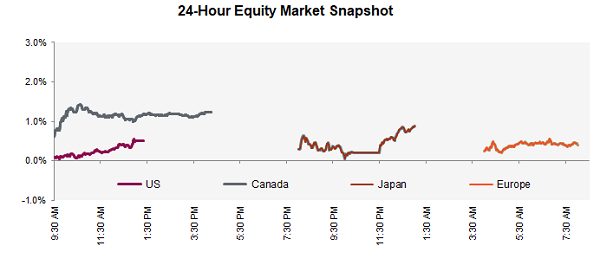
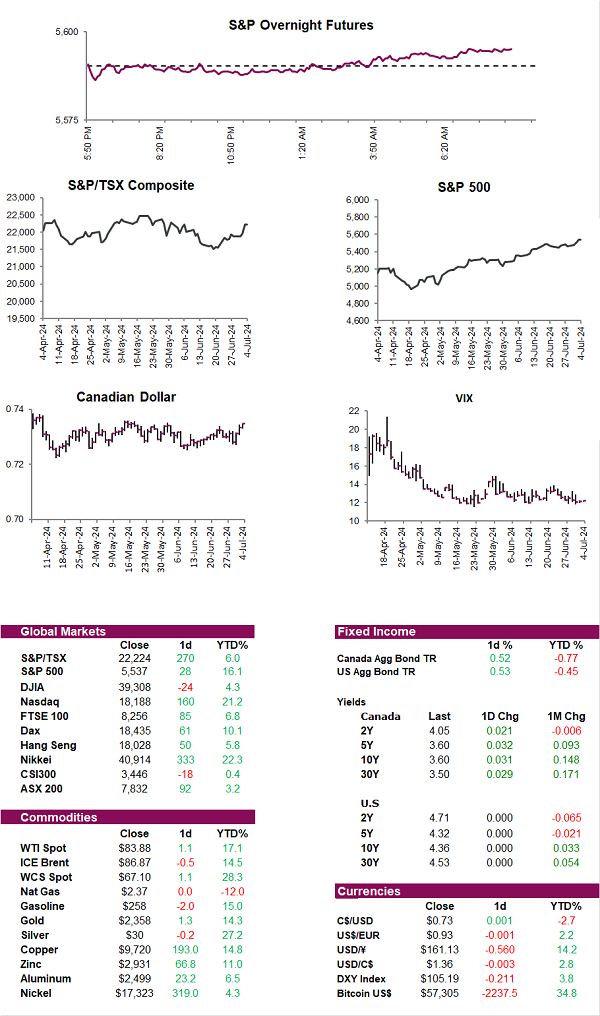
Overseas markets are mostly higher in what should be a quiet day of trading with U.S. markets closed. However, key elections are taking center stage. France’s CAC40 gained ahead of the final round of snap parliamentary elections, while the UK voted in its general election, with exit polls expected soon. The UK election today will pit the incumbent Conservative Party, led by Prime Minister Rishi Sunak, against the Labour Party, led by Keir Starmer, in a race where polls predict a historic Labour victory despite requiring a significant vote swing. Sunak's surprise early call for the election aims to capitalize on recent economic improvements, but the outcome remains uncertain with over 100 seats too close to call. Key campaign issues include housing, the NHS, and defense, with the results expected tomorrow morning. This morning’s moves follow another positive day for markets which saw the S&P 500 climb above 5,530 while the Nasdaq surged by 156 points in the shortened trading day ahead of the July 4th holiday, with both indexes setting new record highs.
Fed officials were divided on how long to keep interest rates elevated and awaited further evidence of cooling inflation at their June policy meeting. Minutes from the meeting showed a consensus that it wouldn't be appropriate to lower borrowing costs until inflation is on a clear path to the 2% goal. The Fed has maintained its key policy rate at 5.25%-5.5%, the highest in over two decades. Officials reduced the number of expected rate cuts this year, with varying opinions on 2024 cuts. Some officials emphasized patience, while others were ready to raise rates if inflation persisted. Recent data indicated a small improvements in underlying inflation, but Fed Chair Jerome Powell stressed the need for more evidence before reducing rates. Concerns about the labour market were noted, with potential further weakening possibly leading to higher unemployment. There was also debate on whether the long-run neutral interest rate might be higher than previously thought, suggesting current policies may be less restrictive than they appear.
In June, the U.S. services sector contracted at the fastest pace in four years, with the ISM composite gauge falling to 48.8, driven by sharp declines in business activity and new orders. This marked a significant reversal from the previous month's performance. Despite this, the S&P Global services index indicated expansion, rising to 55.3. The ISM report highlighted pressures from high borrowing costs, reduced business investment, and uneven consumer spending. Employment in the services sector continued to shrink, and inventories fell rapidly, while prices for materials showed signs of cooling inflation. Industry respondents reported mixed sentiments, with some stabilization in costs but ongoing concerns about inflation and economic conditions.
Canada recorded a goods trade deficit of $1.9 billion in May, marking the third consecutive month of deficits, the longest streak in nearly a year. This widened from $1.3 billion in April, surpassing economists' expectations of $1.3 billion. Total exports fell by 2.6%, the lowest level since July 2023, while imports decreased by 1.6%. The decline in exports was led by unwrought gold, crude oil, and propane, while the drop in imports was driven by unwrought gold, passenger cars, light trucks, and crude oil shipments. Notably, eight out of eleven product groups saw decreases in exports, indicating a broad-based decline.
Toronto home sales rose 4.2% in June from May, marking the first increase since January, following the BoC's first interest-rate cut in over four years. Despite this uptick, sales remained 16.4% lower than the same month last year. New listings increased by 12.3%, contributing to a 4.6% annual decline in benchmark home prices, which still edged up 0.4% monthly to $1.09 million. The rate cut provided some relief but it appears that many buyers are waiting for further reductions before re-entering the market. The real estate market in Vancouver is also not looking great compared to where it was a year ago. Greater Vancouver's real estate market saw a 19.1% drop in home sales in June compared to the previous year, with 2,418 homes sold, 23.6% below the 10-year seasonal average. The number of homes listed for sale increased by 42% y/y to 14,182, about one-fifth higher than the 10-year seasonal average. The composite benchmark home price was $1,207,100, up 0.5% from a year ago but down 0.4% from May.
Chinese manufacturing PMIs showed mixed signals in June, with the Caixin PMI slightly increasing to 51.8, indicating expansion, while the NBS measure remained unchanged at 49.5, indicating contraction. The divergence is attributed to different methodologies: Caixin surveys includes smaller, export-oriented firms, whereas NBS includes a broader range of companies, such as large state-owned enterprises. The Caixin PMI has been bolstered by global manufacturing activity, but is expected to decline towards the NBS measure due to stagnant global import volumes and a potential U.S. recession. Weak external demand, ongoing trade tensions, and domestic challenges such as property market issues and low private sector sentiment are expected to limit China's export growth and domestic-driven growth.
Revenge travel still? Despite high fuel costs and the threat of a hurricane, a record number of Americans are expected to travel today, with experts forecasting nearly 71 million travelers. Around 60 million will drive, 6 million will fly, and approximately 4.6 million will use buses, trains, or cruises. This significant travel activity is reminiscent of pre-pandemic levels and is viewed as a key indicator of consumer sentiment. Although fuel prices remain elevated compared to historical levels, they have stabilized in recent months, mitigating consumer concerns. Additionally, gasoline, diesel, and jet fuel inventories are well-stocked, reducing the risk of sudden price hikes. Despite Hurricane Beryl's impact on the Caribbean, it is expected to weaken before reaching Mexico's Yucatan Peninsula, leaving U.S. vacation travel plans largely unaffected.
Diversion: Let's hope they learned their lesson this year...
|
|
|
(% equity weight)
Our tactical fund is designed to complement your existing holdings to minimize portfolio volatility. To learn more, please click here.
|
|
|
| |
|
|
Company news
Air Canada is hitting the headlines, and not for flight disruptions. Short sellers are targeting the airline company as investors expect rising operational costs and weaker post-pandemic consumer demand to weigh on growth. Air Canada’s short interest as a percentage of float (a metric that measures how many traders sold shares compared to the total amount of stock available to trade) is at nearly 19% in early July, according to financial data firm S3 Partners LLC. This is more than double the 7.4% rate a year earlier, signaling that investors expect shares to come under further pressure as Canadians allocate more of their pay to cover higher costs of living. It’s also the highest rate recorded since December 2021 when additional COVID-19 travel restrictions were imposed, sending the rate to nearly 21%.
Ford Motor’s biggest moneymaker, the F-Series pickup truck, sales dropped in the second quarter as the automaker slowly rolls out a redesign of its top-selling model to avoid quality problems and recalls. Sales of the F-Series declined 6.1% in the April-to-June period and are down 8% this year. It was the model’s third straight quarterly decline. Ford held about 60,000 redesigned F-150s in the first quarter for extra quality checks, which Chief Executive Officer Jim Farley said helped the new truck avoid 12 recalls. The F-Series has a huge influence over Ford’s overall sales, with the nearly 200,000 trucks it sold in the second quarter accounting for 37% of the automaker’s total vehicle deliveries. Ford’s overall sales rose 1% in the second quarter.
Amazon’s executive chair Jeff Bezos has disclosed a plan to sell 25 million additional shares of Amazon.com Inc. worth $5 billion on the day the stock hit a fresh record. The notice was filed after the market closed Tuesday, though sales could also take place as early as that day, according to the filing. Filings also show that Bezos sold shares worth about $8.5 billion over nine trading days in February — the first time he disposed of company stock since 2021. Bezos would still hold nearly 912 million shares, or about 8.8% of Amazon, following the latest sale.
|
|
|
|
Commodities
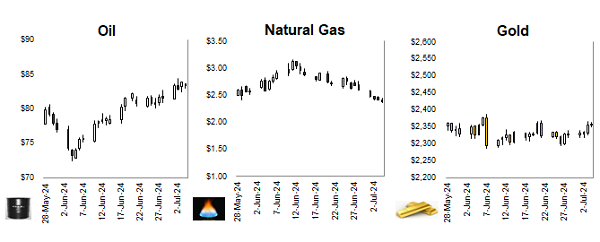
Oil prices are lower coming off two-month highs as traders assessed lower U.S. crude inventory data and the severity of Hurricane Beryl. Trading volumes are likely to be thin today due to a U.S. holiday. Data showed U.S. crude inventories dropped by more than 12 million barrels last week, the most in almost a year, to the lowest since March. Hurricane Beryl is disrupting US oil output, with companies including Shell Plc, BP Plc and Exxon Mobil Corp. evacuating some of their platforms in the Gulf of Mexico. Around 73,000 bpd of federal offshore oil production is within the projected path of the storm. Crude has risen more than 10% since early June on OPEC+ supply constraints, expectations for higher summer demand, geopolitical risks and bullishness in equity markets. Gains have been pared by concerns about demand in China, the world’s biggest crude importer, which has seen muted buying activity.
Iron ore prices are hitting the highest levels in a month as traders bet on a modest improvement for China’s steel market. Futures in Singapore rose the previous four trading days and are up more than 6% this week due a tick-up in demand and hopes for a stimulus boost at a major Chinese political gathering — known as the Third Plenum. Iron ore has rebounded from below $100 a ton in May, after the government unveiled a rescue package for the key property sector. However, real estate prospects are still murky and attention is focused on what policies emerge from the Third Plenum in mid-July, where China’s Communist Party elite will flesh out long-term goals. A note from Chaos Ternary Research Institute reported that mills still have appetite for iron ore with their furnace run-rates at high levels and there has been a recent rebound in steel demand, and expectations for China’s economy are improving ahead of the July meeting.
|
|
|
|
Fixed income and economics
The Japanese yen reached a new 38-year low against the U.S. dollar and a record low against the euro yesterday, as market participants anticipated potential intervention from Japan to support the currency. Concurrently, the U.S. dollar weakened due to softer-than-expected U.S. economic data, raising expectations for Fed rate cuts later this year. U.S. private payrolls and jobless claims indicated slowing labour market momentum, while a contraction in the U.S. services sector further pressured the dollar. The euro remained resilient, buoyed by high inflation data suggesting the European Central Bank would delay rate cuts. The yen's decline continued ahead of the July 4th holiday in the U.S., with Japanese authorities remaining vigilant but largely silent on immediate intervention plans.
The ECB and the European Banking Authority (EBA) are collaborating on a proposal to simplify the reporting requirements for significant risk transfers, a type of credit insurance that could help banks increase their lending capacity. This initiative aims to remove obstacles for banks in offloading risk, thus unlocking more capital for lending, which is crucial for meeting the EU's significant investment needs in defense and green transitions. Major banks like Deutsche Bank, Nordea Bank, and Banco Santander already use SRTs to transfer credit default risks to investors through synthetic securitization. This process involves bundling and selling the highest-risk tranches of loan portfolios to investors, thereby reducing the banks' required capital reserves and freeing up equity for new loans or shareholder payouts. The proposal, part of a broader EU effort to revive the asset-backed debt market, is expected to be presented to the European Commission later this year.
|
|
|
|
Quote of the day
 |
The triumph can't be had without the struggle.
Wilma Glodean Rudolph
|  |
|
|
Contributors: A. Innis, A. Nguyen, P. Kwon
|
|
|
Charts are sourced to Bloomberg unless otherwise noted.
The opinions expressed in this report are the opinions of the author and readers should not assume they reflect the opinions or recommendations of Richardson Wealth Limited or its affiliates. Assumptions, opinions and estimates constitute the author's judgment as of the date of this material and are subject to change without notice. We do not warrant the completeness or accuracy of this material, and it should not be relied upon as such. Before acting on any recommendation, you should consider whether it is suitable for your particular circumstances and, if necessary, seek professional advice. Past performance is not indicative of future results. Richardson Wealth Limited, Member Canadian Investor Protection Fund. Richardson Wealth is a trademark of James Richardson & Sons, Limited used under license.
|
|
| Address: 100 Queens Quay East, Suite 2500 Toronto ON M5E 1Y3 Canada
|
|
|
|
|