Today
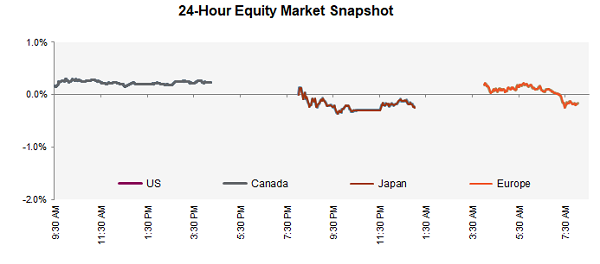
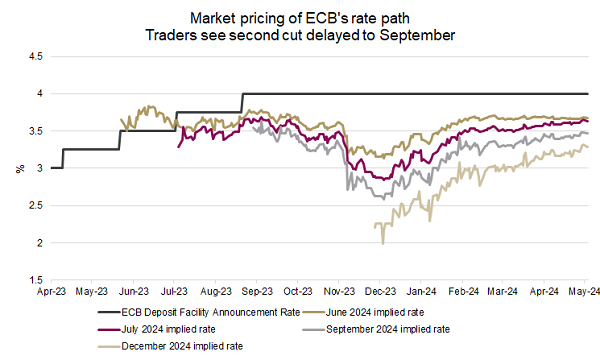
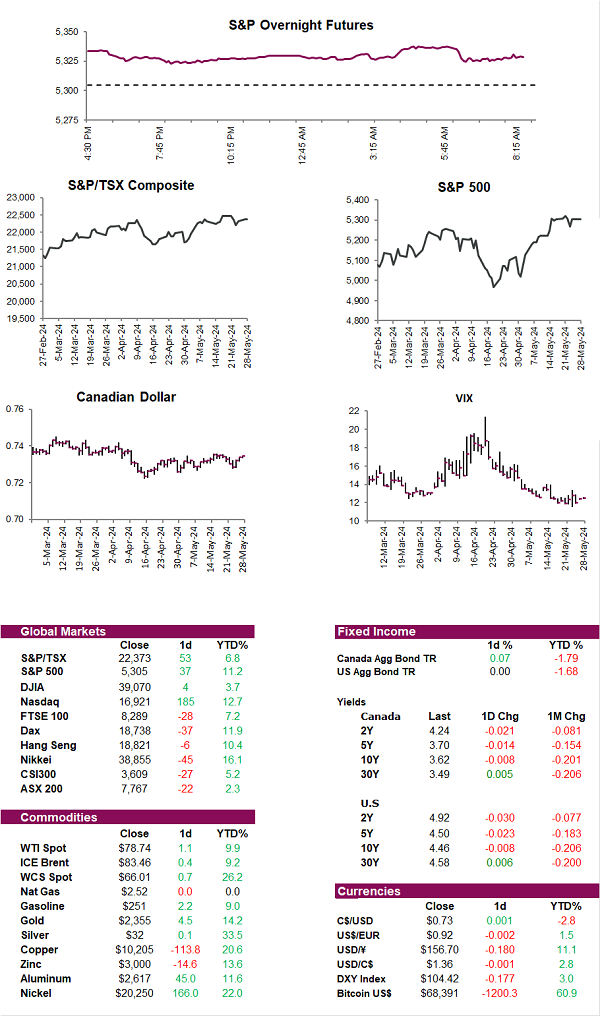
Futures are mixed this morning, with markets awaiting the latest U.S. inflation prints and central bank speakers for hints on the timing of interest-rate cuts. Earlier this month, softer inflation data suggested Fed rate cuts could come earlier than investors had anticipated, although those hopes were quickly challenged after economic data and Fed comments pointed to the contrary. Even with mixed opinions on where rates are going, the S&P 500 and TSX are looking to close higher and even recover losses from April’s slump. In a busy week for data, traders are concentrating on the PCE deflator, the Fed’s preferred gauge of inflation, on Friday.
Volatility across various markets, including stocks, bonds, oil, and forex, has fallen to its lowest level since 2020, with the VIX Index recently touching a near five-year low. Factors contributing to this decline include the market's ability to absorb risk events such as inflation data and corporate earnings with minimal disruption, and high demand for options selling which further suppresses volatility. The proliferation of derivatives income funds continues to push volatility downward. As the summer holidays and the end of the earnings season approach, along with expectations of Fed rate cuts later in the year, there appears to be little impetus for market volatility to rise in the near term. The one thing that does appear to have the potential to alter this low-volatility environment (in the minds of some investors) is the upcoming elections in the U.S. and India. For a deeper dive into the recent market volatility (or lack thereof), the Market Ethos (out later today) will focus on it.
China, Japan, and South Korea have begun their first trilateral summit since 2019 in Seoul, emphasizing cooperation amid growing pressures from their closer ties with the US. Chinese Premier Li Qiang, Japanese Prime Minister Fumio Kishida, and South Korean President Yoon Suk Yeol discussed economic, trade, and regional security issues. The summit comes as Japan and South Korea, having improved bilateral ties, aligning more closely with U.S. strategies on security and semiconductor production, and challenging China's stance. Beijing aims to deter Japan and South Korea from joining U.S.-led restrictions on advanced chip technology exports. The meeting, covering six cooperation areas, will also address North Korea's nuclear ambitions and security concerns in the Taiwan Strait. Despite potential economic collaborations, significant divergences on security issues persist.
Investors in Canada are increasingly betting on a June or July rate cut by the BoC, which is just what the country's bank stocks may have needed. The S&P/TSX Banks index has lagged the broader S&P/TSX Composite due to concerns about high interest rates, mortgage renewals, and rising loan losses. However, optimism has grown after a cooler-than-expected inflation report in May increased the likelihood of a rate cut to 65%. Interest rate cuts are expected to positively impact the Canadian economy and banks' profitability by lowering funding costs and easing economic pressures although some caution that the potential benefits may already be priced in.
The real estate sector isn’t the only thing China is trying to prop up. China has launched its largest semiconductor investment fund, amassing $47.5 billion to bolster its domestic chip industry amid escalating tensions with the U.S. The third phase of the National Integrated Circuit Industry Investment Fund, known as Big Fund III, includes contributions from the central government and state-owned enterprises like the Industrial & Commercial Bank of China. This move is part of President Xi Jinping's broader strategy to achieve technological self-sufficiency as the U.S. imposes strict export controls on advanced chips and chipmaking equipment. Despite past setbacks and corruption issues, China aims to use this substantial investment to support its semiconductor giants like SMIC and counteract U.S. restrictions. The fund also highlights China’s ongoing commitment to its Made in China 2025 initiative, targeting breakthroughs in advanced chip development and manufacturing.
For those interested in getting into the weeds of behind-the-scenes operational activity, the Canadian Securities Administrators (CSA) announced the shorter settlement cycle for equity and debt securities officially took effect yesterday. As of May 27, the new settlement cycle, or days it takes for a securities trade to “settle” (securities and cash exchange hands) will be T+1, cut in half from the previous settlement cycle of T+2. This aligns Canadian securities trading with the industry’s move to shorten the settlement time to improve operational efficiencies and potentially reduce operational risk. Back in the 1990’s, the settlement window was trade date plus five (T+5), then moved to T+3, then T+2 in 2017. The U.S. officially adopts the T+1 settlement cycle today, March 28 one day after Canada’s adoption.
After all these years, Dennis the Menace has finally been apprehended. An 81-year-old man, Prince King, known as a “serial slingshot shooter,” was arrested after a decade-long spree of vandalism in his neighborhood. King had been using a slingshot to strike residential windows, dent car windshields, and narrowly miss people. The local police department began investigating after multiple residents reported these incidents, which had occurred over 9-10 years. During a search of King’s residence, police found ball bearings and a slingshot. No injuries were reported, but the motive behind the vandalism remains unclear. King was booked into the Los Angeles County Jail without bail and is set to appear in court on Tuesday. The public’s faith in the police department has also been restored, after it only took them 10 years to find the suspect.
Diversion: That’s why we have engineers.