Daily market commentary
The Launch Pad |
|
|
|
 |
| | |
|
Today
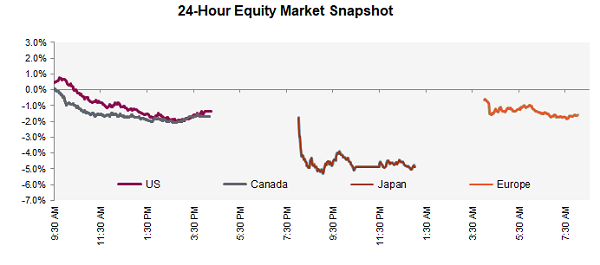
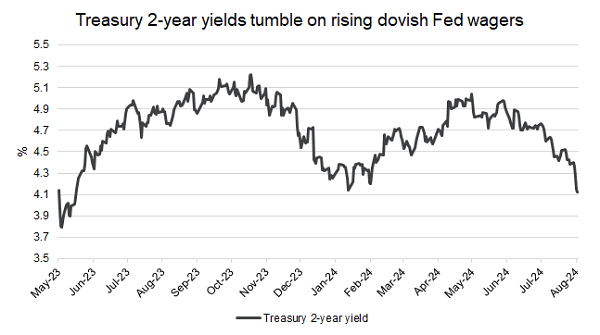
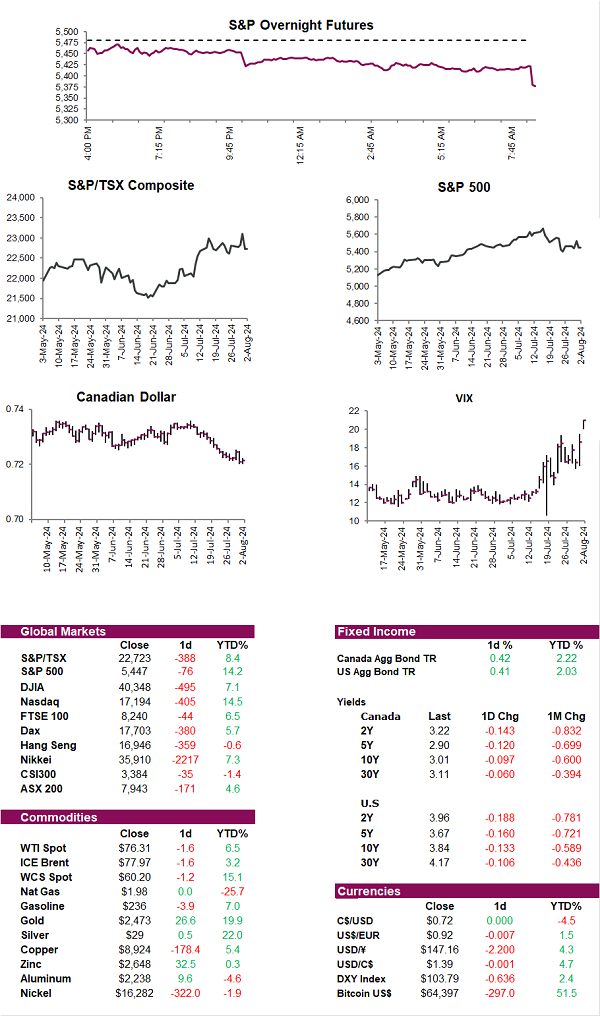
The recent selloff in stocks deepened this morning after a weak jobs report fueled worries the Fed has been too slow to cut interest rates. Disappointing tech earnings have also been adding fuel to the equity rout. Job growth in the U.S. slowed more than expected during July, with nonfarm payrolls growing by just 114,000 for the month, down from the downwardly revised 179,000 in June and below the 185,000 estimates. Adding to this, the unemployment rate ticked higher to 4.3%, its highest since October 2021. The weak jobs report boosts the chances of a Fed cut next month, with the main data points now indicating that the job market may have turned. U.S. Treasuries extended its rally for another day with the two-year yield (which is most sensitive to policy changes) dropping to a 14-month low with rate markets now aggressively pricing in three possible cuts by the end of the year. This comes on the heels of the Fed holding rates steady this week, while leaving the gates open for a September cut, and data that showed increasing jobless claims and weaker manufacturing. More in fixed income below.
The latest Labor Department data shows new unemployment claims in the U.S. reaching an 11-month high, suggesting a potential softening of the labour market, though such claims are often volatile at this time of year. Initial claims rose to 249,000 for the week ending July 27, surpassing expectations, with part of the rise attributed to temporary factors like auto plant retooling and Hurricane Beryl. Despite this, layoffs remain low, and planned job cuts dropped significantly in July. However, the number of people receiving continued benefits increased. Speculation of a possible interest rate cut by the Fed in September grows, though strong worker productivity growth offers a positive outlook for managing inflation and economic stability.
A sudden selloff in Japan has shaken a reliable trade this year. The Topix index fell about 6% today, marking a two-day decline of over 9% following the Bank of Japan's interest rate hike and Governor Kazuo Ueda’s hawkish stance. This 2-day drop, the largest since the 2011 Fukushima disaster, erased nearly $600 billion in market value. Contributing factors include the yen's surge past the 150 mark against the dollar, macro funds shorting Japanese stocks, and volatility affecting commodity trading advisors. The decline highlights the vulnerability of Japanese assets to price swings as the economy adjusts to inflation. Exporters and real estate firms were significantly impacted, and banking stocks, which initially gained from the rate hike, also suffered heavy losses. Foreign investors sold a substantial amount of Japanese equities, exacerbating the market's downturn. Concerns over the U.S. and Chinese economies further fueled the bearish sentiment, leading to a sharp decline in tech shares and a general shift in market trends.
Canadian manufacturing activity hit its weakest point this year in July, as production and new orders declined more sharply, continuing a record-setting period of contraction. The S&P Global Canada Manufacturing Purchasing Managers' Index dropped to 47.8 from June's 49.3, marking its lowest since December and its 15th consecutive month below the 50.0 threshold, indicating sector contraction. High inflation, geopolitical tensions, and shipping challenges contributed to this decline, with new export orders particularly affected, falling to 43.5, the lowest since May 2020. Despite a slight increase in employment, the future output index, reflecting sentiment, plummeted to a four-year low.
Canada’s not alone. China's manufacturing PMI fell from 49.5 to 49.4 in July, marking the third month of contraction due to weak domestic and foreign demand. The non-manufacturing PMI also dropped to 50.2, below expectations. In response, Chinese officials announced a CNY 300 billion trade-in program for durable goods and equipment, following recent rate cuts. However, with rates already low, further cuts are expected to have limited impact. Analysts note the trade-in program, representing only 0.5% of 2023's retail sales, is unlikely to significantly boost the economy, and local governments face funding challenges. If that wasn’t enough, wage growth, crucial for consumption, remains weak, and external demand is also expected to falter, particularly if the U.S.-China trade war intensifies.
A recent survey of 1,800 hiring managers in Canada reveals that about half of Canadian businesses plan to add new positions in the second half of 2024, though many are taking longer to hire. The poll indicates that 52% of companies aim to create new roles, while 41% plan to fill existing vacancies, consistent with hiring trends in the first half of the year. Despite economic caution, businesses remain confident in growth, with company expansion being the primary driver for hiring (50%), followed by employee turnover (41%) and project-based needs (39%). However, 90% of managers face challenges in finding skilled professionals, with 32% expecting longer hiring times.
A movie theater in New Zealand recently removed two women for bringing their own snacks, which eventually required police intervention. The women, who were watching "Despicable Me 4" with children, were told to put away their snacks by an employee who remained in the theatre to monitor compliance. When a child continued to eat the forbidden snacks, the situation escalated, leading to the police's arrival, although no further action was taken. The cinema's strict policy against outside food, aimed at supporting their struggling financial model, contrasts with more lenient approaches elsewhere, reigniting the debate over whether customers should be allowed to bring their own snacks. Next time, leave the forbidden snacks at home, or at a minimum, avoid eating them in front of the snack police.
Diversion: This guy really likes his shoes...and his dog.
|
|
|
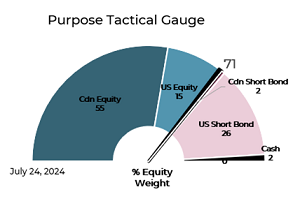
(% equity weight)
Our tactical fund is designed to complement your existing holdings to minimize portfolio volatility. To learn more, please click here.
|
|
|
| |
|
Company news
Apple beat earnings expectations despite a year-over-year decline in iPhone sales. Analysts have been closely watching Apple's performance in China, one of its most important markets. The company has fought to regain market share from homegrown rivals including Huawei, but fell short of expectations in the region. Apple saw revenue out of Greater China top out at $14.7 billion compared to analysts’ survey ed by Bloomberg were anticipating revenue of $15.2 billion. Apple reported China revenue of $15.7 billion in the same quarter last year. Overall iPhone sales hit $39.2 billion versus expectations of $38.9 billion, falling short of the $39.6 billion Apple saw in Q3 2023.
Amazon shares are under pressure after reporting third quarter sales guidance that missed analyst estimates. The company guided to a range of $154 billion to $158.5 billion in sales for the period, compared to analyst forecasts of $158.43 billion. The company's booming advertising segment, which has routinely grown by double-digit percentages, continued to show strength, but that segment too came in just below expectations, registering $12.8 billion in revenue versus the $13 billion expected. A bright spot of the report came from its cloud business, Amazon Web Services. AWS raked in $26.3 billion in revenue compared to the $26 billion expected and well above the $22.1 billion during the same time last year.
Intel shares are heading toward its biggest decline in 24 years after giving a grim growth forecast and laying out plans to slash 15,000 jobs. Intel is also suspending dividend payments to shareholders starting in the fourth quarter, and will continue that until “cash flows improve to sustainably higher levels,” according to the statement. The company has paid a dividend since 1992. The company is reducing its spending on new plants and equipment in 2024 by more than 20%, and is now budgeting between $25 billion and $27 billion. Next year, expenses will range between $20 billion and $23 billion.
Exxon Mobil Corp. beat profit expectations after the $63 billion acquisition of Pioneer Natural Resources Co. pushed oil and natural gas output to a record. The Pioneer takeover closed in early May, helping lift Exxon’s overall production by 15% on a sequential basis, and setting the stage for daily output to average more than 4 million barrels this year. Exxon’s results provide assurance to investors that the oil giant is well-placed to execute a 15% ramp-up in share buybacks to $20 billion a year even despite bearish crude-market signals. Production in Guyana and the Permian Basin reached all-time highs during the second quarter. Exxon is now the biggest producer in the Permian after closing the Pioneer transaction, its biggest deal since the historic Mobil merger in 1999.
|
|
|
|
Commodities
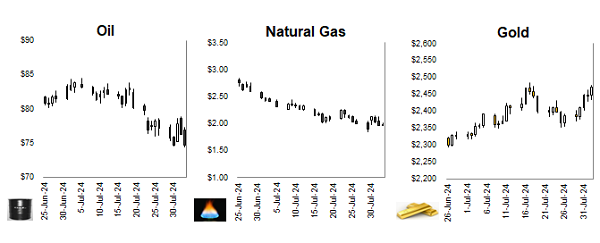
Oil prices are lower and heading for a fourth weekly decline as demand concerns in the world’s two biggest economies overshadowed heightened geopolitical risk. Factory gauges in the US and China both showed contractions this week, signaling weakness in manufacturing. Oil is set for its longest run of weekly losses since December as demand concerns linger in No. 1 importer China. At the OPEC+ meeting yesterday, the group agreed that, starting in October, they would gradually begin restoring output that was halted in late 2022 to shore up prices. About 540,000 barrels a day are due to be added over the course of the fourth quarter. However, officials did say that supply hikes can be paused or reversed as needed.
European natural gas prices settled at the highest level since December, illustrating the market’s sensitivity to supply disruptions as scorching temperatures take hold. Prices have risen more than 15% in the past week as stronger fuel consumption elsewhere in the world diverts energy supplies. Europe has received fewer LNG cargoes recently, while demand has increased in places such as Asia and Egypt, where extreme temperatures have raised air conditioning needs. Geopolitical risks int the Middle East are also playing a part, an escalation of the conflict in the energy-rich region, which is also home to buyers such as Egypt and Jordan, may tighten the global fuel market and cause sentiment to sour.
 |
|
|
|
|
Fixed income and economics
U.S. government bonds rallied as the 10-year Treasury yield fell below 4% for the first time since February, driven by data suggesting a cooling labour market. Traders are fully pricing in three quarter-point Fed rate cuts this year, with Fed Chair Jerome Powell indicating a possible cut in September if economic data supports it. Treasury debt had its best monthly performance since December, and while the unemployment rate is expected to stay above 4%, any significant increase could raise concerns. Market expectations of 200 bps of easing by the end of next year reflect concerns about potential economic headwinds with some strategists noting the need for more aggressive rate cuts.
|
|
Quote of the day
 |
Some people grow into their dreams, instead of out of them.
Lois McMaster Bujold
|  |
|
|
Contributors: A. Innis, A. Nguyen, P. Kwon
|
|
|
Charts are sourced to Bloomberg unless otherwise noted.
The opinions expressed in this report are the opinions of the author and readers should not assume they reflect the opinions or recommendations of Richardson Wealth Limited or its affiliates. Assumptions, opinions and estimates constitute the author's judgment as of the date of this material and are subject to change without notice. We do not warrant the completeness or accuracy of this material, and it should not be relied upon as such. Before acting on any recommendation, you should consider whether it is suitable for your particular circumstances and, if necessary, seek professional advice. Past performance is not indicative of future results. Richardson Wealth Limited, Member Canadian Investor Protection Fund. Richardson Wealth is a trademark of James Richardson & Sons, Limited used under license.
|
|
| Address: 100 Queens Quay East, Suite 2500 Toronto ON M5E 1Y3 Canada
|
|
|
|
|