Daily market commentary
The Launch Pad |
|
|
|
 |
| | |
|
Today
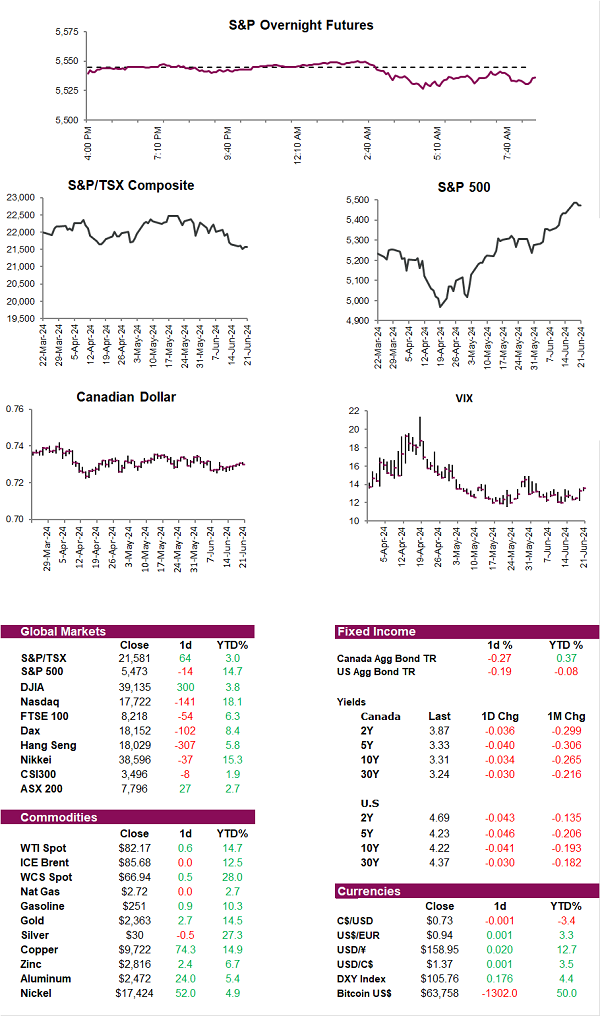
Equity futures are moving lower this morning although major averages in the U.S. are still on pace for weekly gains. Investors appear to be risk-off as the rally in AI stocks show some signs of slowing down. Today's U.S. options expiration involving about $5.5 trillion tied to indexes, stocks, and ETFs, may create some volatility in the market. The "triple-witching", where multiple options contracts expire simultaneously, prompts investors to adjust their positions, potentially causing significant market movements. The event coincides with index rebalancing and happens at a time when the implied volatility on S&P 500 options is near its lowest level since before the pandemic. While the impact of such expiries may be overstated, even minor stock gyrations might stand out against the recent market lull. Speaking of gyrations, this quarter's expiration may be significant with Nvidia's influence, highlighted by the substantial value of its expiring contracts.
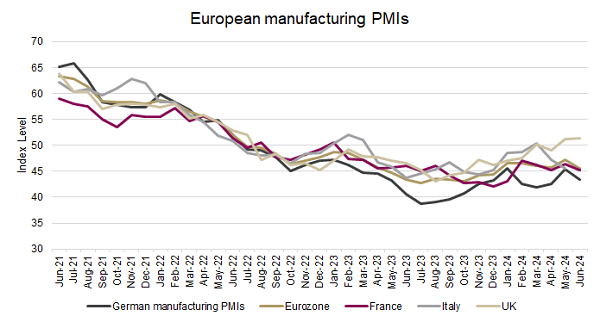
The euro-area private-sector business activity slowed unexpectedly, thanks in part to the French snap election and a significant slump in manufacturing. S&P Global’s composite PMI dropped to 50.8 in June, below expectations of 52.5. The slowdown comes despite an initial recovery from last year's technical recession, with recent data indicating a potential loss of momentum. French President Emmanuel Macron’s unexpected call for a snap election has added uncertainty, causing companies to halt new investments. The weaker-than-expected economic performance in France has impacted the broader euro-zone economy, prompting predictions of only a 0.2% GDP rise in the second quarter. These figures have led to higher speculation about future interest rate cuts by the ECB and the BOE. The market is reacting to the slowdown with German bond yields and the euro falling this morning. Despite these concerns, there is still hope that cooling inflation and potential rate cuts could create an economic rebound in the euro area.
If you’re opting for a variable rate mortgage for a new home or renewal, you’re not alone. More Canadians are choosing variable-rate mortgages to fund their homes as expectations for further interest rate cuts by the Bank of Canada rise. In the first quarter, 12.9% of borrowers chose these loans, up from a low of 4.2% in Q3 2023. This shift began even before the BoC cut its policy rate to 4.75% in June and indicated more cuts could follow. Economists predict the rate could drop to 3% by the end of 2025, which would bring the current commercial bank prime lending rate to 5.2%. The growing interest in variable-rate mortgages, despite their current higher rates, suggests a changing sentiment in the housing market, with buyers betting on future rate decreases to lower their long-term costs.
A cyberattack on CDK Global, a major software provider to over 15,000 auto dealerships, has severely disrupted the industry, affecting operations across the U.S. and Canada. The attack, which began earlier this week and was compounded by a second incident yesterday, causing significant setbacks for dealers who rely on these systems for financing, inventory management, and sales processes. Dealers are resorting to manual methods, such as handwriting contracts and estimating creditworthiness, resulting in substantial delays and business losses. The disruption has caused notable financial market reactions, with significant drops in the stocks of companies like Brookfield Business Partners and major auto dealers. Customers are also experiencing delays, underscoring the industry's vulnerability and highlighting its dependence on a few key software providers.
In a blog post on Liberty Street Economics (NY fed officials blog too), officials highlighted that non-bank financial institutions may pose a growing risk to America's big banks. During market stress, non-banks raise their demands for liquidity from large banks, potentially creating severe market disruptions and could force authorities to intervene extensively. Unlike the big banks, non-banks operate under less restrictive regimes, and the rising interconnectedness between banks and non-banks means risks are now shared across these sectors. The Fed estimates the correlation of risks between banks and non-banks rose from 65% pre-2008 to over 80% now. Commercial real estate is highlighted as a critical area of concern, with $929 billion of CRE loans maturing in 2024 amidst rising vacancies, declining valuations, and high interest rates. The Fed is emphasizing the need for comprehensive financial regulation and systemic risk monitoring that considers the relationship between banks and non-banks.
The Fed's June projections suggest current rates may be less restrictive than previously thought. The most recent dot pot shows the Fed’s outlook remains hawkish, with the FOMC median rate cut expectations of 25 bps, down from the 75 bps suggested in March. However, interest rate markets look to be in the middle predicting 50 bps in cuts, with one in September and December, due to slowing inflation and rising unemployment. The Fed uncertainty looks to be diverting from the rest of the world. Forecasts show a decline in the global central bank rate from 7.2% in Q1 2024 to 6.3% by year-end, and further to 4.8% in 2025. Advanced economies' rates may fall from 4.5% in Q1 2024 to 3.8% by year-end, while emerging markets excluding China could see a sharper decline from 14% to 12.4% by the end of 2024 and to 8.9% in 2025.
A British farmer, James Steele, 95, was reunited with his Rolex watch 50 years after it was believed to have been eaten by a cow. Steele bought the watch after his 21st birthday in 1950 but lost it about 20 years later while working on his farm in Shropshire, England. Despite searching, his only clue was a cow that might have eaten it with some grass. The watch resurfaced when Steele's son allowed treasure hunter Liam King to use a metal detector on the property. The Rolex, now with a green-tinted face and missing half its bracelet, was a surprising find for Steele, who had thought it lost forever. If Rolex is paying attention to the news cycle, they should replace Mr. Steele’s beloved Rolex. May we suggest the “Explorer”, known for its durability and “rugged” look, two qualities he would likely appreciate.
Diversion: Does your car have AC?
Me- Even better! 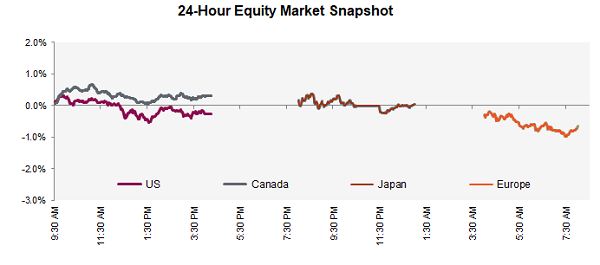 |
|
|
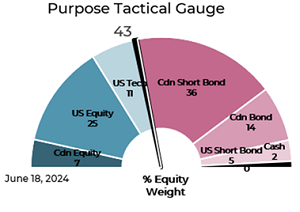
(% equity weight)
Our tactical fund is designed to complement your existing holdings to minimize portfolio volatility. To learn more, please click here.
|
|
|
| |
|
|
Company news
Vale SA plans to spend as much as $3.3 billion on improvements at its mining operations in Brazil and Canada to boost copper and nickel production capacity over the next four years. The Brazilian mining giant sees the potential to expand production capacity to about 500,000 tons of copper by 2028 mainly through improvements to its Salobo and Sossego mines in Brazil, Vale said in its latest estimates for its base metals unit. Vale produced 321,000 tons of the wiring metal last year. Nickel also gets a capacity lift. Mark Cutifani, the former Anglo American Plc boss who leads the Vale Base Metals board, presented a plan that includes billions of dollars in capital expenditure initiatives to increase productivity and reduce costs in nickel and copper mines and processing plants. There is a broad consensus that the copper market is likely to face deficits in the next few years, and the world’s biggest mining companies are all seeking to increase their production in anticipation of future price gains.
During China's annual "618" shopping festival, ecommerce giants like Alibaba, ByteDance, and PDD are offering steep discounts, celebrity endorsements, and enhanced customer service strategies to invigorate wary shoppers amidst economic uncertainties. The festival serves as a critical test of consumer sentiment and the effectiveness of aggressive marketing tactics in a volatile economy. This year's event, marked by intense competition, aims to revive the ecommerce sector's pre-2020 growth. Despite efforts including no-questions-asked returns and price-matching guarantees, overall sales across platforms fell by 7% compared to the previous year, highlighting the challenges of maintaining profitability.
|
|
|
|
Commodities
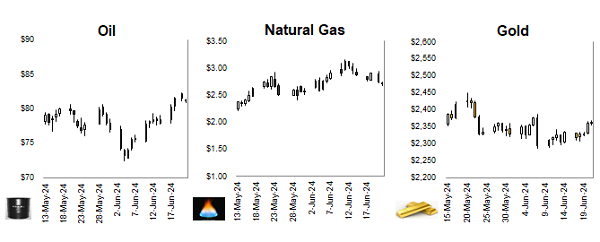
Oil prices are little changed this morning and but heading for a second consecutive weekly gain following a decrease in U.S. inventories. Data showed that U.S. crude stockpiles fell by 2.2 million barrels, while inventories of gasoline and diesel-type fuel also declined. Oil has risen from early June, when the Saudi energy minister reiterated that OPEC+’s recent deal retains the option to pause or reverse production changes. Banks including Goldman Sachs Group Inc., ING Groep NV and Citigroup Inc. have flagged market deficits. A key metric for Brent futures is now flashing signs of strength, with the prompt spread near the widest backwardation since April.
Soybeans held near the lowest level in more than three years as lackluster feed demand in top importer China weighed on the outlook. China’s industrial feed production, which is typically made up of crushed soybeans, fell 7.5% in May from a year ago as the nation’s massive pig herd shrunk, according to data earlier this week. Futures are also on track for a fourth weekly decline, the longest run of losses since late February. Earlier this month, the US increased its 2024-25 outlook for American soybean inventories, in part due to weaker crushing, while slightly trimming its estimate for global stockpiles. That’s contributed to lower prices in June.
 |
|
|
|
Fixed income and economics
The yen is facing its longest losing streak since March and is nearing a 34-year low, prompting concerns that Japanese officials may need to intervene to support the currency. Yesterday the yen fell for the sixth consecutive session, approaching 160 per dollar, a level that previously triggered intervention. The yen's decline is driven by a significant yield gap between Japan and other major economies, uncertainty about the Bank of Japan's policy normalization, and falling Chinese bond yields affecting other Asian currencies. While the Ministry of Finance is prepared to intervene if movements are seen as excessive or speculative, officials have recently shown reluctance, suggesting they might be accepting the yen's continued weakness due to the persistent yield differential and the Fed's cautious approach to rate cuts.
The municipal bond market in the U.S. has set a new record with 27 mega-deals, each worth $1 billion or more, driven by declining borrowing costs as inflation eases. Top-rated borrowers are now enjoying lower borrowing costs, around 2.80% for 10-year bonds, down from 3.09% in May. This surge follows a drop in municipal supply over the past years, partly due to pandemic aid allowing issuers to delay debt issuance. The current uptick is attributed to pent-up infrastructure demands and moderated inflation in construction costs. Analysts predict that if the Fed avoids triggering a recession and rates continue to fall, the trend of increasing muni bond sales will continue, supported by both new capital projects and refinancing opportunities. This year, states and localities have already sold $221.4 billion in long-term debt, significantly outpacing last year's rate.
|
|
|
|
Quote of the day
 |
The first problem for all of us, men and women, is not to learn, but to unlearn
Gloria Steinem
|  |
|
|
Contributors: A. Innis, A. Nguyen, P. Kwon
|
|
|
Charts are sourced to Bloomberg unless otherwise noted.
The opinions expressed in this report are the opinions of the author and readers should not assume they reflect the opinions or recommendations of Richardson Wealth Limited or its affiliates. Assumptions, opinions and estimates constitute the author's judgment as of the date of this material and are subject to change without notice. We do not warrant the completeness or accuracy of this material, and it should not be relied upon as such. Before acting on any recommendation, you should consider whether it is suitable for your particular circumstances and, if necessary, seek professional advice. Past performance is not indicative of future results. Richardson Wealth Limited, Member Canadian Investor Protection Fund. Richardson Wealth is a trademark of James Richardson & Sons, Limited used under license.
|
|
| Address: 100 Queens Quay East, Suite 2500 Toronto ON M5E 1Y3 Canada
|
|
|
|
|