Daily market commentary
The Launch Pad |
|
|
|
 |
| | |
|
Today
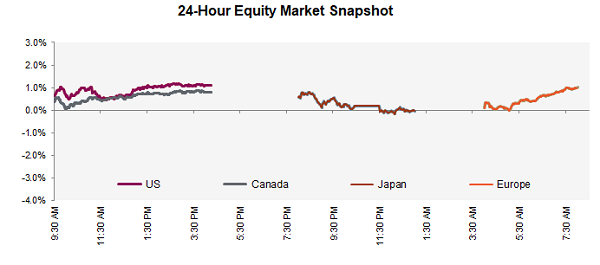
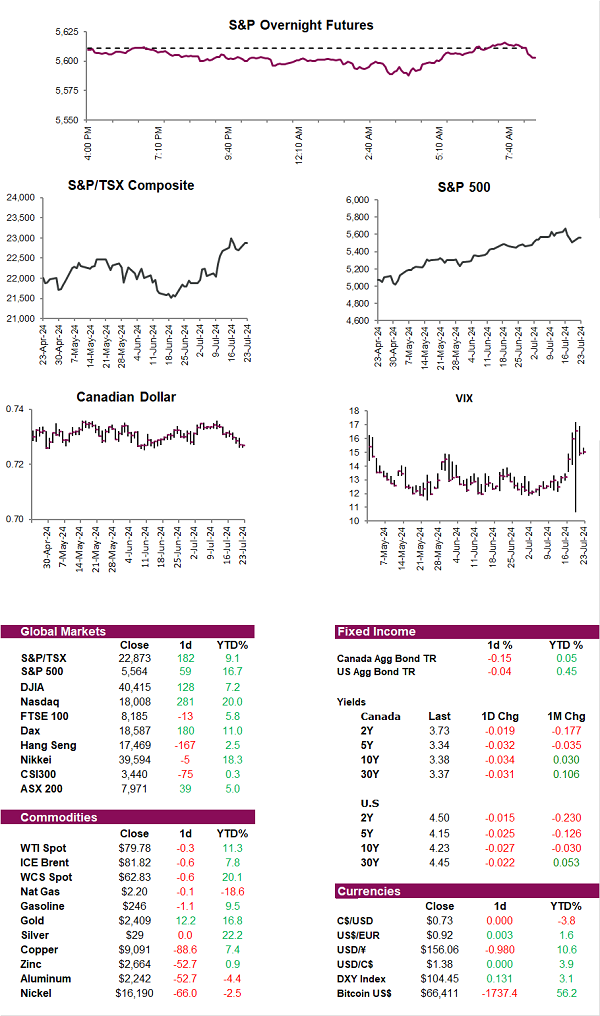
Stock futures are little changed this morning, with investors’ focus swinging from U.S. politics to tech. Major tech companies start reporting their quarterly results today with Alphabet and Tesla kicking off after the bell, followed by Microsoft, Meta, Apple, and Amazon next week. Last week, the Nasdaq had its worst weekly performance in three months, declining –3.7%. By yesterday, the index rallied and was up 1.58% as investors looked past Biden’s end to his re-election campaign and focused their attention on the upcoming tech earnings season. Lofty valuations, seasonal weakness, and political uncertainties have left some investors weary, but apparently not weary enough after yesterday’s broader market rally as dip buyers made their way back in. With investors still on edge after last week’s tech route, investors will be looking for more evidence that businesses are on track and the excitement around AI is justified.
BOJ officials are grappling with whether to raise interest rates at their upcoming policy meeting due to weak consumer spending. Some officials favour postponing a rate hike to allow more time for data assessment, aiming to avoid appearing overly hawkish. Other officials argue for a rate increase, citing inflation forecasts and the risk of missing a timely opportunity amid uncertainties. The yen weakened following reports of the opposing views. The BOJ is also expected to announce plans for reducing bond purchases, which is anticipated to be gradual, cutting monthly purchases from ¥6 trillion to ¥3 trillion over two years, and is expected to cut its growth projection to around 0.5%, down from 0.8%. This comes after the Japanese government cut its own growth forecast for the current fiscal year ending March 2025 to 0.9%, down from 1.3% projected in January.
To help fund Canada’s budget, Canadian businesses are facing higher taxes that may deter firms from expanding production, potentially causing longer-term economic issues. While the government believes these measures are about fairness and necessary for funding priorities like housing, critics warn they could exacerbate Canada’s productivity crisis. A Bank of Canada business outlook survey showed increased business anxiety over taxes. Since 2014, the capital stock of machinery and equipment has declined, and businesses are investing less in new capacity. This contrasts sharply with the U.S., where significant investment is being driven by recent legislative acts. The feds are highlighting Canada's tax advantages, but with plans for higher tax rates and potential U.S. tax cuts under a Trump presidency, Canada risks losing its competitive edge.
Canada’s Competition Bureau is seeking public feedback on new greenwashing regulations following the passage of Bill C-59, which requires companies to substantiate their environmental claims with internationally recognized methodologies. This has raised concerns in Alberta’s oil industry, prompting some organizations to remove environmental claims from their websites. The Bureau's consultation aims to provide clarity, with stakeholders invited to comment until late September. This initiative is part of ongoing efforts to combat false environmental claims, following past actions against companies like Volkswagen for misleading marketing practices.
Currency investors are seemingly shifting away from Latin America due to political instability and heightened volatility, opting instead for “safer” bets in G-10 currencies such as the Australian and New Zealand dollars. This change comes after significant returns in currencies like the Mexican peso and Brazilian real over the past two years (specifically in 2022). Concerns over Mexico's surprise election results, Brazil's fiscal outlook, and the upcoming U.S. presidential race have prompted investors to seek more stable, high-yielding alternatives. Positioning in the Australian and New Zealand dollars is at its most bullish since 2021, while the appeal of Latin American currencies has diminished. This shift is further influenced by the relative economic stability and interest rates of countries like Australia and New Zealand compared to the more volatile Latin American markets.
Maybe this will work? President Xi Jinping announced plans to improve the finances of China's indebted local governments as part of a long-term economic strategy. This includes allowing local governments a larger share of consumption tax. The changes aim to address the $9.1 trillion hidden debt crisis of local governments and boost consumer spending. Meanwhile, Xi also took the opportunity to emphasize national security, suggesting its preeminence over economic policies, and proposed expanding China's surveillance system. The initiatives reflect Xi's vision for development through technological innovation and self-sufficiency, especially in areas like AI and chips, amid growing global economic competition.
Red(ish) Lobster. A rare orange lobster, now named "Crush," is safe at Denver's Downtown Aquarium after being accidentally delivered to a Red Lobster restaurant in Colorado. The bright orange coloration, resulting from a genetic mutation affecting proteins, is a rarity with odds of one in 30 million. Noticing the unusual shellfish, the restaurant staff arranged for its safe transport to the aquarium, where it will undergo a veterinarian checkup before being housed in the aquarium. This incident mirrors a similar case in 2022 when another orange lobster, named "Cheddar," was sent from a Florida Red Lobster to Ripley’s Aquarium in South Carolina. Glad to hear Red Lobster is contributing to these rescue efforts despite the business they’re in. We won’t tell Crush and Cheddar.
Diversion: What a beautiful moment.
|
|
|
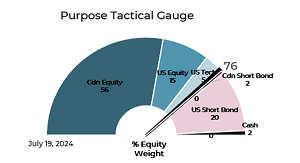
(% equity weight)
Our tactical fund is designed to complement your existing holdings to minimize portfolio volatility. To learn more, please click here.
|
|
|
| |
|
|
Company news
UPS fell short of profit expectations reporting adjusted earnings per share of $1.79 a share, below analysts’ estimates of $1.98 a share. Revenue also fell slightly short of expectations at $21.8 billion vs. $22.2 billion estimate. The company revised their fiscal year 2024 sales lower. After significant growth for everything e-commerce and the deliveries that came with it during the pandemic, UPS is grappling with higher labour costs and softening delivery demand at the same time. Earlier this year, the company announced it would reduce spending and focus on operating margin. Part of the savings would come from cutting 12,000 management jobs. Shares declined –7.6% in pre-market trading.
Air Canada declined as much as 4.9%, touching an intraday low of $16.07, the lowest since October of last year after the company cut its full year adjusted Ebitda guidance below analysts’ expectations. The company cited competitive pressures, supply-chain issues, and lower-than-expected load factors (a measure of how full a plane is) for the second half of the year. Air Canada reported adjust Ebitda of $914 million for Q2, down from $1.2 billion the same period last year. For the year, the company estimates adjusted Ebitda to be between $3.1 billion to $3.4 billion, compared to the previous estimate of $3.7 billion to $4.2 billion.
Tesla has been volatile in the last year, with the stock experiencing a 43% drop earlier in the year, only to rebound and add over $386 billion to its market capitalization in 11 weeks. The rebound has been driven by Elon Musk's focus on Tesla's potential in AI and autonomous technology, despite lackluster sales and earnings. Investors are keenly anticipating Tesla's upcoming second-quarter results (which will be released after the bell today), with expectations of continued lower revenue and profit, but with hope that Musk's AI vision will bolster long-term value. Tesla's shares, trading at high multiples compared to traditional automakers, reflect a belief in Musk's promise of future breakthroughs in self-driving technology.
Coca-Cola shares are looking to open higher after beating earnings estimates and raising its full-year outlook as higher prices bolstered the soft-drink giant’s performance. Coke, now sees organic revenue growth, which strips out currency volatility and other items, in a range of 9% to 10% this year, above the previous projection in April for 8% to 9%. While consumers have begun to resist higher prices on some grocery items, Coca-Cola has continued to increase prices for its beverages. Averaged across regions, the company hiked prices across a mix of its products by 9%, more than the 8% price mix increase expected by analysts. Prices rose 11% in North America. The company is looking ahead to the Paris Olympics, where the company is a major sponsor.
|
|
|
|
Commodities
Iron ore prices have fallen below $100 a ton due to a lack of major stimulus from a recent policy meeting in China and strong supply levels. The Third Plenum in Beijing did not meet investors' expectations for boosting metals demand or addressing the property crisis. Additionally, increased shipments from Brazil and record production levels have contributed to a global surplus in the seaborne market. As a result, iron ore has dropped by over a quarter this year, making it one of the worst-performing commodities. The decline has also impacted miners' share prices, with major companies like BHP Group Ltd. experiencing significant drops.
Gold prices rose slightly above $2,400 an ounce as market attention shifted from U.S. political developments to key economic data due later in the week, which could influence future rate cuts by the Fed. Joe Biden's decision to drop out of the presidential race and Kamala Harris clinching the Democratic nomination had little impact on gold, while the Fed's upcoming GDP data and core personal consumption expenditures price index are expected to provide insights into inflation and potential rate cuts, traditionally bullish for gold. Additionally, India reduced its gold import tax from 15% to 6% to boost local jewelry manufacturing. Despite hitting an all-time high last week, gold faced bearish signals from a sharp drop in Chinese imports and a discount in Shanghai's gold premium. 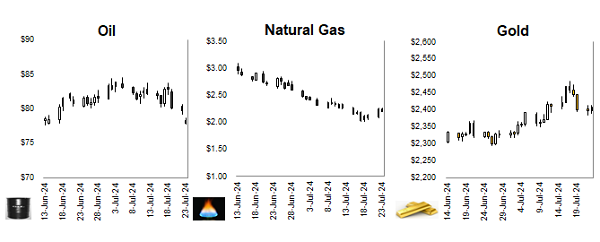 |
|
|
|
|
Fixed income and economics
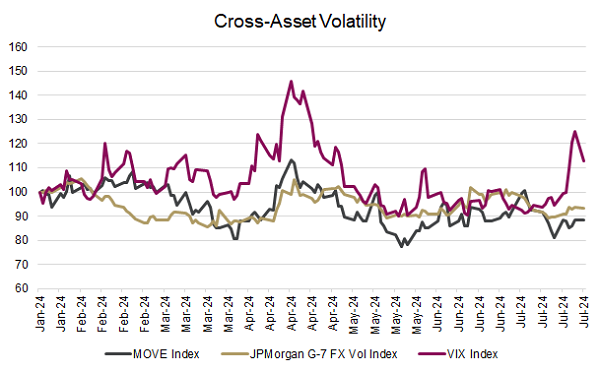
Bond traders are reassessing the so-called Trump trades as Vice President Kamala Harris gains support among Democrats, influencing market sentiment ahead of significant economic data and Fed decisions. Yields rose across maturities, and trading volumes increased, signaling preparation for upcoming auctions, GDP data, and the Fed's favoured inflation report. Investors remain focused on economic fundamentals and Fed policy, with the expectation of at least two rate cuts before the end of 2024. Biden's exit from the presidential race and Harris's potential candidacy have contributed to market volatility, but the main driver remains the economic outlook and the Fed's actions. Key releases later this week, including second-quarter GDP and the core PCE inflation measure, will be crucial ahead of the Fed's July meeting.
|
|
|
|
Quote of the day
 |
There is nothing like returning to a place that remains unchanged to find the ways in which you yourself have altered.
Nelson Mandela
|  |
|
|
Contributors: A. Innis, A. Nguyen, P. Kwon
|
|
|
Charts are sourced to Bloomberg unless otherwise noted.
The opinions expressed in this report are the opinions of the author and readers should not assume they reflect the opinions or recommendations of Richardson Wealth Limited or its affiliates. Assumptions, opinions and estimates constitute the author's judgment as of the date of this material and are subject to change without notice. We do not warrant the completeness or accuracy of this material, and it should not be relied upon as such. Before acting on any recommendation, you should consider whether it is suitable for your particular circumstances and, if necessary, seek professional advice. Past performance is not indicative of future results. Richardson Wealth Limited, Member Canadian Investor Protection Fund. Richardson Wealth is a trademark of James Richardson & Sons, Limited used under license.
|
|
| Address: 100 Queens Quay East, Suite 2500 Toronto ON M5E 1Y3 Canada
|
|
|
|
|