Daily market commentary
The Launch Pad |
|
|
|
 |
| |
|
|
Today
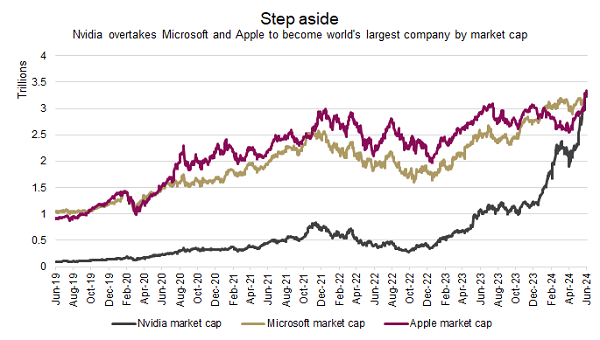
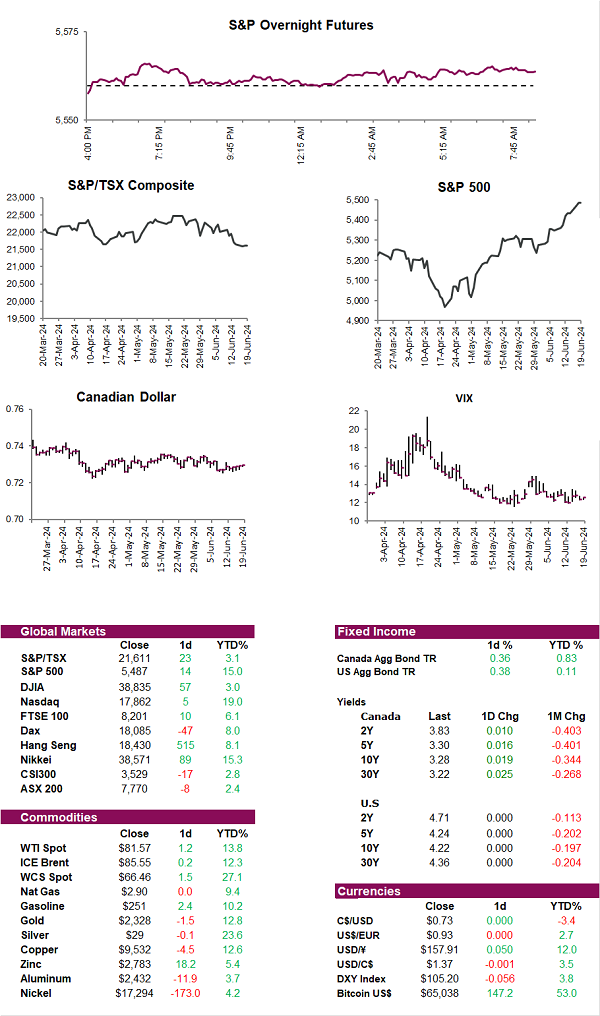
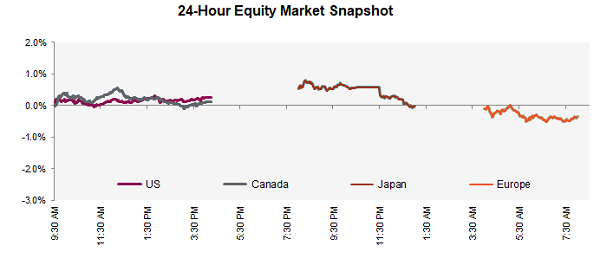
Stock futures and European markets are mixed this morning after the S&P 500 rose to a fresh record as Nvidia continued its march to new highs and managed to top Microsoft and Apple as the most valuable public company. Investors have (for the most part) shrugged off the political tensions in France and signs the Fed could wait to cut interest rates, and instead focused on the strong U.S. economy that could continue to support corporate earnings, especially in the tech sector. With U.S. markets closed today in observation of Juneteenth, markets are taking their cues from Europe and most notably UK data which added to signs inflation is slowing across the developed world.
Brilliant! Inflation in the UK has fallen to the Bank of England's 2% target for the first time in nearly three years, a significant achievement but one that is unlikely to boost Prime Minister Rishi Sunak's political fortunes before the upcoming election. The Office for National Statistics reported that consumer price growth eased to 2% in May from 2.3% in April. Despite this, inflation in the services sector remains higher than expected, with a 5.7% increase in May. This persistent service inflation complicates the BOE's decision-making, making it unlikely to cut interest rates soon. The ruling Conservative Party faces challenges, with polls suggesting a likely defeat to Labour party. And while Sunak hailed the inflation milestone as a victory over the cost-of-living crisis, economists warn that inflation may rise again, potentially reaching 2.4% by year-end.
More eating, less drinking. Stats Canada updated its inflation measurement basket to reflect increased spending on food, with the food basket share rising to 16.72% from 16.13%. This includes food from stores, which now accounts for 10.82% (up from 10.62%), and food from restaurants, which rose to 5.90% (up from 5.51%). The recreation, education, and reading category's share grew to 10.42% from 9.98%, while the shelter component rose to 28.57% from 28.22% due to higher mortgage and rent costs. Conversely, the household operations, furnishings, and equipment category saw the largest drop to 13.46% from 14.57%. The weight for alcoholic beverages, tobacco, and recreational cannabis also decreased to 4.17% from 4.47%.
Despite a cooling job market and slowing productivity, wage pressures remain high in Canada. The average hourly wage for vacant positions rose 7.3% y/y in Q1, reaching $27.25, though after adjusting for job composition, the increase was 4.7%. This trend aligns with other labour market data showing wages growing between 4.5% and 5.5% annually. The Bank of Canada cautions that without productivity gains, these wage increases are incompatible with the 2% inflation target, highlighting a productivity crisis with declines in six of the past seven quarters. Meanwhile, job vacancies dropped 3.6% to their lowest since early 2021, with the job vacancy rate falling to 3.6%, indicating a loosening labor market which may eventually help alleviate wage pressures.
U.S. industrial production rose 0.9% in May, higher than expected, driven by broad gains in factory output, utilities, and mining, surpassing economist forecasts. Manufacturing output, which also climbed 0.9%, was led by an increase in consumer goods production in autos, appliances, and chemicals. The gains are a nice positive for manufacturing, however the sector continues to face challenges such as high input prices, fluctuating consumer demand, and elevated borrowing costs. Economists caution this uptick may not signal sustained strength due to ongoing headwinds.
Mortgage rates in the U.S. fell below 7% for the first time since March, with the 30-year fixed mortgage rate dropping 8 bps to 6.94% and the five-year adjustable-rate mortgage declining 18 bps to 6.27%. This decrease led to a 1.6% increase in mortgage applications for home purchases, marking the highest level since March. Mortgage rates have declined in line with Treasury yields following data showing a broad cooling in inflation, which has increased traders' expectations that the Fed might cut interest rates as early as September (although officials are saying it will likely be later than that). Lower mortgage rates could boost housing demand despite high listing prices, as builders offer incentives such as discounted rates to attract buyers.
The post-pandemic surge in global luxury sales is expected to stall this year. New research from Bain predicts flat worldwide luxury sales in 2024, citing political uncertainty in the U.S. and economic issues in China, which have led to "luxury shaming." Other issues the sector faces include creative director transitions at major fashion houses and a shifting focus away from the middle class and Gen-Z. Some experts are emphasizing the need for brands to realign strategies and price points, noting that growth is unattainable without the middle class and younger generations, who may scoff at the price tag for a classic Chanel flap bag. The forecasted slowdown follows a significant spending surge during the 2021-23 period, with luxury sales rising 24% over 2019 levels, driven by U.S. and Asian tourism to Europe. If you’re in the market for a new bag though (do you prefer lambskin or caviar?), Japan and Europe remain strong markets due to favourable currency exchange rates and increased supply.
McDonald's is discontinuing the use of AI-powered ordering technology in its U.S. drive-throughs after encountering issues such as incorrect and bizarre orders. Developed by IBM, the voice recognition system was trialed in over 100 restaurants since 2019 but proved unreliable, resulting in errors like adding bacon to ice cream (is that a bad thing?) or placing excessive orders for items like chicken nuggets (that’ll be 100 instead of 10 nuggets!). Despite ending the trial, McDonald's remains optimistic about the future integration of voice ordering solutions and continues to evaluate long-term scalable options. IBM expressed confidence in the technology's potential and indicated ongoing collaboration with McDonald's on other projects. So, it looks like for now, drive-through workers won’t have to worry about AI replacing them, at least until people start putting bacon on their ice cream.
Diversion: Coulda fooled me.
 |
|
|
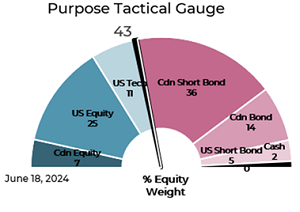
(% equity weight)
Our tactical fund is designed to complement your existing holdings to minimize portfolio volatility. To learn more, please click here.
|
|
|
| |
|
|
Company news
Number #1. Nvidia has become the world's most valuable company, surpassing Apple and Microsoft, as its stock surged over 160% this year, driven by the increasing demand for AI technology. The company's market capitalization reached about $3.3 trillion, bolstered by its dominant position in providing chips crucial for AI applications, such as the H100 accelerators. The rapid growth in Nvidia's value highlights the significant investor interest in AI, with Nvidia, Apple, and Microsoft competing for the top spot in market capitalization.
The AI frenzy isn’t just helping Nvidia either, with Taiwan Semiconductor Manufacturing Co. now approaching a $1 trillion market valuation as analysts from Goldman Sachs, JPMorgan Chase, Citigroup, and Morgan Stanley have raised their price targets, driven by surging AI demand and potential price hikes for advanced chip manufacturing. TSMC's strong position as the main chip supplier for Nvidia, coupled with expectations that AI will contribute significantly to its sales, has boosted investor confidence. The company's US-listed ADRs have gained 73% this year, elevating TSMC to the eighth-largest global company by market capitalization, surpassing Berkshire Hathaway. Analysts anticipate that TSMC will revise its 2024 revenue guidance upward and increase capital expenditures, further solidifying its growth prospects amid the AI boom.
Canada’s financial regulator left capital requirements unchanged for Canada’s big six banks, signaling that officials believe their balance sheets are strong enough to withstand economic turbulence. OSFI left the domestic stability buffer at 3.5% in its semi-annual review, the second consecutive hold. It had increased it in December 2022 and June 2023. The stability buffer is like a rainy-day fund that aims to protect the financial system by ensuring banks can absorb losses in a downturn. The regulator has raised it in stages since 2021 as the economy recovered from the Covid-19 shock and the labor market healed. OSFI had lowered it in the early days of the pandemic to free up capital for lending. The decision means Canada’s banks are required to have Common Equity Tier 1 capital of at least 11.5% of risk-weighted assets. All six large banks already exceed that ratio.
|
|
|
|
Commodities
Oil prices steadied after closing at a seven-week high as a sustained risk-on mood in wider markets outweighed signs of further inventory growing. On the data side, the American Petroleum Institute, reported US crude inventories rose by 2.26 million barrels last week, and if confirmed by official data, would be the third increase in a row. Stockpiles at the Cushing, Oklahoma, hub also climbed, according to the API. Benchmark crude prices has recovered from a loss at the beginning of the month, when OPEC+ said it would bring barrels back to the market, with the group backtracking and stating that such a plan was conditional. Key timespreads have ballooned, indicating stronger near-term demand, while refiners in Asia are restoring some capacity following maintenance despite weak margins, boosting crude consumption.
Iron ore prices are higher for a second day as traders weighed prospects for a recovery in China’s steel demand and a modest gain in output last month. China unveiled a broad real estate rescue package last month to address the biggest cloud over the economy, relaxing mortgage rules and encouraging local governments to buy unsold homes. Still, housing prices fell at a faster pace in May, with new-home prices in 70 cities, excluding state-subsidized housing, dropping 0.71% from April, data showed this week. The property crisis has been a major brake on steel consumption as construction slows. Crude steel production recorded a 2.7% gain in May from a year earlier, though it fell 1.4% in the first five months from the same period in 2023. 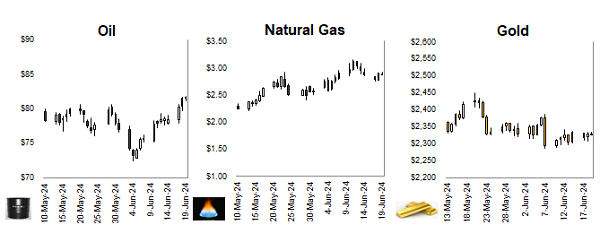 |
|
|
|
Fixed income and economics
Fed officials are sticking to their guns and continuing to emphasize the need for more evidence of cooling inflation before considering interest rate cuts, with some indicating potential timing for such moves. Yesterday, Fed Governor Adriana Kugler suggested rate cuts might be appropriate later this year if economic conditions align, while St. Louis Fed President Alberto Musalem mentioned it could take quarters to see data supporting a cut. Despite recent promising price data, policymakers remain cautious, holding borrowing costs at a two-decade high and projecting only one rate reduction for 2024. This caution stems from the mixed economic signals, including tepid retail sales growth and strong employment, highlighting the complexity of managing inflation and economic stability.
In April, foreign investors heavily invested in Canadian bonds and money market instruments, with bond investments reaching the second highest level on record according to Stats Canada. This influx amounted to $41.2 billion, primarily in private corporate debt, federal government bonds, and provincial bonds. This rise marked the highest investment in Canadian securities since March 2022. Other the other hand, Canadian investors weren’t as interested in foreign securities, with a net investment of only $2.5 million, as purchases of foreign debt were offset by significant sales of foreign equities, particularly U.S. shares. Some note that the increase was driven by continued provincial bond issuance and suggest that this trend of foreign investment in Canadian bonds could persist.
|
|
|
|
Quote of the day
 | If there is no struggle, there is no progress.
Frederick Douglass |  |
|
|
Contributors: A. Innis, A. Nguyen, P. Kwon
|
|
|
Charts are sourced to Bloomberg unless otherwise noted.
The opinions expressed in this report are the opinions of the author and readers should not assume they reflect the opinions or recommendations of Richardson Wealth Limited or its affiliates. Assumptions, opinions and estimates constitute the author's judgment as of the date of this material and are subject to change without notice. We do not warrant the completeness or accuracy of this material, and it should not be relied upon as such. Before acting on any recommendation, you should consider whether it is suitable for your particular circumstances and, if necessary, seek professional advice. Past performance is not indicative of future results. Richardson Wealth Limited, Member Canadian Investor Protection Fund. Richardson Wealth is a trademark of James Richardson & Sons, Limited used under license.
|
|
| Address: 100 Queens Quay East, Suite 2500 Toronto ON M5E 1Y3 Canada
|
|
|
|
|