Today
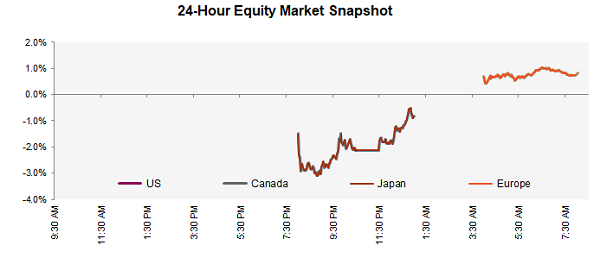
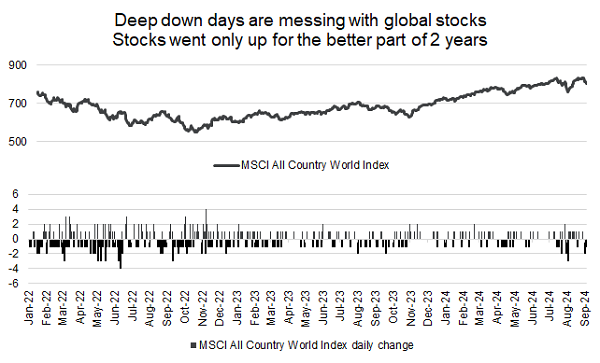
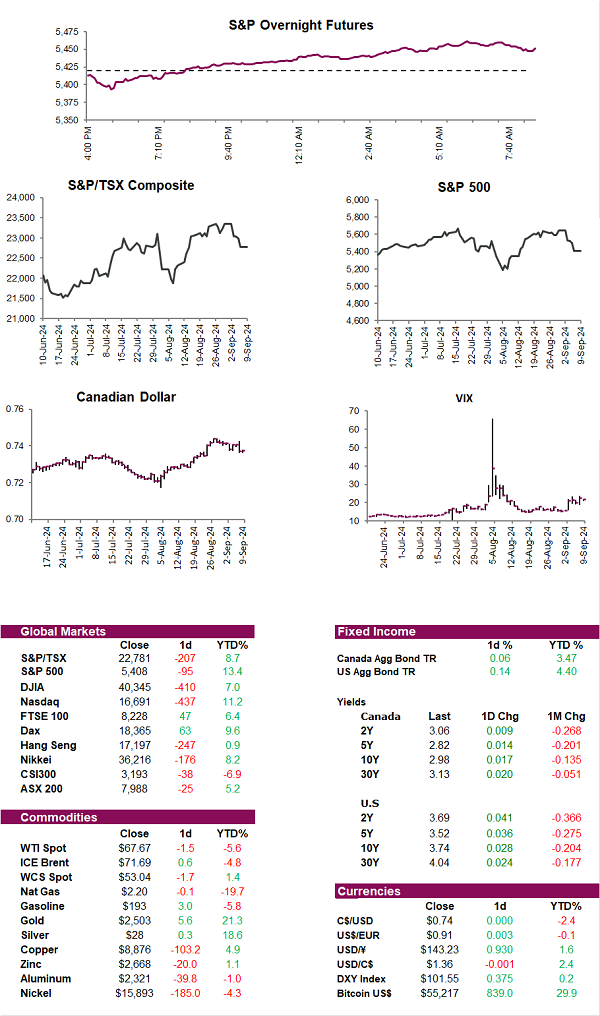
Equities are trying to claw back some of last week’s losses after a selloff triggered by cooling U.S. jobs data left investors unsure of how healthy the U.S. economy really is. September has historically been a tough month for equities and this year has been no exception. So far this month, the S&P 500 has fallen 4.3% and registered its worst week since March 2023 while the Nasdaq fell 5.8% for its worst weekly performance since 2022. The TSX fared a bit better, but is still down 2.4% since the start of the month. For now, it looks like markets are trying to turn things around, with investors awaiting two key inflation reports set to be released this week, August’s CPI and PPI reports, that could further influence the Fed’s next rate decision, and an expected rate cut from the ECB on Thursday.
Concerns over the U.S. economy, shifting Fed policy, and upcoming elections may be weighing on investors. Recent jobs data indicating a slowdown in the labour market has heightened fears that the Fed’s anticipated rate cuts may come too late to avoid economic damage. The S&P 500 dropped 1.7% on Friday and fell nearly 4.3% in the past week, suffering its worst weekly drop since March 2023, with technology stocks like Nvidia declining. Investors are also grappling with high stock valuations, particularly in technology, and the potential impact of a tight U.S. presidential race. The S&P 500's historically poor performance in September adds to the market’s challenges, as investors hope for a soft landing but remain cautious amid deteriorating economic indicators.
Investors in Canada will tune into Tiff Macklem’s speech tomorrow to the Canada-United Kingdom Chamber of Commerce, where he may discuss further rate cuts following the central bank's three consecutive reductions. Also this week, Stats Canada will publish national financial accounts and household debt data, with July wholesale trade figures expected on Friday. Meanwhile, key global central banks, including the ECB are expected to cut interest rates, signaling a shift toward synchronized monetary easing. The ECB is poised for a second rate reduction on Thursday, with the Fed likely to follow on September 18. Meanwhile, China's weak domestic demand, India's inflation data, and industrial output from various countries, including the UK and Japan, will provide further economic insights. Latin American nations like Brazil and Argentina release inflation data that could shape future policy decisions.
The Bank of England faces a pivotal decision on the pace of its quantitative tightening due to an unusually high volume of bond redemptions expected next year. Currently, the BOE is reducing its gilt holdings at a rate of £100 billion annually, but with redemptions set to spike to £87 billion, economists are debating whether the BOE should accelerate this pace or maintain the current rate. The decision, which will be made on September 19, is crucial for managing the UK's rising debt and supporting the budget, as the BOE aims to navigate market stability and balance sheet normalization amid ongoing fiscal challenges.
U.S. job growth fell short of expectations in August, with nonfarm payrolls increasing by 142,000, lower than the forecasted 165,000. This brought the three-month average to its lowest level since mid-2020. Despite a drop in the unemployment rate to 4.2%, the labor market is showing signs of weakening, prompting speculation about the Federal Reserve’s next steps. Treasury yields have fluctuated as traders anticipate a potential half-percentage-point rate cut to address ongoing hiring challenges. Key sectors like manufacturing, retail, and information saw job losses, while employment gains were concentrated in leisure, hospitality, construction, and healthcare. Wage growth remained steady, with average hourly earnings up 3.8% from a year ago.
Staying with jobs, Canada is facing challenges as its labour market struggles to keep pace with a rapidly growing population. In August, while the working-age population expanded by 96,400, only 22,100 new jobs were created, marking the slowest job creation rate in over a year. The unemployment rate for recent immigrants was high at 12.3%, more than double that of long-term immigrants and Canadian-born individuals. The job market's cooling trend is highlighted by a 23% drop in job postings year-over-year. The influx of newcomers, including many foreign students and temporary workers, has exacerbated the mismatch between labour supply and demand, leading to increased policy scrutiny.
The soft-landing camp. Treasury Secretary Janet Yellen thinks there are no significant financial risks or red lights flashing for the U.S. economy, which she believes has achieved a soft landing. In a recent interview, Yellen noted that while employment risks are monitored, the overall economic indicators, such as asset valuations and leverage, appear stable. This reassurance comes amidst recent market turbulence, marked by a significant drop in U.S. equities following disappointing job growth figures. Yellen also emphasized the importance of continued engagement with China and expressed openness to future visits to strengthen economic ties between the two nations.
Soccer players sometimes get accused of embellishing their injuries, but maybe it’s warranted at times. A soccer player in the UK, Victor Adeboyejo, is sidelined with a back injury caused by a powerful sneeze, according to his coach. The injury, which flared up after Adeboyejo sneezed, has resulted in him missing a game. The coaches are awaiting scan results to determine the extent of the injury, but initial assessments suggest it might be a cartilage or muscular issue. This unusual setback adds to the list of bizarre sports injuries, including cases like a player being scalded by an exploding egg and another injuring himself with a boarding pass.
Diversion: Back in Black of the head