Today
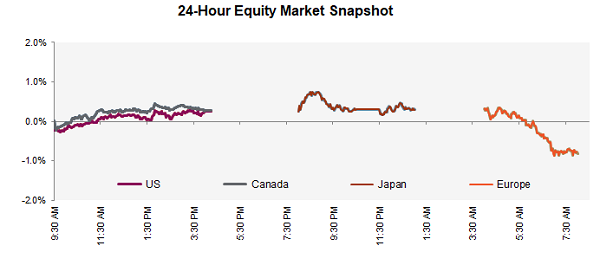
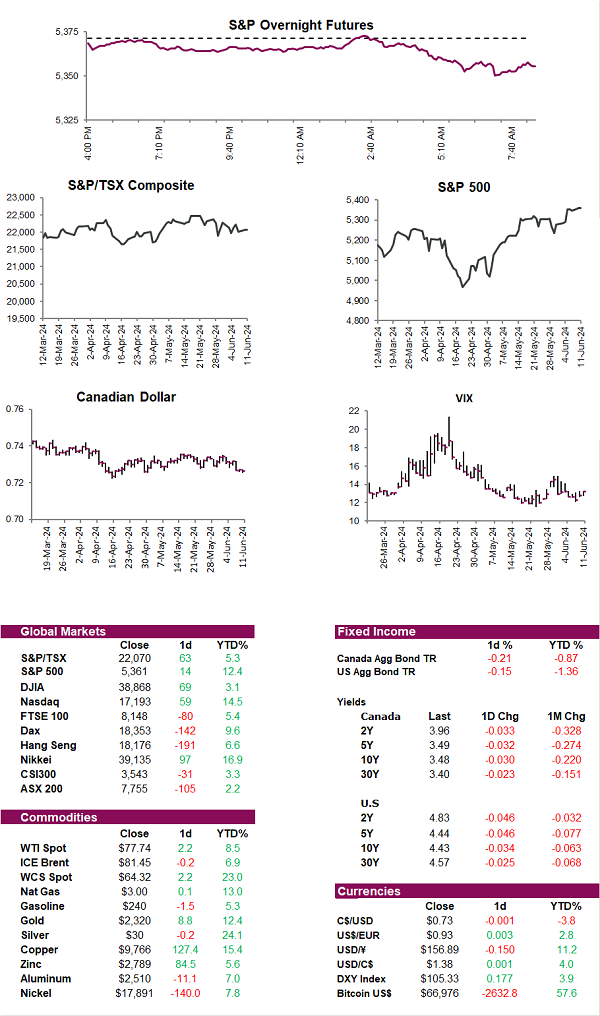
Equities are pointing down this morning with demand for safe haven assets rising with concerns rising over political uncertainty in Europe. Investors are also looking ahead to tomorrow’s U.S. inflation data and the Fed’s interest rate decision. Although expectations for a rate cut are unlikely, markets will be focused on the Fed’s interest rate projections, otherwise known as the dot plot. While there will likely be dissent among officials over the longer-term rate path, there is agreement today that taking a cautious wait-and-see approach is warranted to avoid policy mistakes that may veer the economy and prices away from the central bank’s targets. A year after the Fed lifted interest rates to a two-decade high, they will likely continue to remain focused on the upcoming data for jobs, the consumer, and inflation to determine if the economy is cooling enough to continue the disinflation required to stay on track to meet its targets.
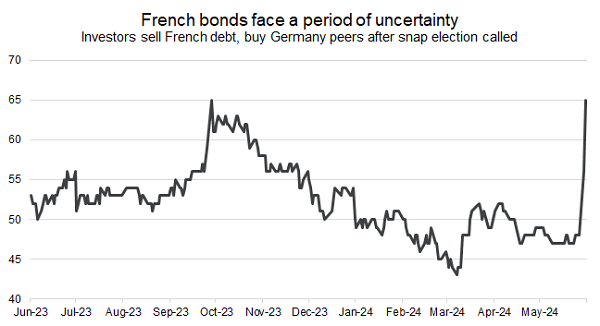
Au revoir bonds. French President Emmanuel Macron's decision to call a snap election has cast some doubt on the stability of the French economy and Macron's pro-business agenda. The move led to a sharp selloff, with French bonds seeing their highest yields relative to German bonds since December. The upcoming vote poses a challenge to Macron's economic policies, particularly regarding budget management and reforms. Macron's policies, which have focused on long-term savings and growth-friendly reforms, will likely face resistance amid growing political turmoil and opposition. The uncertainty surrounding the elections has raised fears of prolonged fiscal deficits and prompted credit rating downgrades, contributing to market volatility and weakening the euro. While Macron's opponents, including Marine Le Pen, criticize his fiscal policies, it remains unclear how they would address France's economic challenges should they come to power.
The significant redeployment of pandemic-era excess savings in the U.S. and Canada has certainly boosted consumption growth and helped the economy avoid a recession (so far). Economists are noting, however, that a similar effect may be unlikely in China, despite households accumulating CNY 144 trillion in bank deposits during the pandemic, noting a weak relationship between changes in bank deposits and consumption growth in China. The reason? unlike the U.S. and Canada, China's fiscal support during the pandemic did not include direct cash transfers to households. Poor household sentiment, driven by a bleak employment and income outlook, further hinders these savings from driving consumption. With labour market conditions in China unlikely to improve until corporate profits recover significantly, consumers are also avoiding short-term loans. Additionally, Chinese stimulus efforts have largely targeted the supply side of the economy rather than reviving consumer demand.
Looking on the bright side. Pessimism about the Canadian economy is easing as consumer confidence reaches a two-year high. The Bloomberg Nanos Canadian Consumer Confidence index climbed to 54, its highest since May 2022, reflecting a growing optimism among Canadians about their personal finances, job security, and economic and real estate prospects. Despite current conditions being viewed more negatively than the historical average, future expectations have improved, driven by bullish real estate sentiment. This rise in confidence comes ahead of the BoC's recent interest rate cut, indicating an anticipation of economic stabilization. However, challenges remain as the country has been in a per-capita recession since 2022 and consumer prices have significantly increased. Notably, sentiment varies across regions, being more positive in Quebec and Atlantic Canada and weaker in BC, Ontario, and the Prairies.
As U.S. major cities look for creative ways to deal with higher office vacancy rates, they are looking to models north of the border for inspiration. According to the WSJ, some U.S. cities have sent delegates to Calgary to learn about the promises (and limitations) of the city’s attempts to convert low occupancy office buildings to residential buildings. A litany of office space came after oil prices plummeted, and coupled with pandemic challenges, it forced Calgary to rethink their real estate footprint. The city offered developers healthy subsidies (at least at the time), with no strings attached. While the city points to progress, the economics have not always panned out. Higher construction costs have left Calgary’s $75 a square foot subsidy insufficient for some developers to step up to take on the risk of repurposing the half empty buildings. For now, developers embarking on a conversion won’t be able to rely on more city incentives but will have to earmark buildings that they can buy at deep discounts and convert quickly.
The U.S. finance sector is defying expectations amid a prolonged period of stable Federal Reserve policy, with interest rates at 23-year highs. Key reasons for its resilience include the privatization of risk, as a significant portion of financing now comes from private markets, reducing the potential for widespread contagion from problems within the private lending sector. Additionally, government debt has played a crucial role in fueling economic growth, perceived as less risky compared to private sector borrowing. However, risks persist, particularly in the opaque private credit market and concerns about unsustainable government debt levels, highlighting the need for continued vigilance and risk management to sustain stability in the U.S. finance sector.
This should be an open and shut case. A juror in the U.S. was dismissed from a trial of seven individuals accused of stealing over $40 million from a pandemic-related program meant to feed children. The dismissal occurred after the juror reported that someone left a bag containing $120,000 cash at her home, with the implication she would receive more if she voted to acquit. Prosecutors characterized the incident as akin to something out of a mob movie. The defendants are among 70 expected to go to trial in a conspiracy that cost taxpayers an estimated $250 million. While 18 others have pleaded guilty, the defendants deny any wrongdoing. The aid money, provided by the USDA and administered by the state Department of Education, was intended to serve meals to children. However, prosecutors allege only a fraction of it went toward that purpose, with the rest spent on luxury items.
Diversion: Good boy.