To view images or for a printer-friendly version, click here

To ensure delivery to your inbox, please add Research@RichardsonWealth.com to your address book.

Richardson Wealth - Connected Wealth
Daily market commentary
The Launch Pad 
May 28, 2024
  
Click here to sign up for the Launch Pad
     
Today

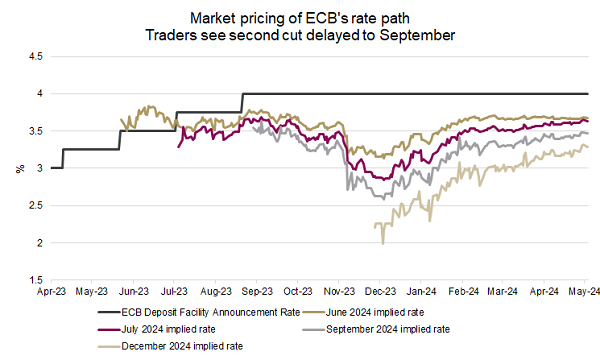
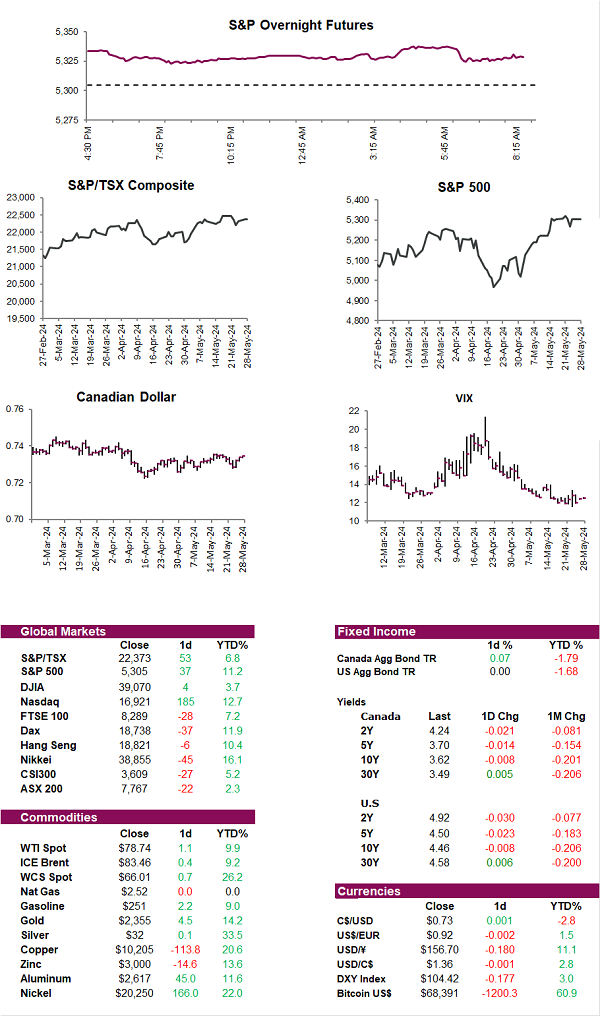
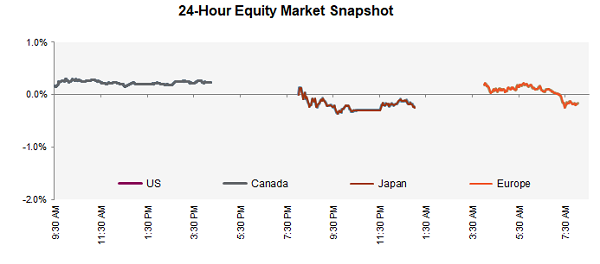
Futures are mixed this morning, with markets awaiting the latest U.S. inflation prints and central bank speakers for hints on the timing of interest-rate cuts. Earlier this month, softer inflation data suggested Fed rate cuts could come earlier than investors had anticipated, although those hopes were quickly challenged after economic data and Fed comments pointed to the contrary. Even with mixed opinions on where rates are going, the S&P 500 and TSX are looking to close higher and even recover losses from April’s slump. In a busy week for data, traders are concentrating on the PCE deflator, the Fed’s preferred gauge of inflation, on Friday. 

Volatility across various markets, including stocks, bonds, oil, and forex, has fallen to its lowest level since 2020, with the VIX Index recently touching a near five-year low. Factors contributing to this decline include the market's ability to absorb risk events such as inflation data and corporate earnings with minimal disruption, and high demand for options selling which further suppresses volatility. The proliferation of derivatives income funds continues to push volatility downward. As the summer holidays and the end of the earnings season approach, along with expectations of Fed rate cuts later in the year, there appears to be little impetus for market volatility to rise in the near term. The one thing that does appear to have the potential to alter this low-volatility environment (in the minds of some investors) is the upcoming elections in the U.S. and India. For a deeper dive into the recent market volatility (or lack thereof), the Market Ethos (out later today) will focus on it.  

China, Japan, and South Korea have begun their first trilateral summit since 2019 in Seoul, emphasizing cooperation amid growing pressures from their closer ties with the US. Chinese Premier Li Qiang, Japanese Prime Minister Fumio Kishida, and South Korean President Yoon Suk Yeol discussed economic, trade, and regional security issues. The summit comes as Japan and South Korea, having improved bilateral ties, aligning more closely with U.S. strategies on security and semiconductor production, and challenging China's stance. Beijing aims to deter Japan and South Korea from joining U.S.-led restrictions on advanced chip technology exports. The meeting, covering six cooperation areas, will also address North Korea's nuclear ambitions and security concerns in the Taiwan Strait. Despite potential economic collaborations, significant divergences on security issues persist.  

Investors in Canada are increasingly betting on a June or July rate cut by the BoC, which is just what the country's bank stocks may have needed. The S&P/TSX Banks index has lagged the broader S&P/TSX Composite due to concerns about high interest rates, mortgage renewals, and rising loan losses. However, optimism has grown after a cooler-than-expected inflation report in May increased the likelihood of a rate cut to 65%. Interest rate cuts are expected to positively impact the Canadian economy and banks' profitability by lowering funding costs and easing economic pressures although some caution that the potential benefits may already be priced in. 

The real estate sector isn’t the only thing China is trying to prop up. China has launched its largest semiconductor investment fund, amassing $47.5 billion to bolster its domestic chip industry amid escalating tensions with the U.S. The third phase of the National Integrated Circuit Industry Investment Fund, known as Big Fund III, includes contributions from the central government and state-owned enterprises like the Industrial & Commercial Bank of China. This move is part of President Xi Jinping's broader strategy to achieve technological self-sufficiency as the U.S. imposes strict export controls on advanced chips and chipmaking equipment. Despite past setbacks and corruption issues, China aims to use this substantial investment to support its semiconductor giants like SMIC and counteract U.S. restrictions. The fund also highlights China’s ongoing commitment to its Made in China 2025 initiative, targeting breakthroughs in advanced chip development and manufacturing. 

For those interested in getting into the weeds of behind-the-scenes operational activity, the Canadian Securities Administrators (CSA) announced the shorter settlement cycle for equity and debt securities officially took effect yesterday.  As of May 27, the new settlement cycle, or days it takes for a securities trade to “settle” (securities and cash exchange hands) will be T+1, cut in half from the previous settlement cycle of T+2. This aligns Canadian securities trading with the industry’s move to shorten the settlement time to improve operational efficiencies and potentially reduce operational risk. Back in the 1990’s, the settlement window was trade date plus five (T+5), then moved to T+3, then T+2 in 2017. The U.S. officially adopts the T+1 settlement cycle today, March 28 one day after Canada’s adoption. 

After all these years, Dennis the Menace has finally been apprehended. An 81-year-old man, Prince King, known as a “serial slingshot shooter,” was arrested after a decade-long spree of vandalism in his neighborhood. King had been using a slingshot to strike residential windows, dent car windshields, and narrowly miss people. The local police department began investigating after multiple residents reported these incidents, which had occurred over 9-10 years. During a search of King’s residence, police found ball bearings and a slingshot. No injuries were reported, but the motive behind the vandalism remains unclear. King was booked into the Los Angeles County Jail without bail and is set to appear in court on Tuesday. The public’s faith in the police department has also been restored, after it only took them 10 years to find the suspect. 


Diversion: That’s why we have engineers. 


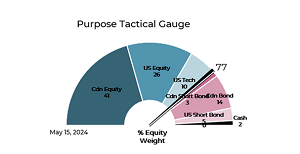
The
Tactical model 
(% equity weight)

Our tactical fund is designed to complement your existing holdings to minimize portfolio volatility. To learn more, please click here.


Company news

Bank of Nova Scotia topped earnings estimates as it saw continued momentum in its wealth-management and capital-markets businesses. Provisions for credit losses totaled just over $1 billion in the three months through April, close to matching analysts’ forecast. The second quarter also marks another period of revenue growth for the lender’s domestic retail division and comes even as credit conditions worsen for North American consumers and businesses. Scotiabank has battled with a higher cost of funding than its rivals and has taken steps to work on that over the past year or so, including by slowing the growth of its mortgage book and seeking out more low-cost deposits.  

Apple’s iPhone staged a rebound in China last month with shipments rising 52% amid a flurry of discounts from retail partners. The latest figures from the China Academy of Information and Communications Technology showed smartphone shipments surging in the country, of which roughly 3.5 million units came from foreign brands. The iPhone accounts for most of such devices, and the rebound comes after registering growth in March following steep declines in the first two months of the year. Apple and its Chinese resellers have been cutting prices since the start of 2024, and those deals are extending into the sale season that accompanies the June 18th shopping festival in the country.  

Indigo Books & Music shareholders have approved a privatization deal with Trilogy Retail Holdings Inc. and Trilogy Investments L.P., entities controlled by Gerald Schwartz, husband of Indigo's CEO Heather Reisman. The $2.50 per share offer, up from an initial $2.25, received strong support, with over 95% of total votes and nearly 83% of independent votes in favour. The privatization aims to alleviate public reporting pressures as Indigo addresses challenges like a cyber attack, financial losses, and boardroom upheaval. As part of its transformation strategy, Indigo has streamlined its product offerings and reintroduced certain in-store features. The transaction is expected to close in June, after which Indigo will be delisted from the Toronto Stock Exchange. 

T-Mobile US Inc., the second-largest mobile carrier in the US, has agreed to buy US Cellular Corp.’s wireless operations and some of its spectrum assets for roughly $2.4 billion. The purchase price of $4.4 billion includes a combination of cash and as much as $2 billion in assumed debt, the companies said in a statement on Tuesday. The deal includes US Cellular’s wireless customers, retail stores and 30% of its spectrum assets. The transaction is expected to close in mid-2025, pending regulatory approvals. 


Commodities

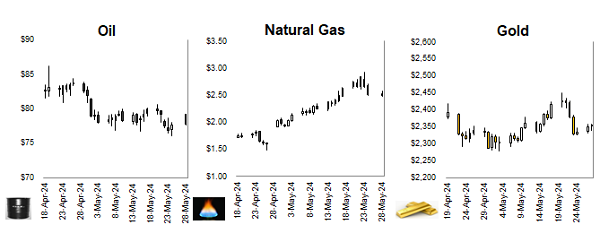
Oil prices are higher after a two-day gain on increased tensions in the Middle East after Egypt’s military confirmed that a border guard was killed at the Rafah crossing into Gaza on Monday. Oil has risen this year on persistent geopolitical risks and OPEC+’s roughly 2 million bpd of output cuts, which the group is expected to prolong into the second half of 2024 at a meeting on Sunday. Still, prices have dipped since early April on weakening demand from Asia, causing Brent’s prompt spread to get close to a bearish contango structure that indicates supply is increasing relative to consumption. 

Iron ore continued its decline for a second day as doubts remained over how successful China’s latest support measures would be in easing its years-long real estate crisis. The People’s Bank of China unveiled 300 billion yuan ($41 billion) of funding earlier this month to help local governments buy unsold homes. Shanghai has eased requirements for downpayments and mortgages on homes, as bigger cities follow through on the central government aid. The steel market has been showing signs of recovery, with prices of reinforcement bar (used in construction) increasing more than 5% since the middle of April. However, mills are still making losses and inventories of iron ore at ports are near the highest in two years. 


Fixed income and economics

Federal Reserve Bank of Cleveland President Loretta Mester said the US central bank should consider ways to better communicate to the public how economic conditions will affect future policy decisions. Speaking at an event in Tokyo, Mester recommended two key changes to help with communications: adding more words to the Fed’s post-meeting policy statement – to describe how officials assess economic developments and potential risks to the outlook – and more detail to its quarterly summary of policymakers’ economic forecasts. Mester added that short policy commentary, while often seen “short and sweet”, can also be problematic as each word takes on added significance. They can also make it harder for the public to see the link between economic developments and policy decisions. She expects officials to consider communications as part of the five-year review of their policy framework set to kick off toward the end of 2024. This should make those side-by-side Fed statement comparisons even more difficult. 

Chart of the day
 

Markets

Quote of the day
 

All you need in this life is ignorance and confidence, and then success is sure.
Mark Twain

Contributors: A. Innis, A. Nguyen, P. Kwon

Charts are sourced to Bloomberg unless otherwise noted.

The opinions expressed in this report are the opinions of the author and readers should not assume they reflect the opinions or recommendations of Richardson Wealth Limited or its affiliates. Assumptions, opinions and estimates constitute the author's judgment as of the date of this material and are subject to change without notice. We do not warrant the completeness or accuracy of this material, and it should not be relied upon as such. Before acting on any recommendation, you should consider whether it is suitable for your particular circumstances and, if necessary, seek professional advice. Past performance is not indicative of future results. Richardson Wealth Limited, Member Canadian Investor Protection Fund. Richardson Wealth is a trademark of James Richardson & Sons, Limited used under license.

Address: 100 Queens Quay East, Suite 2500 Toronto ON M5E 1Y3 Canada