Daily market commentary
The Launch Pad |
|
|
|
 |
| |
|
|
Today
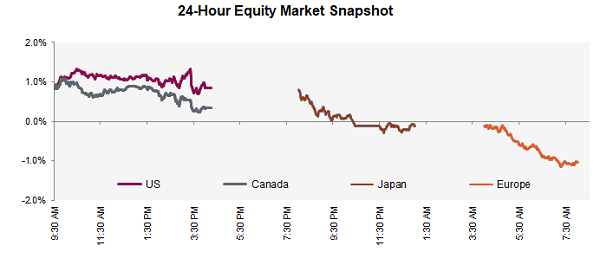
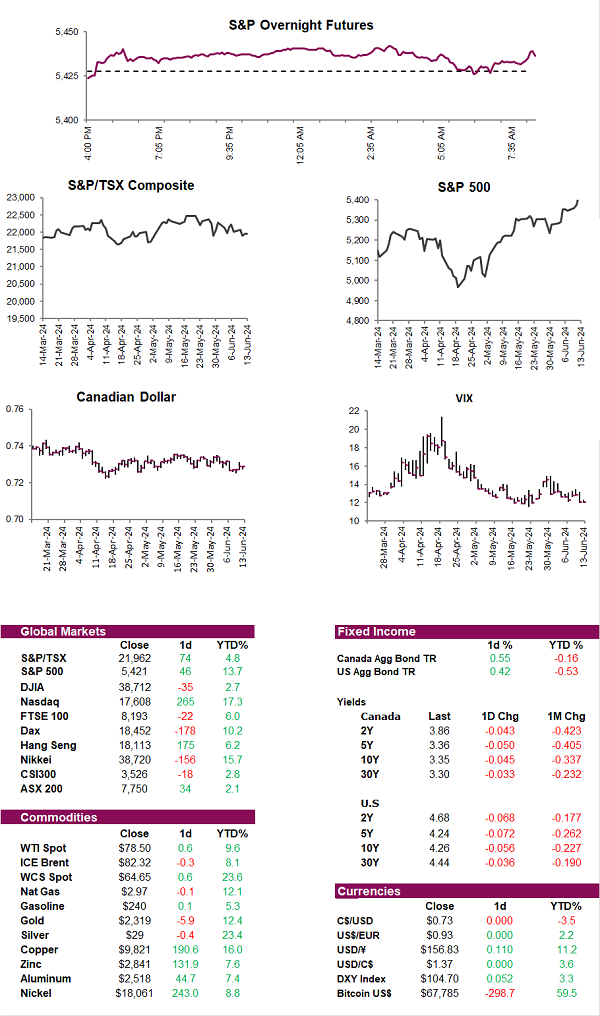
Equities are mixed this morning, with markets coming off a stellar day following softer U.S. inflation data. The S&P 500 even managed to close above 5,400 for the first time, after core CPI fell to its lowest in over three years, fueling bets on faster policy easing. Still, the Fed projected just one quarter-point rate cut this year, down from three in March. U.S. Treasuries held gains signaling that the Fed may once again be at odds with the market. Markets are also getting a bit of a boost after data showed wholesale prices in the U.S. unexpectedly fell in May by the most in seven months, adding to evidence that inflationary pressures are moderating. The PPI index for final demand decreased 0.2% from a month earlier. Compared with a year ago, the PPI rose 2.2%.
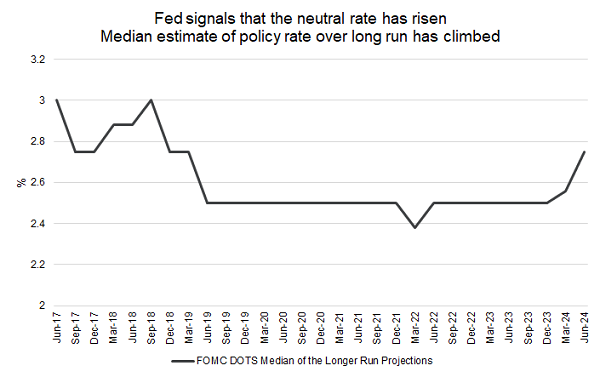
In a widely expected move, the Federal Reserve kept its benchmark rate steady yesterday between 5.25% and 5.50%. The market was more focused on Fed officials’ new summary of economic projections (dot plot), which earmarked just one rate cut for 2024, down from the previous median projection last quarter of three cuts. Fed Chair Powell however, left room for more cuts as he continued to emphasize a cautious data dependent approach. The median rate cut projections for 2025 came in at four, highlighting the intention to maintain higher borrowing costs to combat inflation. The latest Fed decision came only hours after data showed the core consumer price index was essentially flat for the month, rising by 0.2% in May, and 3.4% compared to last year. The encouraging data highlights some progress made towards the Fed's 2% inflation target.
The World Bank revised its global growth forecast for this year to 2.6% from 2.4%, mainly due to strong economic performance in the U.S., whose growth outlook was raised to 2.5% from 1.6%. However, the forecast for 2025 remains at 2.7%. While global inflation is expected to decrease to 3.5% this year and 2.9% by 2025, it is expected to decline more slowly than initially anticipated, leading central banks to likely maintain higher interest rates through 2025-2026. Despite the overall positive outlook, developing countries, particularly in Sub-Saharan Africa, the Middle East, and North Africa, face significant challenges including attracting private investment, managing public debt, improving infrastructure, and coping with conflicts and climate change. The World Bank highlighted a weak global trade outlook, predicting the worst half-decade for trade growth since the 1990s due to trade restrictions and policy uncertainties.
The European Commission will impose additional duties of up to 38.1% on Chinese EV imports starting in July to counteract what it deems excessive subsidies. This move follows the U.S. decision to significantly increase duties on Chinese EVs and risks retaliatory measures from China. The new EU tariffs range from 17.4% for BYD to 38.1% for SAIC, in addition to the standard 10% duty. The EU's decision marks a significant shift in trade policy, reflecting concerns over maintaining a competitive balance in critical industries. These tariffs aim to address the surge of low-cost Chinese EVs, which now make up 8% of the EU market. European automakers fear the impact on their sales in China and potential retaliatory tariffs. Beijing criticized the move as protectionist and promised to defend its interests. In a sneaky move though, Chinese EV makers are starting to invest in European production to bypass these tariffs.
G-7 leaders are set to reach an agreement to provide Ukraine with $50 billion in aid using profits from frozen Russian sovereign assets. The technical details of the deal will need further discussion post-summit, with an aim to disburse the funds by year-end. The complex issues to be resolved include structuring loans to Ukraine and sharing risks among allies while ensuring assets remain frozen. The proceeds from the approximately $280 billion in frozen Russian central bank funds are estimated to generate €3-€5 billion annually. Both the EU and the US are working to expedite support for Ukraine, and discussions are progressing, with US officials indicating that specific frameworks are being developed.
Staying in the EU, bond investors are feeling snappy about French President’s Emmanuel Macron’s decision to call a surprise election following defeat in European Parliament elections. Polls are currently giving Marine Le Pen’s far right Nationally Rally the nod, which spooked markets owing to the perception the party will be unwilling to keep the country’s budget deficits under control and their mantra will be spend rather than save. The French bond market and the Euro took notice and declined, while bank stocks also plunged. If the bond market’s reaction to the possibility of a new president with a propensity to spend was negative, whoever prevails in the election should take note. Also, it wasn’t that long ago that Liz Truss’ short-lived leadership was undone over her attempts at implementing unfunded tax cuts to the dismay of bond markets.
Catch of the day. A New York City couple got more than they bargained for while magnet fishing (apparently that’s a thing) in Flushing Meadows Corona Park in Queens. Using a line with a strong magnet, they pulled out a safe containing $100,000 in water-damaged cash. Magnet fishing, a hobby they took up during the pandemic for its low-cost treasure-hunting appeal, typically involves retrieving metal objects from water. Upon discovering the bundles of $100 bills, they contacted the New York police department, who confirmed there was no crime associated with the money and no way to identify its original owner, allowing the couple to keep it. This find was unlike any of their previous ones, which included old guns, WWII grenades, a motorcycle, foreign coins, and jewelry. Sounds like a good idea for a new side hustle.
Diversion: Good way to learn |
|
|
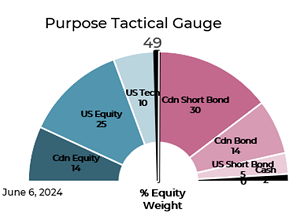
(% equity weight)
Our tactical fund is designed to complement your existing holdings to minimize portfolio volatility. To learn more, please click here.
|
|
|
| |
|
|
Company news
He’s at it again. Tesla shares are looking to open higher after Elon Musk said shareholders voted “by wide margins” in favour of re-approving his compensation package and moving the company’s state of incorporation to Texas. Musk and Tesla’s board have spent the last two months rallying support for the measures, putting particular emphasis on the pay deal that made Musk eligible for as much as $55.8 billion in stock options based on the company hitting certain milestones. A Delaware judge voided the award earlier this year, pointing to conflicts of interest among Tesla directors and disclosure failures.
Broadcom Inc., a chip supplier for Apple Inc. and other big tech companies, is looking to get a boost in share price after its latest results topped estimates, lifted by robust demand for AI products. Revenue also rose to $12.5 billion, compared with a projection of $12.1 billion. Sales in the full fiscal year, which runs through October, will be about $51 billion, the company said. Analysts had projected about $50.6 billion, and Broadcom earlier said the figure would be closer to $50 billion. Broadcom offers a range of components that are used in computing and networking — including ones that are vital to data centers — giving it a boost from the trend. Broadcom also announced a 10-for-1 split.
|
|
|
|
Commodities
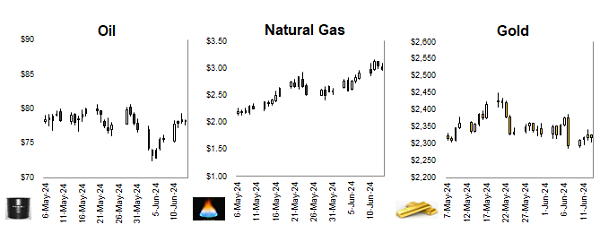
Oil prices are lower after three consecutive days of gains as markets weighed an unexpected build in American crude inventories and the prospect of tighter-for-longer U.S. monetary policy. Data showed U.S. crude inventories swelled by 3.7 million barrels last week, contrasting with an industry report that had pointed to a draw. Government figures also signaled rising gasoline stockpiles. U.S. data out yesterday sparked a risk-on mood across broader markets as inflation cooled for a second month, but the Federal Reserve left interest rates unchanged and penciled in just one cut this year. The International Energy Agency said in a report on Wednesday that global markets face a major surplus this decade as the shift away from fossil fuels picks up pace.
Copper and other base metals are under pressure after the Federal Reserve signaled U.S. interest rates will likely stay higher for longer than previously indicated, a scenario that may hurt demand for industrial commodities. The hawkish signal comes amid concerns that copper’s rally to a record last month ran ahead of market fundamentals. Since then, copper has fallen more than 10% from that high due to worries about a steady increase in global inventories, profit-taking by investment funds and weak Chinese demand.
 |
|
|
|
|
Fixed income and economics
U.S. inflation data for May showed a promising slowdown, with the core CPI rising only 0.2% from April and 3.4% y/y, the slowest in over three years. This unexpectedly tame inflation has fueled market optimism and speculation about potential Fed rate cuts later in the year. However, Fed officials stress the need for sustained downward trends before making policy changes, highlighting that a single month of data is not sufficient. While inflation for physical goods has normalized, services inflation, driven by high housing and wage costs, remains stubborn. Looking closer at the data, consumers continued to face food inflation, with a 2.1% y/y increase and a 0.1% rise from April. Grocery prices remained flat m/m but increased by 1% y/y, while dining out costs rose by 0.4% month over month and 4% year over year. At grocery stores like Costco and Walmart, prices were mixed, with cereals down 0.9% but bakery items up 2.6%. Meat prices, particularly for poultry and ground beef, saw slight increases. Companies like General Mills and WK Kellogg reported higher prices but lower volumes, indicating consumer pushback. Fast food chains such as McDonald's, KFC, and Burger King are introducing value menus to combat perceptions of rising dining costs, although these measures may impact their medium-term sales and margins. Overall, economists are cautiously optimistic, noting the need for several more months of declining inflation to confirm a sustained trend. So, while the May report is encouraging, indicating early stages of inflation resuming a downward trend, the Fed remains cautious, awaiting more consistent signs of lower price pressures before adjusting interest rates.
|
|
|
|
Quote of the day
 | You can't cross the sea merely by standing and staring at the water.
Rabindranath Tagore |  |
|
|
Contributors: A. Innis, A. Nguyen, P. Kwon
|
|
|
Charts are sourced to Bloomberg unless otherwise noted.
The opinions expressed in this report are the opinions of the author and readers should not assume they reflect the opinions or recommendations of Richardson Wealth Limited or its affiliates. Assumptions, opinions and estimates constitute the author's judgment as of the date of this material and are subject to change without notice. We do not warrant the completeness or accuracy of this material, and it should not be relied upon as such. Before acting on any recommendation, you should consider whether it is suitable for your particular circumstances and, if necessary, seek professional advice. Past performance is not indicative of future results. Richardson Wealth Limited, Member Canadian Investor Protection Fund. Richardson Wealth is a trademark of James Richardson & Sons, Limited used under license.
|
|
| Address: 100 Queens Quay East, Suite 2500 Toronto ON M5E 1Y3 Canada
|
|
|
|
|