To view images or for a printer-friendly version, click here

To ensure delivery to your inbox, please add Research@RichardsonWealth.com to your address book.

Richardson Wealth - Connected Wealth
Daily market commentary
The Launch Pad 
September 9, 2024
  
Click here to sign up for the Launch Pad
     
Today

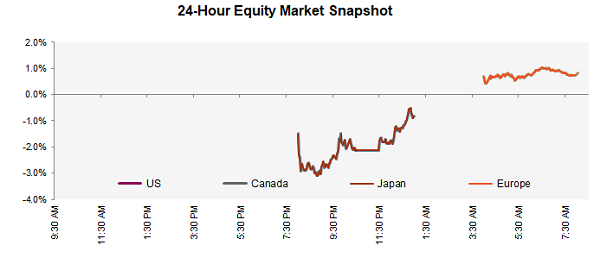
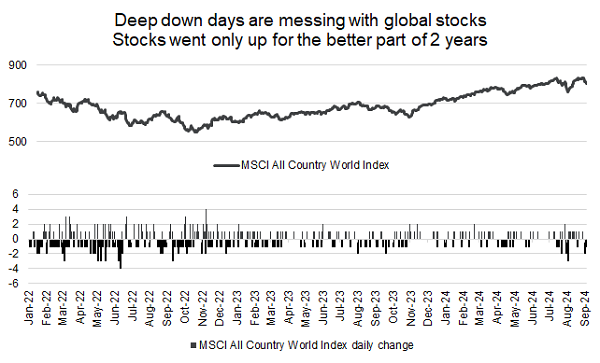
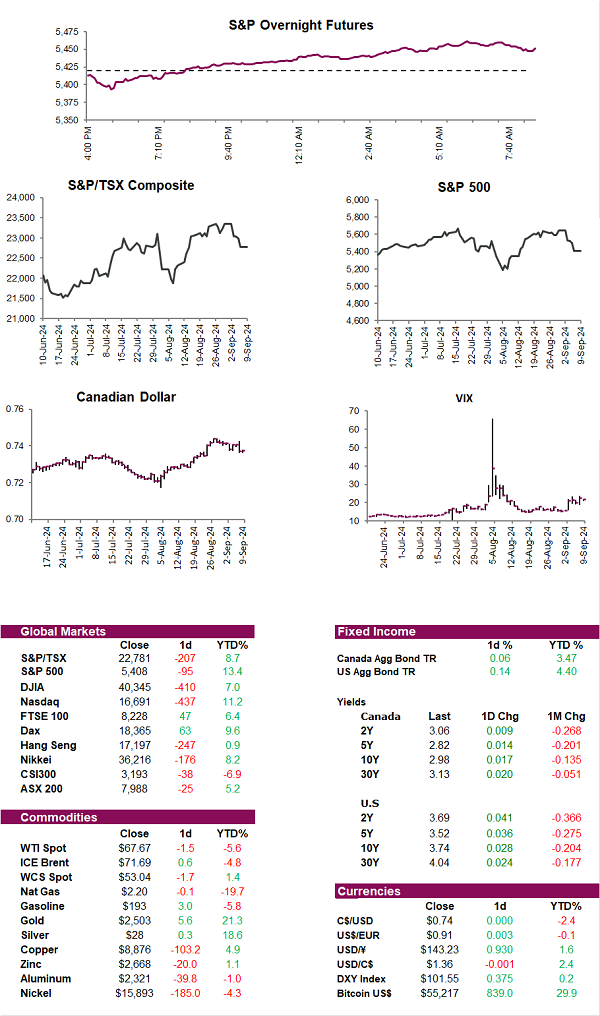
Equities are trying to claw back some of last week’s losses after a selloff triggered by cooling U.S. jobs data left investors unsure of how healthy the U.S. economy really is. September has historically been a tough month for equities and this year has been no exception. So far this month, the S&P 500 has fallen 4.3% and registered its worst week since March 2023 while the Nasdaq fell 5.8% for its worst weekly performance since 2022. The TSX fared a bit better, but is still down 2.4% since the start of the month. For now, it looks like markets are trying to turn things around, with investors awaiting two key inflation reports set to be released this week, August’s CPI and PPI reports, that could further influence the Fed’s next rate decision, and an expected rate cut from the ECB on Thursday. 

Concerns over the U.S. economy, shifting Fed policy, and upcoming elections may be weighing on investors. Recent jobs data indicating a slowdown in the labour market has heightened fears that the Fed’s anticipated rate cuts may come too late to avoid economic damage. The S&P 500 dropped 1.7% on Friday and fell nearly 4.3% in the past week, suffering its worst weekly drop since March 2023, with technology stocks like Nvidia declining. Investors are also grappling with high stock valuations, particularly in technology, and the potential impact of a tight U.S. presidential race. The S&P 500's historically poor performance in September adds to the market’s challenges, as investors hope for a soft landing but remain cautious amid deteriorating economic indicators. 

Investors in Canada will tune into Tiff Macklem’s speech tomorrow to the Canada-United Kingdom Chamber of Commerce, where he may discuss further rate cuts following the central bank's three consecutive reductions. Also this week, Stats Canada will publish national financial accounts and household debt data, with July wholesale trade figures expected on Friday. Meanwhile, key global central banks, including the ECB are expected to cut interest rates, signaling a shift toward synchronized monetary easing. The ECB is poised for a second rate reduction on Thursday, with the Fed likely to follow on September 18. Meanwhile, China's weak domestic demand, India's inflation data, and industrial output from various countries, including the UK and Japan, will provide further economic insights. Latin American nations like Brazil and Argentina release inflation data that could shape future policy decisions. 

The Bank of England faces a pivotal decision on the pace of its quantitative tightening due to an unusually high volume of bond redemptions expected next year. Currently, the BOE is reducing its gilt holdings at a rate of £100 billion annually, but with redemptions set to spike to £87 billion, economists are debating whether the BOE should accelerate this pace or maintain the current rate. The decision, which will be made on September 19, is crucial for managing the UK's rising debt and supporting the budget, as the BOE aims to navigate market stability and balance sheet normalization amid ongoing fiscal challenges. 

U.S. job growth fell short of expectations in August, with nonfarm payrolls increasing by 142,000, lower than the forecasted 165,000. This brought the three-month average to its lowest level since mid-2020. Despite a drop in the unemployment rate to 4.2%, the labor market is showing signs of weakening, prompting speculation about the Federal Reserve’s next steps. Treasury yields have fluctuated as traders anticipate a potential half-percentage-point rate cut to address ongoing hiring challenges. Key sectors like manufacturing, retail, and information saw job losses, while employment gains were concentrated in leisure, hospitality, construction, and healthcare. Wage growth remained steady, with average hourly earnings up 3.8% from a year ago.  

Staying with jobs, Canada is facing challenges as its labour market struggles to keep pace with a rapidly growing population. In August, while the working-age population expanded by 96,400, only 22,100 new jobs were created, marking the slowest job creation rate in over a year. The unemployment rate for recent immigrants was high at 12.3%, more than double that of long-term immigrants and Canadian-born individuals. The job market's cooling trend is highlighted by a 23% drop in job postings year-over-year. The influx of newcomers, including many foreign students and temporary workers, has exacerbated the mismatch between labour supply and demand, leading to increased policy scrutiny. 

The soft-landing camp. Treasury Secretary Janet Yellen thinks there are no significant financial risks or red lights flashing for the U.S. economy, which she believes has achieved a soft landing. In a recent interview, Yellen noted that while employment risks are monitored, the overall economic indicators, such as asset valuations and leverage, appear stable. This reassurance comes amidst recent market turbulence, marked by a significant drop in U.S. equities following disappointing job growth figures. Yellen also emphasized the importance of continued engagement with China and expressed openness to future visits to strengthen economic ties between the two nations. 

Soccer players sometimes get accused of embellishing their injuries, but maybe it’s warranted at times. A soccer player in the UK, Victor Adeboyejo, is sidelined with a back injury caused by a powerful sneeze, according to his coach. The injury, which flared up after Adeboyejo sneezed, has resulted in him missing a game. The coaches are awaiting scan results to determine the extent of the injury, but initial assessments suggest it might be a cartilage or muscular issue. This unusual setback adds to the list of bizarre sports injuries, including cases like a player being scalded by an exploding egg and another injuring himself with a boarding pass. 


Diversion: Back in Black of the head 

The
Tactical model 
(% equity weight)

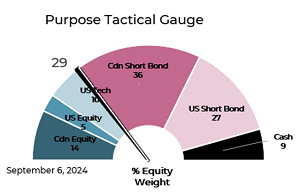
Our tactical fund is designed to complement your existing holdings to minimize portfolio volatility. To learn more, please click here.


Company news

Alimentation Couche-Tard is seeking further negotiations with Seven & i Holdings after its initial takeover offer of around $14.86 per share was rejected by the Japanese company. Seven & i, which operates 7-Eleven stores, found the bid too low and raised concerns about regulatory challenges but is open to a revised offer. If successful, the deal would create a global convenience store giant and be the largest foreign acquisition of a Japanese company. Couche-Tard remains confident in its ability to finance the deal and address regulatory issues, aiming for a mutually agreeable transaction. 

Boeing and the International Association of Machinists and Aerospace Workers have reached a tentative labour agreement just before a potential strike was set to begin. The deal includes a 25% wage increase over four years, improved healthcare and retirement benefits, and a commitment from Boeing to build its next airplane in the Pacific Northwest. The agreement, which still needs worker approval in a vote scheduled for September 12, is seen as a crucial step for Boeing as it navigates safety and quality challenges under new CEO Kelly Ortberg. The proposed contract also represents the largest general wage increase in the company’s history and addresses concerns about medical costs and work-life balance. 


Commodities

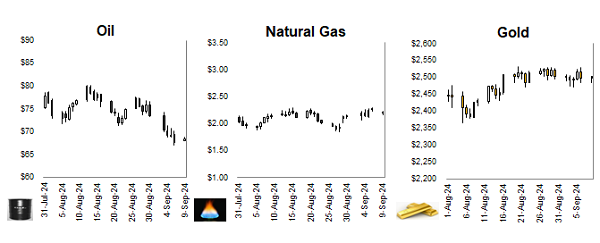
Oil prices are higher, rebounding from six consecutive days of losses as the focus shifts to key reports on the energy market’s outlook. At a major oil conference in Asia which started earlier today, top energy traders struck a cautious note. Trafigura Group said Brent crude is probably heading into the $60s soon and Gunvor Group Ltd. sees supply outpacing demand. Meanwhile, Morgan Stanley cut its forecasts for the second time in a matter of weeks and speculators now have record-low bullish wagers on crude prices.  Energy markets will also get plenty of market insights this week as three prominent forecasters, OPEC, the Energy Information Administration and the International Energy Agency, publish monthly outlooks. Crude has tumbled over the past three weeks as the broader market mood became more bearish, joining other commodities and equities in a wide selloff that’s spooked investors. There has also been widespread softness in product markets, including US gasoline and European diesel. The weakness prompted OPEC+ to defer a plan to relax supply curbs by two months. 

Iron ore is below $90 a ton for the first time since 2022 as industrial commodities faced sustained pressure from tepid Chinese demand and gathering worries over global growth. Futures for iron ore have fallen by more than –30% this year as an unresolved steel crisis in China threatens demand for the raw material. This is adding to broader headwinds, with base metals and crude oil also retreating in recent weeks as 2024 turns out to be a volatile year across the commodities complex. The more cautious mood in metals was underscored last week by Goldman Sachs Group Inc. Cutting nearly $5,000 a ton off its long-standing bullish copper forecast, largely due to soft Chinese demand. Citigroup also stated, uncertainty around the U.S. presidential election in November will keep the global economy subdued and weigh on metals prices.   


Fixed income and economics

The bond market is focused on how quickly the Fed will cut interest rates, with traders divided on the pace and extent of the cuts. While some expect more aggressive rate reductions, others believe the market has already priced in too much easing. We saw last week that U.S. job growth slowed in August with nonfarm payrolls rising by 142,000, which wasn't enough to definitively guide the Fed's next move. Most expect a quarter-point rate cut at the September meeting, with some betting on a larger 50-basis-point cut, and markets anticipate rates falling to around 3% by mid-2025. Despite the anticipation of rate cuts, some strategists warn that the bond market may have rallied too quickly, with risks of inflation re-accelerating if conditions loosen too much. 

In response to recent market volatility and upcoming economic uncertainties, developing world borrowers have accelerated their bond sales to secure favorable terms before potential disruptions. By early September, they had already issued $28 billion in bonds, surpassing previous years' figures for the same period. This proactive approach comes amid fears of market turbulence related to the U.S. presidential election and economic slowdowns, which have historically impacted emerging market debt. Currently, emerging market issuers benefit from some of the lowest yields in two years, averaging 6.5%. There is a strong preference for dollar-denominated bonds due to their liquidity and stability, with sales in this currency up 54% year-to-date. 


Chart of the day
 

Markets

Quote of the day
 

You can, you should, and if you’re brave enough to start, you will.

Stephen King

Contributors: A. Innis, A. Nguyen, P. Kwon

Charts are sourced to Bloomberg unless otherwise noted.

The opinions expressed in this report are the opinions of the author and readers should not assume they reflect the opinions or recommendations of Richardson Wealth Limited or its affiliates. Assumptions, opinions and estimates constitute the author's judgment as of the date of this material and are subject to change without notice. We do not warrant the completeness or accuracy of this material, and it should not be relied upon as such. Before acting on any recommendation, you should consider whether it is suitable for your particular circumstances and, if necessary, seek professional advice. Past performance is not indicative of future results. Richardson Wealth Limited, Member Canadian Investor Protection Fund. Richardson Wealth is a trademark of James Richardson & Sons, Limited used under license.

Address: 100 Queens Quay East, Suite 2500 Toronto ON M5E 1Y3 Canada