Daily market commentary
The Launch Pad |
|
|
|
 |
| |
|
|
Today
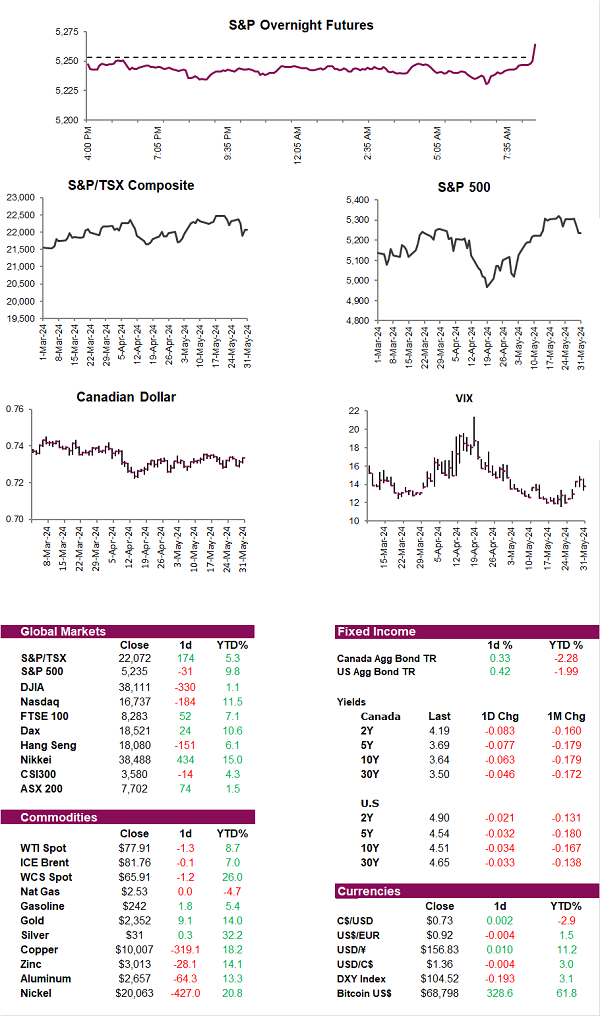
Equities rose and bond yields fell this morning after the Fed’s preferred inflation gauge reinforced speculation policymakers will have room to cut rates this year. The core personal consumption expenditures price index increased 0.2% from the prior month, while the y/y figure rose 2.8%. The report is expected to offer Fed officials some comfort about the pathway for inflation after seeing some setbacks earlier in the year.
Canada's economy grew at an annualized rate of 1.7% in the first quarter of 2024, missing estimates of 2.2% and the BoC forecast of 2.8%. Despite the lower print, the numbers do point to strong household spending on services and goods, marking an improvement from the previous quarter's 0.1% growth. With core inflation easing but economic momentum persisting, some speculate that policymakers might delay rate cuts, although a 25 bp reduction is anticipated at the BoC’s next meeting. Key sectors like housing investment and business capital spending saw increases, while compensation and household savings also rose, adding complexity to the BoC's rate decision.
Inflation in the euro zone rose 2.6% in May above the forecasted 2.4%, yet this did not alter market expectations for an interest rate cut from the ECB at its upcoming meeting. Core inflation, excluding energy, food, alcohol, and tobacco, rose to 2.9%. Despite the uptick, markets are still pricing in a 25 bp rate cut from the ECB, the first since 2019. The headline inflation has cooled significantly from its peak of 10.6% in October 2022, but services inflation, a critical domestic pressure indicator, increased to 4.1%. ECB members may emphasize a cautious approach to rate cuts to avoid destabilizing inflation expectations. Economists suggested the May inflation rise is likely a minor deviation in the broader disinflation trend, yet noted recent data alone wouldn't justify a June rate cut without the prior nine months' momentum.
Many Canadians are prepared to make significant purchases if interest rates fall, but most will wait for multiple or significant cuts by the Bank of Canada before opening their pocketbooks, according to a quarterly consumer sentiment survey by Dye & Durham (D&D), a legal software firm. While 42% of respondents are ready for major purchases post-rate cuts and 38% have postponed big-ticket items due to high rates, only 4% plan to buy immediately after a rate cut. A new car, a new home, and major renovations top the list of planned purchases. Although 65% of respondents believe rate cuts would improve their financial well-being, only 31% expect a rate cut in June. Additionally, 81% think rate cuts will make mortgages more affordable, with 41% of homeowners planning to refinance. Among renters, 50% say lower rates would increase the likelihood of buying a home, rising to 70% for those aged 18–34.
Some strategists believe it will take a significant risk-on sentiment to attract investors back to smaller cap stocks, cautioning that their current deep discount relative to the S&P 500 may not constitute a generational buying opportunity. Although the size premium identified by Fama and French historically led to small-cap outperformance, this was largely due to a few successful small companies transitioning to mid- and large-cap status. Nowadays, the dynamics have shifted as promising small companies often find capital through private equity, acquisitions by large tech firms, or IPOs after substantial growth, bypassing the traditional public small-cap markets. This shift has diminished the overall quality of public small-cap stocks, as reflected in their declining median return on equity over the last few decades.
Japan's Ministry of Finance confirmed its first currency intervention since October 2022 after the yen plunged to a 34-year low in April. Between April 26 and May 29, the ministry spent 9.7885 trillion yen to stabilize the currency, which rebounded from a low of 160.03 yen per U.S. dollar to 156 levels. The intervention coincided with the yen strengthening by over 2% within days. Analysts had estimated the intervention size to be between 5 trillion and 6 trillion yen. This move follows the end of the Bank of Japan's negative interest rate policy in March, which had exerted sustained pressure on the yen. Japanese finance minister had indicated support for interventions to mitigate the impact of sharp currency movements on households and companies, with the yen trading at 157.25 against the dollar this morning.
Donald Trump became the first former U.S. president to be found guilty of crimes, as a New York jury convicted him on all 34 counts of falsifying business records to hide a hush-money payment. The trial concluded with Trump facing up to four years in prison, with sentencing set for July 11, just days before the GOP convention. Trump plans to appeal and remains the presumptive Republican nominee for the upcoming presidential election. Trump still faces three other criminal trials, including those related to attempts to overturn the 2020 election and mishandling classified documents. How will the conviction ultimately affect his campaign? Your guess is as good as ours.
Kevin! The iconic house from "Home Alone," located at 671 Lincoln Avenue in Winnetka, Illinois, is up for sale for $5.25 million. Built in 1921, the redbrick Georgian home spans 9,126 square feet and features five bedrooms, six bathrooms, four fireplaces, a gym, a private movie theater, and an indoor sports court. The house was last sold in 2012 for $1.585 million and underwent a full renovation and expansion in 2018. While the home was updated, elements like the front door and the central staircase, famously featured in the movie, remain unchanged. The formal living and dining rooms also retain their original form and structure. Maybe they should consider lowering the price, given the high burglary rate in the neighborhood.
Diversion: Crazy Stat!
|
|
|
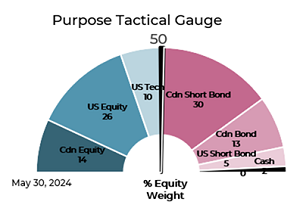
(% equity weight)
Our tactical fund is designed to complement your existing holdings to minimize portfolio volatility. To learn more, please click here.
|
|
|
| |
|
|
|
Company news
Costco reported strong fiscal Q3 results, with net sales reaching $58.52 billion, surpassing estimates of $57.98 billion, and adjusted earnings of $3.78, beating the expected $3.70. Executives highlighted the company's success in consumables as members move away from dining-out due to rising prices (And hey! You can dine out at Costco and feed your family for $10). Same-store sales, excluding fuel, increased 6.5%, driven by international growth (8.5%), Canada (7.4%), and the US (6%). As inflation moderates, consumers are returning to discretionary items like toys and garden supplies. Costco's e-commerce surged 20.7%, fueled by demand for gold, silver bullion, and appliances. The company saw a significant increase in foot traffic, outperforming competitors Sam's Club and BJ's Wholesale Club. Membership fees, a crucial revenue stream, rose 7.6% to $1.12 billion, with the total number of paid members at 74.5 million.
The FAA confirmed Boeing has set up performance goals that will be used by the agency to determine if the jet company is meeting quality expectations. Boeing communicated its six KPIs (for all the project managers that love acronyms) that will be used by the FAA to measure the company’s progress. Thresholds are being set within each metric to ensure corrective action will be taken should any be required. The FAA already imposed production limits on Boeing 737 MAX earlier this year after a door panel blew out on a flight and said it will not increase the limit set while the company addresses its performance issues. Sounds like a typical performance appraisal, except with very different stakes should they underperform.
Laurentian Bank of Canada swung to a loss as impairments and restructuring costs weighed on performance in the second fiscal quarter. Laurentian Bank incurred impairment and restructuring charges of C$196.8 million, or C$3.56 per share, related to restructuring its operations and the personal and commercial segment. Total revenue fell C$4.6 million to C$252.6 million, in line with analysts' expectations for the period. Common equity tier 1 capital ratio, which measures the bank's core equity capital compared with its riskier assets such as loans and mortgages, was 10.4%, up from 9.3%. Provision for credit losses, which is capital set aside to cover any potential bad loans, rose slightly to C$17.9 million from C$16.2 million.
Dell Technologies shares are under pressure after its first revenue increase since 2022 wasn’t enough to impress investors with high expectations for the company’s AI server business. Revenue from Dell’s powerful AI servers more than doubled from the previous quarter to $1.7 billion, Chief Operating Officer Jeff Clarke said in the statement. The backlog for those machines increased more than 30% quarter-over-quarter to $3.8 billion, he added. The company raised its revenue outlook for the fiscal year ending in February 2025 to a range of $93.5 billion to $97.5 billion, an 8% increase at the mid-point, which would top analysts’ average estimate of a 7% gain. Adjusted profit will be about $7.65 a share, compared with the $7.70 average estimate.
|
|
|
|
Commodities
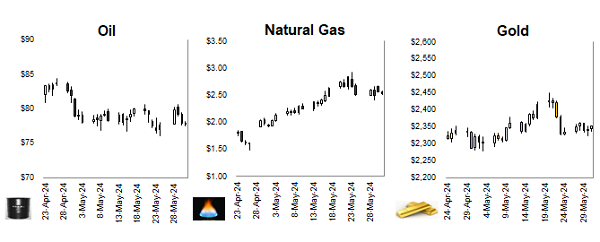
Oil prices are lower and on course for a monthly loss as attention focuses on Sunday’s OPEC+ meeting. Brent’s monthly decline comes amid a darkening outlook for China’s demand and euro-area inflation accelerating more than expected. Against this backdrop, OPEC+ is pressing on with informal talks aimed at finalizing an agreement on oil-output cuts this weekend. Saudi Arabia and its partners are discussing whether to prolong roughly 2 million bpd of production curbs into the second half of the year. They’re also considering the possibility of extending some restraints into 2025, according to delegates. On the option front, the prompt timespread for Brent futures is now in a bearish contango structure for the first time since January, although the rest of the curve for 2024 remains in backwardation.
Wheat prices are lower for a second session as forecasts for rain in top exporters across the world improved the supply outlook, although dry conditions in some growing regions should cap losses. Chicago futures slumped as much as 2.8% yesterday, the largest intraday decline since April 29. This comes after the prices hit the highest level in 10 months on Tuesday. Wheat started rallying in mid-March on expectations global stockpiles will fall to a nine-year low in the coming season. Estimates for Russia’s crop have been cut, while Australia and Ukraine grapple with dryness. Recent news that India will likely become a net importer have also been supportive.
 |
|
|
|
Fixed income and economics
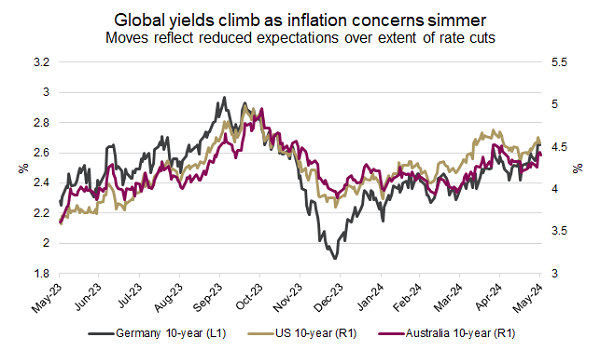
Global bond markets are experiencing turbulence as hopes for imminent interest rate cuts diminish due to persistent inflation and resilient economies. This has led to significant losses, with global government debt down approximately 5.2% this year. Central banks, including the Fed, BoC, and ECB, are maintaining a cautious stance, signaling that any rate cuts will be gradual. The US Treasury market has been particularly volatile, with higher-than-expected yields indicating weaker demand. Internationally, similar pressures are seen in Japan, Australia, and Europe, where inflation data remains concerning. Investors are now adjusting their strategies, with some focusing on short-dated TIPS to hedge against potential inflation surprises, while central banks are expected to keep rates higher for longer.
Major bond investors are back in the market for some of the riskiest bank securities, with a view that they will rally if the Federal Reserve starts cutting interest rates later this year. Firms such as PIMCO, Invesco Ltd., and JPMorgan Asset Management are buying up instruments, known as additional Tier 1, or AT1, bonds, which have both debt and equity features because banks use them to raise capital beyond common equity. Therefore, AT1s offer investors far less protection than bonds that are higher up in the capital structure. Keep in mind that this was a major problem last year, when Credit Suisse Group AG ran into trouble and its purchase by rival UBS Group AG resulted in wiping out some $17 billion worth of AT1s. Alos, there has also been stress among U.S. regional banks since the failure of Silicon Valley Bank which happened just over a year ago in March 2023. However, these money managers believe the banking industry at large is in good shape, helped by a resilient economy that’s fueling corporate profits and easing recession concerns. These bond managers are not unaware of the risks, but choose to take them for higher payments — especially because while AT1s are comparable to high-yield bonds, they are treated better for tax purposes. The yields offered by AT1s is hard to resist: AT1s offer an average yield of about 7.58%.
|
|
|
|
Quote of the day
 | I think being able to age gracefully is a very important talent. It is too late for me.
Clint Eastwood |  |
|
|
Contributors: A. Innis, A. Nguyen, P. Kwon
|
|
|
Charts are sourced to Bloomberg unless otherwise noted.
The opinions expressed in this report are the opinions of the author and readers should not assume they reflect the opinions or recommendations of Richardson Wealth Limited or its affiliates. Assumptions, opinions and estimates constitute the author's judgment as of the date of this material and are subject to change without notice. We do not warrant the completeness or accuracy of this material, and it should not be relied upon as such. Before acting on any recommendation, you should consider whether it is suitable for your particular circumstances and, if necessary, seek professional advice. Past performance is not indicative of future results. Richardson Wealth Limited, Member Canadian Investor Protection Fund. Richardson Wealth is a trademark of James Richardson & Sons, Limited used under license.
|
|
| Address: 100 Queens Quay East, Suite 2500 Toronto ON M5E 1Y3 Canada
|
|
|
|
|